Year-End Crypto Tax-Loss Harvesting: A Practical 2026 Guide
For U.S. crypto investors, a good year-end tax-loss harvesting result is not simply “sell everything that is down.” The goal is to realize selected capital losses that improve your tax position without creating a worse investment outcome, a reporting problem, or an avoidable compliance risk. You should finish the process knowing exactly which lots you disposed of, how much loss you realized, what gains those losses may offset, what records support the calculation, and whether your post-trade portfolio still fits your investment plan.
This guide reflects federal tax rules and IRS guidance available as of September 2026. Digital assets are generally treated as property for federal income tax purposes, so selling or exchanging them can create capital gains or losses when the assets are held as investments. State rules, entity structures, dealer or trader status, tokenized securities, derivatives, retirement accounts, and unusual DeFi transactions can change the analysis. Use the process below as a planning framework, not individualized tax advice. The IRS overview is available at Digital assets.
What a successful tax-loss harvesting process should achieve
Before making a trade, define what “good” looks like. A successful year-end review should produce four concrete outputs:
A reconciled list of realized and unrealized gains and losses across the wallets and accounts you actually use.
A documented reason for harvesting each selected loss, including the tax lot and its basis.
An estimate of how the realized loss changes your federal capital-gain position, while recognizing that the final tax result depends on your complete return.
A post-trade portfolio that remains acceptable after fees, spreads, market movement, and any re-entry decision.
If you cannot produce those outputs with reasonable confidence, the right move may be to improve your records or involve a tax professional before trading.
Step 1: Start before the final day of the year
Tax-loss harvesting depends on completing a taxable disposition during the tax year. Waiting until the final hours of December creates unnecessary execution and recordkeeping risk. Exchanges can experience maintenance, withdrawal delays, order slippage, or account restrictions, and a transaction initiated before year-end is not useful if the relevant disposition is not treated as occurring in the intended tax year.
Start the review early enough to reconcile records, choose lots, execute trades, and preserve documentation before year-end.
Create a simple timeline: reconcile accounts, calculate gains and losses, review tax lots, decide which positions still belong in the portfolio, execute any chosen dispositions, and save the evidence. The quality signal here is not speed. It is whether you can explain each trade before you place it.
Step 2: Build one complete view of your gains, losses, and cost basis
Pull transaction histories from custodial exchanges, hosted wallets, self-custody wallets, and any other venue where you sold, exchanged, or spent digital assets. Do not assume a broker form will capture everything. The IRS states that taxpayers must report digital-asset income, gains, and losses whether or not they receive Form 1099-DA. See Understanding your Form 1099-DA.
Review the portfolio by tax lot and cost basis rather than looking only at which coins are below their recent market highs.
An unrealized loss exists when the current value of a position is below its adjusted basis, but it generally does not become a deductible capital loss merely because the price fell. A sale or other taxable disposition is normally needed to realize the loss. The IRS explains that selling a digital asset for U.S. dollars generally produces a gain or loss, and exchanging one digital asset for another can also be a taxable disposition. Review the IRS digital asset transaction FAQs for current guidance.
Do not confuse account value with tax basis
If you bought the same asset many times, each acquisition may have a different basis and holding period. A coin can be down from its all-time high while some of your lots are still profitable. Harvesting should therefore be based on specific lots, not a chart showing that an asset is “down 60%.”
Step 3: Estimate the tax impact before deciding what to sell
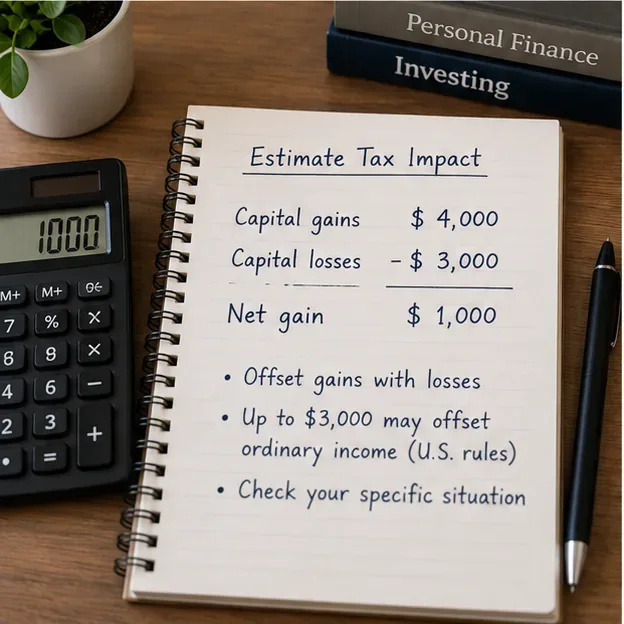
Capital losses can offset capital gains. If your total capital losses exceed your capital gains, individuals may generally deduct the lesser of the remaining net loss or $3,000 against other income for the year, or $1,500 if married filing separately. Unused net capital losses may generally carry forward to later years. The IRS summarizes these rules in Topic No. 409, Capital Gains and Losses and Publication 550.
Estimate the effect of the proposed loss on your total capital-gain position before trading; the final tax result depends on the whole return.
Suppose you have $12,000 of realized capital gains and a position with a $7,000 unrealized capital loss. If you sell that position and the loss is fully recognized, the loss may reduce the net capital gain before other Schedule D netting rules and return items are applied. That is more useful than harvesting a $7,000 loss when you have no current gains, little taxable income, and no reason to expect the carryforward to be useful soon.