Overview of Arweave
What is Arweave?
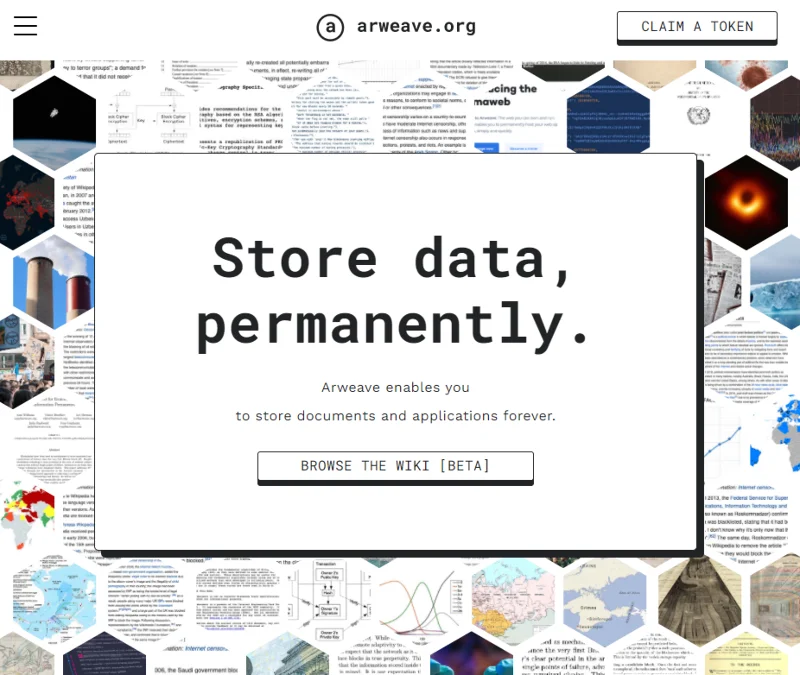
Arweave is a decentralized project that provides a platform to store data indefinitely based on a new generation consensus algorithm Proof-of-Access. Arweave acts as a hard drive that is owned by many people. A permanent place to store valuable information, applications and history.
Arweave wants to adopt a "Pay once, store forever" data storage model based on Moore's law to give users a permanent store.
In addition, Arweave allows developers to build decentralized financial applications and has grown into an ecosystem called Permaweb.
Features of Arweave
According to the Yellow Paper, Arweave is looking for ways to ensure that information can be stored and shared between individuals and subsequent generations. To achieve this, Permaweb must be built on blockweave – a technology created by Arweave. At that time, miners need to store more data to be able to access previous random blocks and add new blocks and receive rewards.
Besides, to build a sustainable ecosystem, Arweave has allowed developers to receive dividends through the “Profit sharing tokens” program. Then, the transaction fees generated by the developer's applications, they will receive a profit.
In addition, Arweave is also a place to support the building of applications based on Permaweb technology through incentive programs. The project also works with startups through the “Boost” program, which will provide free storage and access to investors and development teams.
Arweave's main technology
Arweave is built on four core technologies that work in tandem to deliver a blockchain platform that provides low-cost, high-throughput permanent data storage.
Blockweave : Has a blockchain-like structure, allowing on-chain data storage expansion at low cost. As the amount of data stored on the system increases, the Hashrate of consensus decreases thereby reducing the cost of data storage.
Proof-of-Access : According to Arweave, current consensus mechanisms are not sustainable and their energy is used to keep the system running. Arweave uses a new consensus mechanism called Proof-of-Access that provides unlimited data storage.
Normally, to mine coins/tokens on traditional blockchains, miners need to consume a large amount of power. In the Arweave network, miners are encouraged to provide multiple copies of data and information stored in the system in order to receive coins/tokens. This mechanism reduces power consumption and waste in current blockchain networks.
Wildfire : This is a system that solves the problem of sharing data in a decentralized network. Wildfire ensures that miners actively participate and share data, thereby increasing the speed of data requests on the network. This is a mechanism to encourage miners to work and actively contribute to the system.
Blockshadows : This technology from Arweave (AR) allows for reduced data waste and faster execution of consensus mechanisms, while also speeding up transaction processing in the network.
Profit sharing communities
Profit sharing communities of Arweave are similar to programs to encourage developers, investors to promote ecosystem development… This is an economic model that provides sustainable incentives for founders, the project's developers, contributors, and user community.
The profit sharing community will be more fair for startups when they only need to pay the cost of storing data on Arweave once. Additionally, it gives founders more control and flexibility over their projects, and contributors to those projects have more power.
Besides PSC there is also a profit sharing token (PST) that allows people who build websites and applications to earn money easily and flexibly. PST is used to incentivize and reward both the founders of the Permaweb application and those who actively contribute to that project.
As such, the profit sharing community (PSC) has gone a step further in providing sustainable economics for applications, integrating a decentralized autonomous organization (DAO) with a profit sharing token. .
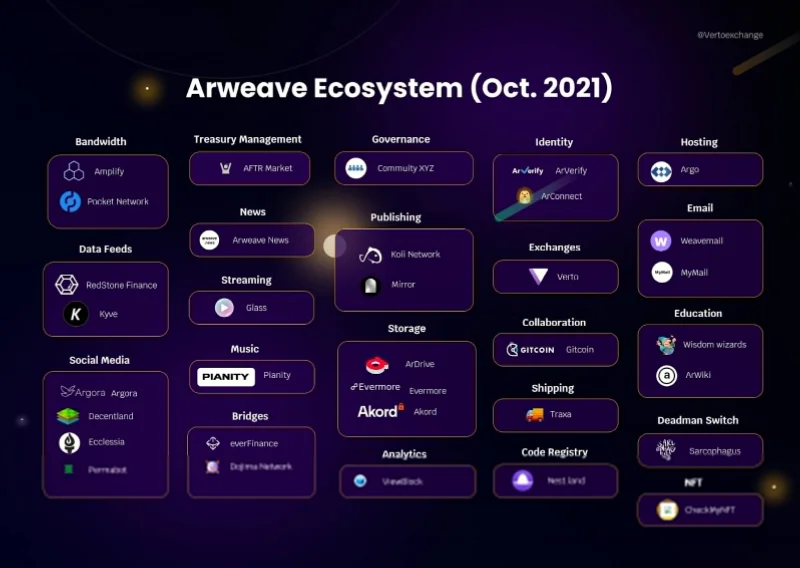
Arweave's Ecosystem
Projects in the NFT . segment
NFT could be one of the driving forces behind the growth of transactions on Arweave. Digital assets, metadata, or NFTs are typically stored Off-chain on centralized servers or through decentralized peer-to-peer protocols or networks like IPFS. This leads to the problem that the data will not be kept permanently.
This data is not stored On-chain because decentralized Layer 1 blockchain platforms are limited in their ability to store large amounts of data. As a result, a lot of data must be stored Off-chain and sometimes NFT data can be lost resulting in some NFT assets having no functional value.
Therefore, Arweave was born with the desire to solve this problem. The project provides indefinite On-chain data storage at low cost. This has made Arweave the right place to store NFT assets.
In recent times, Arweave has seen a huge growth in the number of NFTs stored on the network thanks to their growth on the Solana ecosystem. In particular, Metaplex is the factor driving that outstanding growth. This is a toolkit that makes it easy for creators to mint NFT works from Arweave on Solana .
The fact that Metaplex chose Arweave as a data storage system, NFT on Solana has shown a growing correlation between Arweave and the project's tokens in the Solana ecosystem.
Web Applications 3.0
Permaweb
This is an ecosystem of Web 3.0 applications built on Arweave's data storage layer. Recently, there has been a strong growth in the number of applications and developers in the network, mostly coming from Open Web, start-up incubators.
Since 2019 to date, developers from blogging platforms to games built under the support of Arweave are more than 600 people by 2021.
SmartWeave
SmartWeave is a smart contract platform developed by Arweave which has also seen a dramatic increase in the number of contracts being initiated. This shows that the ecosystem of this platform is expanding in a sustainable way.
The project allows developers to monetize their applications and profit from real-world adoption with the support of profit sharing communities (PSCs) and profit sharing tokens ( PST).
As mentioned, PSC is a new model for reshaping startups built on Web 3.0. And PST is considered a reward for developers and application owners when their applications are interacted by users.
This is one of the factors that motivates many Web 3.0 developers to build on the Arweave platform.
Layer 1 . storage
Today, blockchain platforms are increasingly used, which will lead to an increase in the amount of data that needs to be stored on the network. This will require blockchains to be scalable.
Faced with that problem, many networks have begun to switch to storing data on Arweave to save costs with the "Pay once, store forever" policy. This made Arweave the infrastructure platform for Layer 1.
Typically, Solana has chosen Arweave as her default data storage solution through SOLAR Bridge. At the same time, Arweave will also serve as Layer 1 for developers to launch applications or projects.
Recently, The Graph announced that they will be integrating Arweave into the system. This is intended to allow indexed data from The Graph's open APIs to read and organize data stored on Arweave. This integration could become the method by which Internet applications can query information on Web 3.0.
![What is Arweave? Overview of the development of the Arweave ecosystem]()
Arweave project developer and investor
Arweave dev team
Arweave was founded by Sam Williams and William Jones, where:
Sam Williams has experience related to distributed and decentralized system, he has developed an operating system called HydrOS.
William Jones is a researcher in graph theory and neural networks. While Williams dropped out of graduate school to focus on company, Jones completed her PhD at the University of Kent.
The idea to develop Arweave was conceived by Sam Williams while walking up a mountain in Scotland, then presented the idea to his collaborator William Jones. After launching Arweave, Williams was appointed as an advisor to Minespider, a company that provides blockchain-based supply chain tracking. In addition, he has served as a consultant for several programs organized by Techstars company.
![What is Arweave? Overview of the development of the Arweave ecosystem]()
Investor of Arweave
Arweave successfully raised US$5 million in 2019 with the participation of well-known venture capital funds including Andreessen Horowitz, Union Square Ventures.
By March 2020, Arweave announced that it had raised an additional $8.3 million from investment funds such as Andreessen Horowitz, Union Square Ventures and Coinbase Ventures .
In total, after 7 rounds of raising capital, Arweave has raised 22 million USD, including up to 15 investors including both institutions and individuals.
Overview of the AR . coin
What is AR?
AR is the native token of the Arweave network with certain functions such as:
- AR is used as a means of paying for data storage costs on Arweave.
- The AR coins collected from users as well as transaction fees will be used to pay miners to maintain the network and provide services on Arweave.
Detailed information about AR . coin
- Ticker: AR
- Total supply: 66,000,000,000 AR
- Current circulating tokens: 50,108,502 AR
- Blockchain Network: Arweave
Allocation of AR
Arweave held a Pre-sale event in August 2017. Of which 10.8% of the total initial generated AR supply was sold in two public sales in May 2018 and June 2018 for 7.1% and 1.1% of the initial supply, respectively.
Arweave allocated an additional 19.5% to Private Sale, 2.9% to project advisors, 13% to development team (5 years lock and 20% release per year).
The remaining amount of AR includes 19.1% for ecosystem development and 26.5% for future Arweave platform use (5-year lock and 20% annual unlock).
Where can investors buy and sell AR?
AR is currently listed on most major exchanges such as Binance, KuCoin, Huobi Global , Gate.io, Hotbit , OKEx…
What is the future of the Arweave project?
Decentralized hosting played an important role in the transition from Web2.0 to Web 3.0. At the same time, it is also an essential component of the infrastructure of the cryptocurrency market. Arweave provides a single solution for data storage indefinitely, decentralized and censorship-resistant with its “Pay once, store forever” model.
In addition, Arweave's Permaweb has flourished with decentralized financial applications taking on many important roles in this ecosystem.
Although data on Arweave currently accounts for less than 1% of all data stored in decentralized protocols, demand for Arweave will come from non-Crypto businesses and Crypto applications on Web 3.0.
Along with the continuous development of the cryptocurrency market, the birth of many Web 3.0 applications and NFT projects, the demand for using Arweave to store data will also grow. Therefore, in the future, Arweave promises to explode and receive more user attention.
summary
Above is all the information of the Arweave ecosystem and the AR coin. In general, the Arweave ecosystem also owns many projects that play an important role in the transition from Web 2.0 to Web 3.0. If the PSC program attracts developers and users, Arweave's ecosystem will grow even more in the future.