Home
» Project analysis
»
Aptos Explained: Parallel Execution, Staking Rewards and Token-Supply Checkpoints
Aptos Explained: Parallel Execution, Staking Rewards and Token-Supply Checkpoints
Aptos is often summarized with three claims: it executes transactions in parallel, APT holders can earn staking rewards, and its token supply follows a known schedule. Each statement is directionally useful, but each can also mislead if you stop there. A better result is to understand what the mechanism actually does, what number you should verify, and which parts can change through governance.
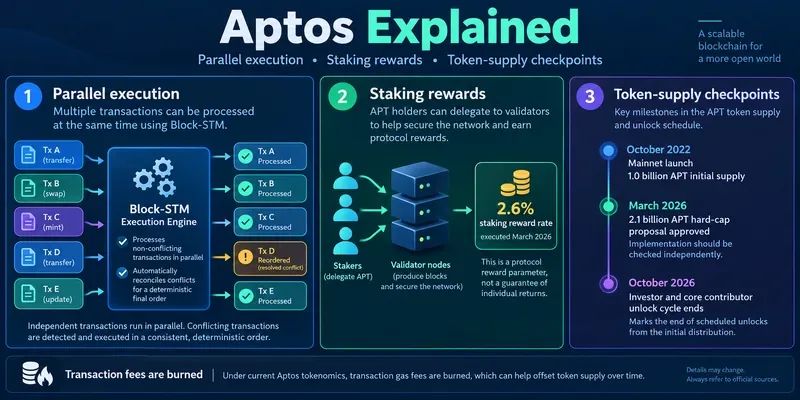
As of September 29, 2026, the biggest recent tokenomics change is already on-chain: Aptos governance executed a proposal in March 2026 that reduced the staking reward rate parameter from 5.19% to 2.6%. A separate governance vote approved a 2.1 billion APT hard-cap proposal, but the proposal page explicitly said code implementation would follow. That distinction matters: an approved policy and an implemented protocol rule are not always the same checkpoint.
Aptos combines speculative parallel execution, proof-of-stake rewards and a changing token-supply framework; the useful habit is to verify each mechanism at the protocol or governance source rather than treating one headline number as permanent.
What should you understand after reading this?
A useful understanding of Aptos should let you answer four questions without relying on slogans:
Why can Aptos execute many transactions at once without giving up deterministic results?
Why does a protocol staking reward rate not equal the return every delegator actually receives?
Why can total supply rise even when transaction fees are burned?
Which supply milestones are scheduled, which were approved by governance, and which still need implementation verification?
If you can separate those ideas, you can evaluate performance and tokenomics with much less risk of mixing benchmark claims, validator economics and circulating-supply narratives.
Parallel execution: what Aptos actually means by it
Aptos uses an execution engine called Block-STM. STM stands for software transactional memory. In practical terms, the engine speculatively executes transactions in parallel, detects conflicts between transactions that touch overlapping state, and re-executes or validates work as needed so every validator arrives at a deterministic result.
The important point is that “parallel” does not mean transactions are allowed to produce inconsistent outcomes. The original Block-STM research describes an outcome equivalent to executing transactions according to a preset serial order, while using parallel hardware to finish compatible work sooner. The Aptos white paper likewise describes transaction dissemination, ordering, parallel execution, storage and ledger certification as pipelined stages that can operate concurrently. See the Block-STM research paper and the Aptos white paper.
What does good performance look like?
Do not judge parallel execution from a theoretical transactions-per-second number alone. A better evaluation asks whether the workload has independent state access, whether conflict-heavy transactions force re-execution, and whether the rest of the pipeline can keep up. Aptos documentation notes that storing user-specific state under separate accounts or objects generally parallelizes better, while a hot global resource can serialize competing writers.
Useful signal: if an application spreads writes across independent resources, Block-STM has more parallel work available. If many transactions compete for one shared resource, the performance advantage can shrink.
When to change your approach: developers seeing contention should inspect state layout rather than assuming more validator CPU will solve the bottleneck. The Aptos resource documentation explains why data placement affects parallelism.
Common misunderstanding: parallel execution is not the same as parallel submission
Aptos also supports application patterns where multiple machines can submit transactions from the same account using replay-protection nonces. That is a submission feature, not the same thing as Block-STM’s execution model. Conflating them can make system design discussions confusing.
Action: when comparing Aptos with another chain, define which layer you are discussing: transaction submission, consensus ordering, execution, or finality.
Staking rewards: start with the protocol parameter, then subtract reality
Aptos uses proof of stake. Validators participate in consensus, while token holders can delegate stake through supported staking mechanisms. Rewards are distributed at the protocol level, but the amount a particular holder receives can depend on validator performance, commission or fee arrangements, delegation terms and the period actually staked.
The historical tokenomics page originally described a maximum reward rate that started at 7% annually and declined over time. That number is no longer the right current headline. On March 16, 2026, Aptos governance executed Proposal 184, implementing AIP-140’s reduction from 5.19% to a 2.6% staking reward rate.
Verified: the governance record shows the 2.6% rate change was executed.
Context-dependent: 2.6% should not be read as a guaranteed wallet APY. A validator or delegation product can produce a different realized return because protocol rewards, validator performance, commissions and timing are not identical concepts.
Action: before staking, verify the current protocol parameter and the validator or service’s commission, performance history, lock or withdrawal mechanics, and any extra incentives. Do not annualize a short promotional period and call it the protocol yield.
Why staking can increase supply while fees reduce it
APT supply has two important flows moving in opposite directions. Staking rewards create new APT under the protocol’s reward rules, while transaction gas fees are burned under the current tokenomics model. Therefore, “fees are burned” does not automatically mean total supply must decline.
The net direction depends on how much APT is issued as rewards versus how much is burned, plus distributions or unlocks that affect circulating supply but do not necessarily change total minted supply. The accepted AIP-140 tokenomics update explicitly frames future supply dynamics around lower emissions and higher burns.
Action: track three values separately: total supply, circulating or unlocked supply, and the amount burned. A change in one does not tell you what happened to the other two.
The APT supply checkpoints that matter
Checkpoint
What is verified
What to check next
October 2022 mainnet launch
The initial total supply was 1 billion APT.
Use this as the baseline, not as today’s supply.
Ongoing staking rewards
Rewards increase minted supply; the current reward-rate parameter was cut to 2.6% in March 2026.
Check current governance before projecting future issuance.
Gas-fee burn
Current Aptos tokenomics burn transaction gas fees.
Compare aggregate burns with emissions instead of assuming “burn” means deflation.
October 2026 unlock milestone
The original investor and core-contributor four-year lock schedule reaches its endpoint around the fourth anniversary of mainnet.
Distinguish the end of scheduled initial unlocks from new issuance through staking.
2.1B hard-cap vote
Governance Proposal 183 was executed on March 9, 2026 and approved establishing a 2.1 billion APT hard cap.
The proposal itself says code implementation would follow, so verify implementation separately before treating the cap as an enforced protocol invariant.
The original Aptos tokenomics overview is still useful for the launch allocation and vesting design. It says community and Foundation allocations were expected to distribute over ten years, while investors and core contributors followed a four-year lock-up schedule from mainnet launch. It also warns that projected figures are forward-looking and subject to change.
Why October 2026 is a meaningful checkpoint but not a “zero inflation” date
The end of the initial investor and core-contributor unlock cycle reduces one source of new liquid supply. It does not stop staking rewards, erase Foundation or community distribution schedules, or guarantee that circulating supply falls. AIP-140 states that the four-year initial unlock cycle concludes in October 2026 and describes a material reduction in annualized unlock pressure afterward.
Action: if you are modeling supply after October 2026, remove the completed initial investor/core-contributor schedule from future unlock assumptions, but keep protocol emissions, burns and any remaining ecosystem distributions as separate lines.
The 2.1 billion hard cap: approved does not automatically mean enforced
This is the easiest 2026 tokenomics headline to overstate. Governance Proposal 183 was executed in March 2026 and approved a 2.1 billion APT hard supply cap. However, the proposal description explicitly says that code implementation would follow approval.
That means the governance vote is strong evidence of the network’s approved policy direction, but the proposal record alone is not sufficient evidence that the cap is already enforced at the minting layer. In researching this article, I did not find a later official source in the checked materials that independently confirms the implementation step.
Action: for any investment model, dashboard or tokenomics report, label this checkpoint precisely: “hard cap approved by governance; implementation should be independently verified.” Replace that label only when an official implementation or on-chain parameter source confirms it.
How to judge an Aptos performance claim
Parallel execution is valuable when the workload exposes concurrency, but benchmark throughput is not a promise about every application. The Block-STM paper reports strong benchmark scaling across multiple cores, including under contended workloads, yet production performance also depends on consensus, networking, storage, state contention, gas limits and application design.
A sound evaluation therefore looks for:
Workload definition: simple transfers, swaps and shared-state applications stress the chain differently.
Conflict rate: independent transactions can parallelize more effectively than writes to the same hot state.
End-to-end latency: execution speed alone is not the same as user-observed confirmation time.
Sustained rather than burst performance: a short benchmark peak is not equivalent to long-running production capacity.
Protocol version: Aptos is upgradeable, so old benchmark numbers may describe a different software stack.
When to change your approach: if an application is dominated by one highly contended resource, redesigning the state model may matter more than relying on the chain’s maximum parallel-execution capacity.
A practical way to read Aptos tokenomics in 2026
Use a checkpoint method rather than a single “tokenomics” number. First record the current staking reward parameter from governance. Second, identify fees burned over the same period. Third, distinguish total supply from circulating supply. Fourth, map remaining scheduled unlocks or distributions. Fifth, verify whether approved structural changes such as the hard cap have reached implementation.
This method produces a more durable result because each component can change independently. It also avoids two common errors: treating a staking reward rate as guaranteed personal yield, and treating the end of one vesting schedule as the end of all supply growth.
Bottom line
Aptos’s technical design and token economics are easier to understand when you keep three layers separate. Block-STM is an execution technique that speculatively processes independent transactions in parallel while preserving deterministic results. Staking is a network-security mechanism whose protocol reward-rate parameter was reduced to 2.6% in March 2026, but individual realized returns can differ. Supply is a set of moving checkpoints: a 1 billion APT launch baseline, ongoing staking emissions, gas-fee burns, the October 2026 end of the initial investor/core-contributor unlock cycle, and an approved 2.1 billion hard-cap policy whose implementation should be verified independently.
The best sign that your analysis is working is not that you can repeat one TPS figure or one APY. It is that you can explain which metric is being measured, where it comes from, what could change it, and which official checkpoint you would revisit before using it in a decision.