Home
» Project analysis
»
Sky Protocol Explained: How USDS Differs From DAI and Which Governance Changes Matter
Sky Protocol Explained: How USDS Differs From DAI and Which Governance Changes Matter
A common Sky Protocol problem starts with a simple wallet question: you already hold DAI, but newer Sky interfaces and documentation talk about USDS, sUSDS and SKY. Do you need to convert? Is USDS just DAI with a new name? Does holding USDS automatically earn the Sky Savings Rate? And if you still hold MKR, can you keep using it for governance?
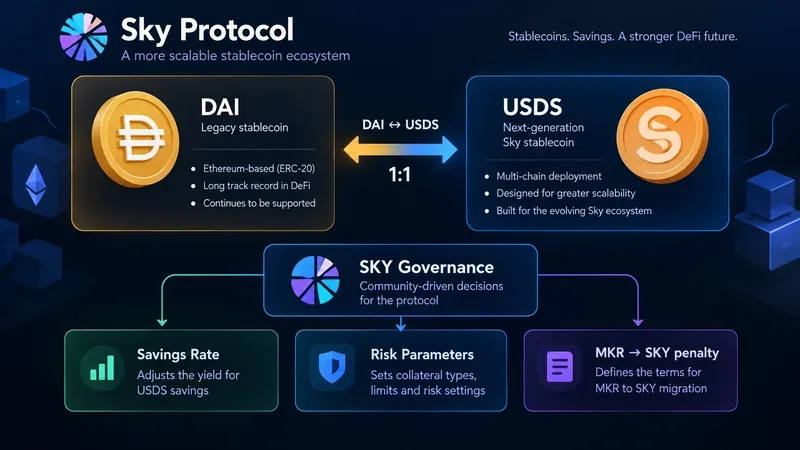
The short answer is that DAI and USDS remain distinct tokens, but Sky designed a permissionless 1:1 converter between them. USDS is the newer native stablecoin of Sky Protocol, while DAI continues to exist and can still be used wherever applications support it. The more important changes are around how newer Sky products are accessed and how governance now works. Sky’s current materials say SKY, not MKR, is the governance token, and recent governance proposals have continued to change the penalty applied when MKR is upgraded late to SKY. See Sky’s official USDS overview, the USDS contract repository, and the official SKY token guide.
DAI and USDS are separate stablecoin tokens connected by a 1:1 converter, while SKY governance controls protocol-level parameters such as savings, risk settings and migration policy.
First question: do you actually need to convert DAI to USDS?
Not necessarily. If your only goal is to hold or use DAI in a wallet, exchange, lending market or application that still supports it, there is no automatic requirement to convert just because Maker became Sky. Sky itself describes USDS as the upgraded version of DAI rather than saying that every DAI holder must migrate immediately.
The practical reason to move into USDS is access to the newer Sky product stack. Sky.money uses USDS as the stablecoin entry point for products such as sUSDS and other Sky-native features. If you want to remain in an application that is built around DAI, keeping DAI may be simpler. If you want to use current Sky-native savings or staking-related products, USDS is usually the relevant base asset.
Before moving anything, check three things:
whether the application you plan to use supports DAI, USDS or both;
whether the token contract and network shown in your wallet match the official deployment you intend to use;
whether converting changes anything important for a connected DeFi position, collateral account or tax record in your jurisdiction.
What is the concrete difference between DAI and USDS?
They are separate tokens, not two tickers for one contract
USDS has its own ERC-20 contract. The official Sky repository describes the USDS token, a USDS join adapter and a DaiUsds converter as separate contracts. The converter can move DAI to USDS and USDS back to DAI at a 1:1 exchange rate. Sky’s repository describes that converter as permissionless.
This matters because integrations are token-specific. A protocol can support DAI but not USDS, support USDS but not DAI, or support both. A wallet balance labeled “DAI” does not silently become “USDS.” Conversion is an explicit onchain action.
USDS was designed as the native stablecoin for the current Sky system
Sky’s June 2026 USDS documentation calls USDS the native stablecoin of Sky Protocol and states that USDS itself does not generate yield. Instead, USDS is the entry point to sUSDS, which represents access to the Sky Savings Rate. That distinction avoids one of the most common misunderstandings: simply holding USDS in a wallet is not the same as holding sUSDS.
Sky’s official sUSDS guide describes sUSDS as an ERC-4626 value-accruing token. The quantity of sUSDS held does not need to rebase upward; rather, each sUSDS becomes redeemable for more USDS as the governance-set rate accrues. The rate is variable and can be changed by governance.
USDS has different contract architecture
The official USDS code repository states that the token uses the UUPS upgradeability pattern and ERC-1967 proxy storage slots. This is a real architectural difference worth understanding because USDS is not merely a cosmetic rename of DAI. Users do not need to interact with upgrade machinery directly, but developers, integrators and risk teams should treat USDS as its own contract system and review its current implementation and governance controls rather than assuming DAI behavior carries over automatically.
How should you decide between DAI and USDS?
Goal
What to check first
Likely focus
Keep using an existing DeFi position
Which token the protocol currently supports
Stay with the supported asset unless there is a clear reason to migrate
Use current Sky-native products
Whether the product requires USDS
USDS is the usual entry asset
Access the Sky Savings Rate
Whether you are actually receiving sUSDS
USDS alone does not accrue the savings rate
Move between DAI and USDS
Official converter, token addresses and network fees
Use the 1:1 conversion path rather than assuming a market swap is necessary
Participate in governance
Whether you hold SKY rather than MKR
SKY is the current governance token
Governance change #1: SKY has replaced MKR for voting
The governance transition is more consequential than the DAI-to-USDS branding change. Sky’s August 2026 SKY guide says the governance-token transition is complete: SKY is now the sole governance token, and MKR can no longer be used to vote. Holders who want to participate in current Sky governance need SKY.
Sky states that the base conversion rate is 1 MKR to 24,000 SKY before any delayed-upgrade penalty. The same guide explains that there is no fixed deadline after which MKR disappears, but waiting can reduce the amount of SKY received because governance introduced a Delayed Upgrade Penalty.
This creates a practical difference between the stablecoin migration and the governance-token migration. DAI holders can evaluate whether USDS is useful for their application. MKR holders who want current governance power cannot simply continue voting with MKR.
Governance change #2: the delayed MKR-to-SKY penalty keeps changing
This is one of the areas where old articles can become misleading quickly. Sky governance set the delayed upgrade penalty to 1% in September 2025, then approved later increases. A June 4, 2026 executive proposal specified an increase from 3% to 4%. A September 10, 2026 executive proposal specified another increase from 4% to 5%. The September proposal can be reviewed on the official Sky governance page.
One limitation is important: the indexed public text for that September 10 proposal clearly shows the proposed 4%-to-5% increase, but it did not expose enough execution-state detail in the retrieved result to independently confirm the live converter rate from that page alone. Before converting MKR, verify the amount of SKY shown by the current official interface or conversion contract rather than relying on an older percentage in an article.
Governance change #3: savings and risk parameters are not fixed product promises
Sky governance does more than manage token migration. Current governance can change the Sky Savings Rate, collateral parameters, debt ceilings, reward streams, allocator settings and other protocol-level controls. This means a rate shown today should not be treated as a permanent yield promise.
Sky’s own documentation states that the Sky Savings Rate is governance-set and variable. The same principle applies to risk settings around protocol collateral and capital allocation. A user who checks only the token symbol but ignores governance changes can miss the most economically important part of the system.
The live Sky Executive Proposals page is therefore a more useful source for current protocol changes than an old explainer. As of September 2026, governance proposals continue to adjust allocator debt ceilings, reward programs, treasury operations and other system parameters.
Governance change #4: the system is broader than the old Maker core
Sky Protocol now describes its architecture in terms of a core protocol and a network of independent capital allocators or “Sky Agents” operating under governance-defined constraints. Recent executive proposals reference allocator vaults, Agent proxy spells and risk limits for entities such as Spark and Grove. For users, the important point is not the naming. It is that governance decisions can affect where protocol liquidity is allocated and under what limits.
This does not mean every USDS holder needs to read every executive spell. It does mean that anyone evaluating USDS as a stablecoin should understand that collateral composition, liquidity infrastructure and capital-allocation rules can evolve through governance.
A practical way to handle DAI, USDS and SKY
Step 1: identify what you are trying to do
Do not start by converting tokens. Start with the destination. If you want to use an existing DAI-only protocol, conversion may add unnecessary work. If you want sUSDS or another Sky-native product, USDS may be required.
Step 2: verify the exact token and network
Use official Sky documentation or the application’s verified token list. Do not rely on ticker symbols alone. Fake tokens can use the same name and symbol as legitimate assets.
Step 3: use the direct DAI–USDS conversion path when appropriate
The official Sky contracts provide a 1:1 DAI/USDS converter in both directions. A market swap through an unrelated liquidity pool can introduce price impact or routing fees that are unnecessary when the native converter is available for your intended network and interface.
Step 4: separate USDS from sUSDS in your mental model
USDS is the stablecoin. sUSDS is the savings token. If your objective is to access the Sky Savings Rate, verify that the transaction actually results in sUSDS rather than leaving idle USDS in your wallet.
Step 5: treat MKR migration as a separate decision
MKR-to-SKY conversion is governed by different rules from DAI-to-USDS conversion. The base ratio and delayed-upgrade penalty determine the amount of SKY received. Because the penalty can change, check the current conversion preview immediately before acting.
How to self-check that you understood the system correctly
You should be able to answer all of the following before moving funds:
Which token do I currently hold? DAI, USDS, sUSDS, MKR and SKY serve different roles.
Does my target application support it? Token support is application-specific.
If I convert DAI to USDS, am I using the official 1:1 path? Verify the contract or official interface.
If I expect savings yield, do I actually hold sUSDS? USDS itself does not automatically accrue the Sky Savings Rate.
If I want governance rights, do I have SKY? Current Sky materials state that MKR no longer carries voting power.
If I am converting MKR, what penalty is live now? Check the current conversion result rather than an old percentage.
Have I checked recent executive proposals? Savings, risk, rewards and allocator parameters can change.
The cleanest way to think about Sky Protocol in 2026 is that USDS is the newer stablecoin layer, sUSDS is the savings layer, and SKY is the governance layer. DAI and MKR did not simply vanish, but their roles are no longer equivalent to the newer tokens. If you keep those functions separate and verify the live governance state before acting, the migration becomes much easier to evaluate without relying on outdated assumptions.