Home
» Project analysis
»
Celestia Explained: Data Availability, Blobspace Fees, and Risks TIA Users Should Monitor
Celestia Explained: Data Availability, Blobspace Fees, and Risks TIA Users Should Monitor
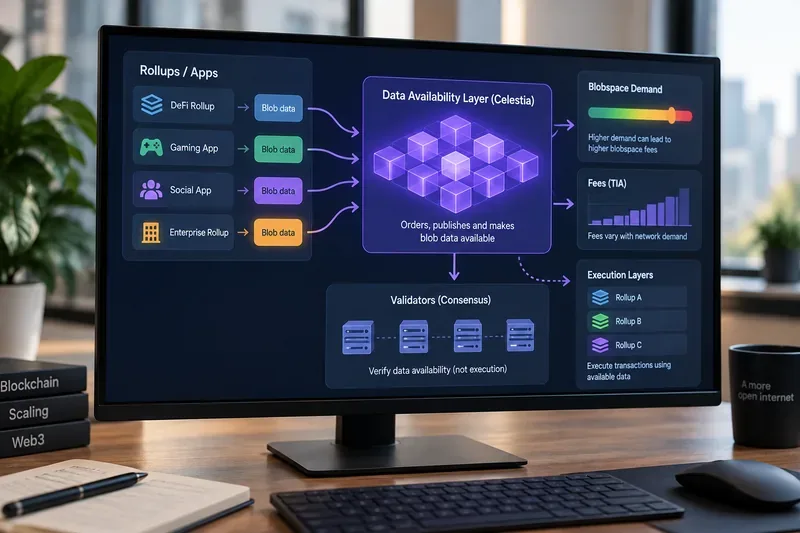
A common mistake when evaluating Celestia is to look at the TIA token first and the network service second. That reverses the useful order of questions. Celestia is primarily a data availability network: rollups and other applications publish transaction data to Celestia so that participants can verify the data was made available, while execution and settlement can happen elsewhere.
For a TIA user, the practical challenge is connecting that architecture to what actually matters: what rollups are paying for, why blobspace fees can change, what staking does and does not protect against, and which protocol or supply changes can affect the network even if your wallet appears to be working normally.
Celestia separates data availability from execution: rollups publish blob data to the DA layer, while TIA-denominated fees and proof-of-stake validators support the network around that service.
Start with the problem Celestia is trying to solve
Rollups can execute transactions somewhere other than a base chain, but users still need confidence that the underlying transaction data was actually published. If a block producer withholds the data, independent parties may be unable to reconstruct state, verify transitions, or challenge invalid behavior.
Celestia calls this the data availability problem. Its documentation defines the core question simply: has the block data been published, and can it be downloaded? Celestia is designed so applications can use the network for ordering and publishing data without requiring Celestia itself to execute those applications' transactions. See the official Celestia data availability overview.
This distinction matters because “Celestia processed my rollup transaction” is usually the wrong mental model. The rollup may execute the transaction; Celestia's role can be to make the relevant data available and commit to it.
How does Celestia verify that data is available?
Downloading every byte of every block would make light verification increasingly expensive as block capacity grows. Celestia instead combines erasure coding with data availability sampling (DAS).
Block data is extended with erasure coding and committed into the block header. Light nodes then request random portions, or shares, of the extended data and verify the associated proofs. Successful samples increase confidence that the full block was made available without requiring every light node to download the entire block. Celestia's documentation describes this as a probabilistic guarantee rather than an absolute mathematical statement that every light client downloads every byte. The network can tune sampling parameters to make false-positive probability sufficiently small. See the transaction lifecycle documentation and data availability FAQ.
Celestia also uses namespaced data structures so an application can retrieve data relevant to its own namespace rather than scanning unrelated blobs. The result is a specialized service: applications buy publication capacity, while the network provides consensus over ordered data and mechanisms for checking availability.
What is blobspace, and why does it cost TIA?
Celestia uses the term blobspace for the block capacity used to publish application data. A rollup submits one or more blobs through a PayForBlobs transaction. The blob contains the data and namespace, while the executable portion of the transaction includes the payment and commitment information.
TIA is the native asset used to pay those fees. The official TIA documentation lists paying for blobspace as one of the token's core network roles, alongside proof-of-stake security and optional use as a gas token or currency by rollups. See Celestia's TIA overview and paying for blobspace documentation.
Blobspace fees are not one fixed price per blob
Celestia currently uses a gas-price-prioritized mempool. Higher-fee transactions can receive higher priority from validators. For a PayForBlobs transaction, cost depends partly on how much space the blobs consume. Celestia's submission documentation explains that each blob contributes gas according to the shares needed for its size, bytes per share, a gas-per-byte parameter, and a static amount per blob.
The basic transaction fee relationship is:
Total fee = gas limit × gas price.
That means two variables can matter at once. A larger payload requires more gas, while network conditions can affect the gas price needed for timely inclusion. Celestia-node can estimate gas price, and operators can configure a maximum gas price so a blob is not submitted above a chosen ceiling. The current documentation notes that the default maximum is 100 times the minimum gas price, shown as 0.2 TIA, but users should verify current software defaults and network parameters rather than hard-code that number indefinitely. See the official blob submission and fee-estimation documentation.
What should a TIA user monitor first?
The easiest checks are the ones that do not require operating infrastructure. They help separate token-market narratives from observable network mechanics.
What to monitor
Why it matters
What to verify
Blobspace usage and fee conditions
TIA is used to pay for DA publication
Whether application demand is producing sustained blob submissions and how gas prices behave under load
Staking and validator behavior
TIA secures consensus through proof of stake
Validator uptime, commission, concentration, and slashing exposure
Issuance and unlock schedules
Supply can change independently of network usage
Current inflation rules and scheduled unlocks from official documentation
Protocol releases
Node versions can change performance, compatibility, and operational assumptions
Mainnet release notes rather than testnet-only versions
Rollup verification dependencies
A rollup can depend on bridges or attestation components beyond Celestia DA itself
Whether the specific integration path is actively maintained
Risk 1: Do not equate blobspace demand with guaranteed TIA price performance
Blobspace usage is relevant because fees are denominated in TIA, but it is only one part of TIA's economic picture. Token price also reflects supply, staking behavior, broader crypto-market liquidity, expectations, and other factors outside the DA fee mechanism.
A useful discipline is to track the service and the asset separately. Ask first whether more data is being posted, whether fee pressure appears during demand spikes, and whether capacity upgrades change the price users pay for that service. Only then consider how those observations interact with token supply and staking. A rise in technical usage does not mechanically guarantee a proportional change in the market value of TIA.
Risk 2: Data availability is not permanent historical storage
This is one of the most important operational distinctions in Celestia. Proving that data was available when published does not mean every light node will store that data forever.
Celestia's retrievability documentation says that, as of celestia-app v6, light nodes use a seven-day sampling window under CIP-36 and may prune blob data older than that window. Archival nodes can retain older data, but rollups are responsible for ensuring they have suitable historical storage and recovery paths. The documentation explicitly advises applications not to rely on public archival nodes as their only long-term source. See Celestia's data retrievability and pruning guide.
For an ordinary TIA holder, this is not a wallet-loss risk. It is an ecosystem reliability risk: a rollup using Celestia still needs a sound strategy for historical data, state reconstruction, and node synchronization.
Risk 3: Staking rewards come with validator exposure
TIA holders can delegate to validators and receive staking rewards, but delegation does not eliminate validator risk. Celestia uses the Cosmos SDK slashing framework. Its current documentation states that delegators can be affected when a validator is slashed.
The official slashing page says prolonged downtime can jail a validator, while double signing is treated more severely. As documented in September 2026, double signing results in a 2% slash and permanent removal of the validator, with delegators entering a 21-day unbonding period. Because protocol parameters can change, users should check the live documentation before relying on these exact values. See Celestia's jailing and slashing documentation.
Validator commission also matters. Following CIP-41 and the v6 upgrade, Celestia reduced issuance and increased the minimum validator commission. The current staking documentation also notes that, since CIP-30, changing a delegation position no longer automatically claims accrued rewards; users must explicitly withdraw them. See Celestia staking documentation.
Risk 4: TIA supply changes even when your balance does not
TIA launched with a genesis supply of 1 billion tokens, but circulating supply evolves through issuance, staking rewards, and unlock schedules.
Celestia originally started with 8% annual inflation. The Lotus upgrade in July 2025 reduced the rate to about 5%, and the v6 upgrade in November 2025 reduced it again to about 2.5%. Under the current schedule, the rate declines by 6.7% per year until reaching a 1.5% floor. These are protocol issuance rules, not a forecast of token price. See the official staking, governance, and supply documentation.
Unlocks are separate from inflation. Celestia's published schedule says some allocations unlock continuously across multi-year windows. In particular, initial core contributor tokens continue on a schedule through year 3, while the remaining R&D and ecosystem allocation continues through year 4. The documentation notes that yearly unlock milestones fall on October 30 because 2024 was a leap year. A TIA user comparing supply from one month to the next should therefore distinguish newly issued staking rewards from previously locked tokens becoming transferable.
Risk 5: Watch protocol versions, not just headlines about upgrades
Celestia is still evolving quickly. At the time of this article, checked on September 30, 2026, the Celestia-app GitHub release page lists v9.0.8 as the latest Mainnet release, while newer v10.x entries shown there are identified for test networks such as Mocha or Corto rather than Mainnet.
That distinction matters for operators and integrators. A feature appearing in a testnet release does not mean Mainnet users can already depend on it. The v9.0.8 Mainnet release includes consensus/RPC changes and fixes, while v10 testing introduces additional infrastructure changes. See the official celestia-app release page.
Risk 6: A rollup can inherit risks from components around Celestia
Using Celestia for DA does not make every bridge, settlement contract, proof system, sequencer, or interoperability component equally secure or equally maintained.
A timely example is Blobstream. Celestia's documentation now labels Blobstream as legacy and states that, as of September 2026, the Succinct-operated SP1 Blobstream deployments are no longer maintained and do not receive new commitments. The docs tell integrations that still depend on Blobstream for dispute verification to operate or source their own verification path. See the current Blobstream legacy notice.
This does not mean Celestia DA itself has stopped working. It means users evaluating a particular rollup should trace the whole verification path. “Uses Celestia” is not a complete security description.
Move from easy checks to deeper verification
If you only hold or stake TIA, start with official supply, staking, slashing, and Mainnet release documentation. If you use an application that posts data to Celestia, add checks for blob submission costs and the application's own historical-data strategy. If you operate infrastructure or depend on a Celestia-backed rollup for significant value, go further: verify node versions, DA retrieval paths, bridge or settlement dependencies, and how the application reacts when fee estimates rise or archival providers are unavailable.
The deeper the dependency, the less useful a generic “Celestia is cheap” or “Celestia is secure” statement becomes. The relevant question is which part of the stack you are trusting and what happens when that component fails.
How to check whether your Celestia understanding is still current
Before making a technical or financial decision involving TIA or a Celestia-backed application, run this short self-check:
Can you explain the service? Celestia provides data availability; it is not automatically the execution layer for every rollup that uses it.
Can you explain the fee? Blob publication cost depends on gas usage and gas price, so it can vary with blob size, network conditions, and protocol parameters.
Can you separate availability from storage? Successful DA does not guarantee indefinite historical retention by light nodes.
Have you checked current TIA issuance and unlock rules? Do not rely on launch-era tokenomics after later protocol upgrades.
If you stake, have you checked the validator? Review commission, operational history, and slashing exposure instead of looking only at headline yield.
If you use a rollup, have you traced its full verification path? DA, sequencer, settlement, bridge, proof system, and archival strategy can have separate failure modes.
Are you reading the Mainnet release notes? Testnet features and versions should not be treated as already active on Mainnet.
If you can answer those seven questions from current primary sources, you are evaluating Celestia on the mechanics that actually matter rather than on a single token metric. The network's modular design is the key idea: separating execution from data availability can make scaling architectures more flexible, but it also means users must understand where responsibility moves to the layers above Celestia.
Source scope: Technical and tokenomics details in this article were checked against Celestia documentation, Celestia Improvement Proposal-linked changes, and the official celestia-app GitHub releases on September 30, 2026. Network parameters, release status, staking rules, integrations, and software defaults can change after that date.