Home
» Project analysis
»
How to Find Hidden Gem Cryptos Before They Get Listed on Binance
How to Find Hidden Gem Cryptos Before They Get Listed on Binance
Finding a crypto project before a major exchange listing is possible. Predicting which one will actually reach Binance is not. That distinction matters because early-stage tokens are usually less liquid, less transparent, and more vulnerable to manipulation than established assets.
A better approach is to build a repeatable research funnel. The goal is not to guess a secret Binance list. It is to identify projects that already show the kinds of qualities a major exchange may care about: credible teams, real products, healthy token economics, transparent contracts, growing usage, sufficient liquidity, and regulatory awareness.
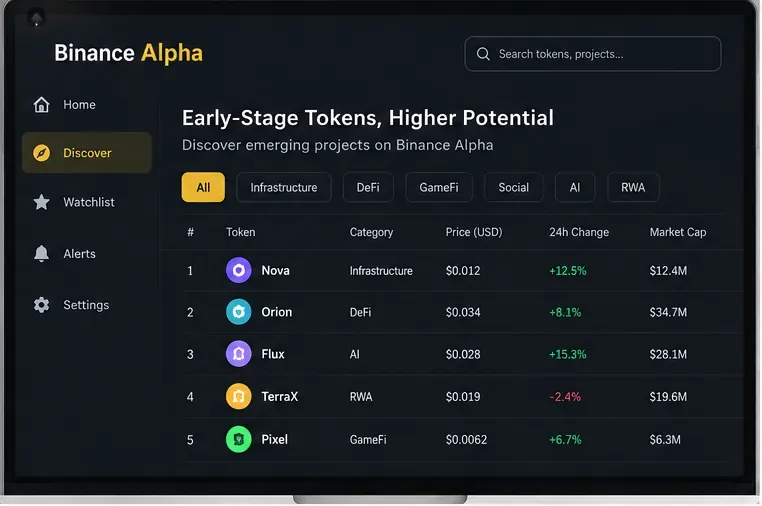
Binance itself describes Binance Alpha as a place for discovering early-stage projects and explicitly says that inclusion does not guarantee a future Binance Exchange listing. In its listing information and requirements notice, Binance also points to project fundamentals, performance metrics, tokenomics, technical risk, team background, and compliance as relevant evaluation areas.
A practical eight-step research workflow
1. Start with primary sources, not influencer lists
Begin with the project's own documentation, code repositories, governance forum, official announcements, token contract, and blockchain explorer records. A strong project should make it reasonably easy to understand what the protocol does, who is building it, what the token is for, and what milestones have actually shipped.
Write down five basics before going any further: the problem being solved, the current product state, the token's real utility, the team or accountable contributors, and the project's next two or three public milestones. If you cannot answer those after reading the primary materials, treat that as a research failure rather than filling the gaps with social-media narratives.
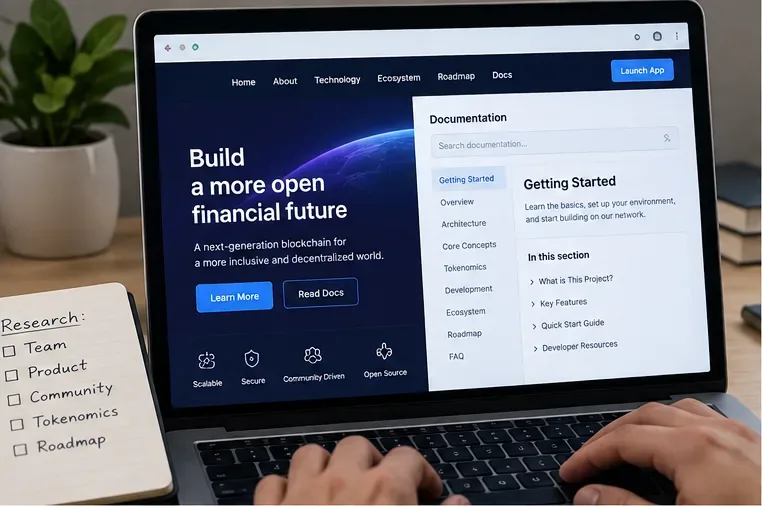
Start with primary project materials: documentation, product scope, roadmap, token utility, and the people responsible for execution.
2. Verify the token contract and privileged permissions
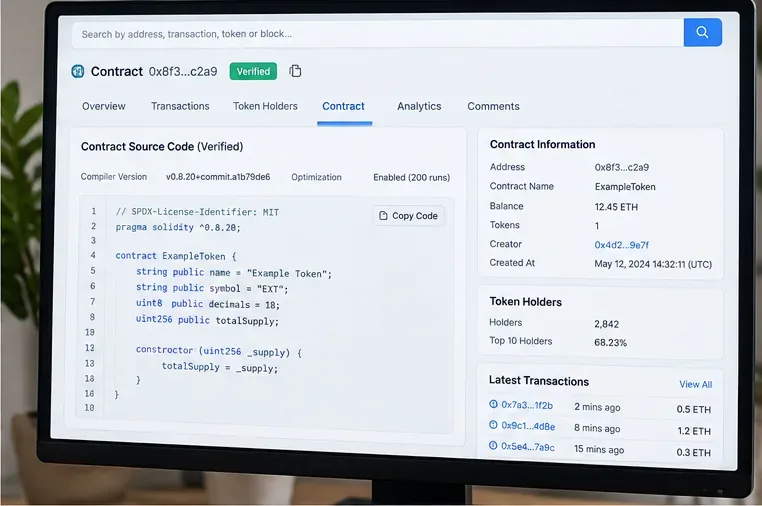
For EVM-compatible tokens, check whether the deployed contract source is verified. Etherscan explains that contract verification publishes source code that corresponds to deployed on-chain code, making the implementation inspectable. Its documentation also provides a source-code endpoint for verified contracts.
Verification is not a safety certificate. A verified contract can still contain risky administrative controls. Review whether privileged roles can mint tokens, pause transfers, blacklist addresses, change fees, upgrade implementation contracts, or otherwise alter user expectations. If the contract is upgradeable, identify who controls the upgrade path and whether that control is protected by a multisignature wallet or timelock.
For smart-contract tokens, verified source code makes it easier to inspect the contract that is actually deployed rather than relying only on marketing claims.
3. Model token supply, unlocks, and dilution
Early investors often focus on market capitalization and ignore future supply. That can be a costly mistake. Calculate the relationship between circulating supply and total or maximum supply, then review vesting schedules for team, investor, ecosystem, treasury, and community allocations.
Large unlocks are not automatically bad. The important questions are who receives the tokens, how fast they unlock, whether the project is producing enough demand to absorb the additional supply, and whether the schedule is transparently disclosed. A low circulating float paired with a very high fully diluted valuation can create fragile price behavior because a relatively small amount of capital may set the visible price while much more supply remains locked.
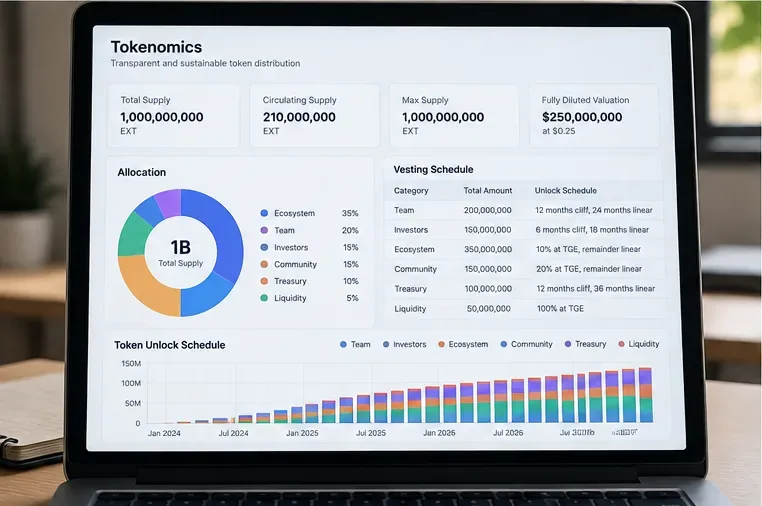
Token distribution and unlock schedules can matter as much as the product because large future unlocks may change circulating supply and selling pressure.
4. Check liquidity before you care about price momentum
A token can show an impressive percentage gain while still being difficult to buy or sell at a reasonable price. Check pool liquidity, 24-hour volume, transaction count, spread, slippage, and the concentration of liquidity providers. Also compare the largest wallet balances with known treasury, bridge, staking, market-maker, and exchange addresses where those labels can be verified.
For small tokens, think in terms of executable size rather than headline market cap. Ask: if I had to exit this position today, how much price impact would I face? A project with thin liquidity and concentrated holders should receive a much smaller risk budget, even if everything else looks exciting.
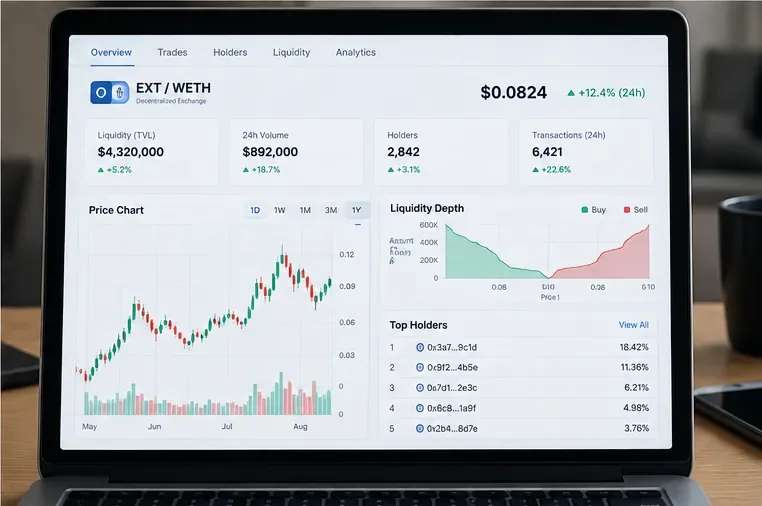
Use on-chain and DEX data to check whether liquidity, trading activity, and holder distribution are deep enough to support real price discovery.
5. Use Binance Alpha as a discovery signal, not a prediction market
Binance Alpha is especially relevant to this topic because Binance calls it a pre-listing token selection pool for emerging projects. The service has evolved since its December 2024 launch, and Binance Academy's July 31, 2026 update still stresses that Alpha exposure does not guarantee a later exchange listing.
That makes Alpha useful for narrowing the universe, not for front-running a listing announcement. Treat it as one input alongside independent research. A token should still pass your contract, tokenomics, liquidity, development, usage, and governance checks. Do not buy merely because a token appears in an Alpha interface or because someone claims that Alpha inclusion means Spot is next.
Binance Alpha can be one discovery input for early-stage projects, but a token appearing there is not a promise of a future Binance Spot listing.
6. Look for evidence that builders are still shipping
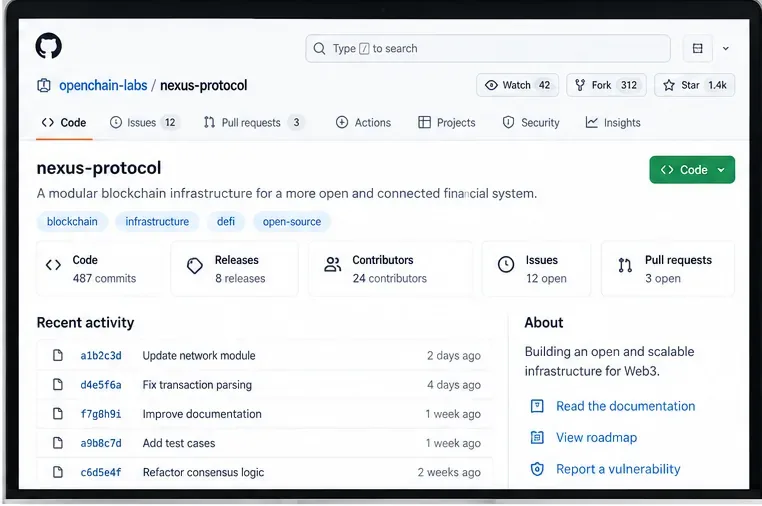
If a project is open source, inspect repository activity over several months instead of counting stars. Look at meaningful commits, releases, contributors, issue resolution, test coverage, documentation updates, and whether development is concentrated in one account or distributed across an active team.
Repository activity can be gamed, so focus on substance. Hundreds of trivial commits are less informative than a handful of releases that correspond to product milestones. For closed-source projects, substitute verifiable product updates, testnet or mainnet releases, audits, developer documentation, public integrations, and user-facing features.
Open-source activity can help distinguish a project that is still shipping code from one whose public development has stalled.
7. Compare social traction with on-chain traction
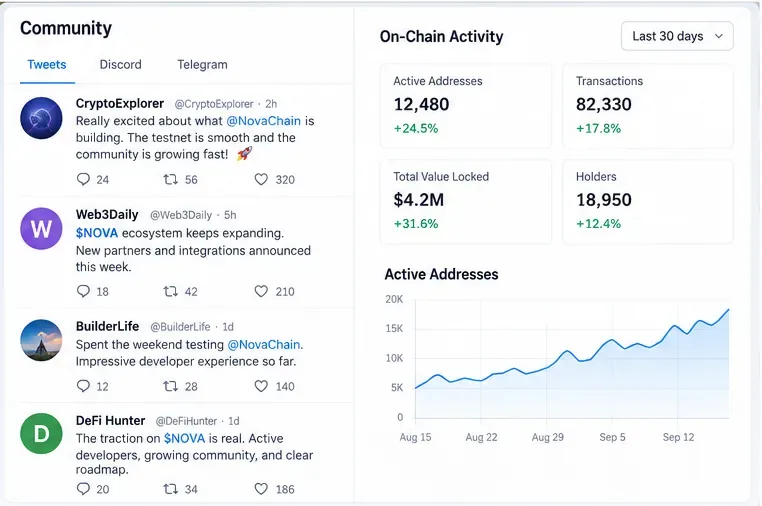
Community growth is useful only when you can separate attention from adoption. Compare social engagement with active addresses, transactions, protocol fees, total value locked where relevant, bridge flows, recurring users, developer activity, or other metrics that reflect actual use.
Be careful with raw follower counts. Sudden follower spikes, repetitive comments, giveaway-driven engagement, and accounts created in clusters may signal low-quality attention. Healthy projects can still run campaigns, but sustainable traction should eventually show up somewhere outside the social feed.
Compare social attention with measurable network activity; strong engagement is more useful when it is accompanied by users, transactions, or protocol usage.
8. Score the project before you allocate capital
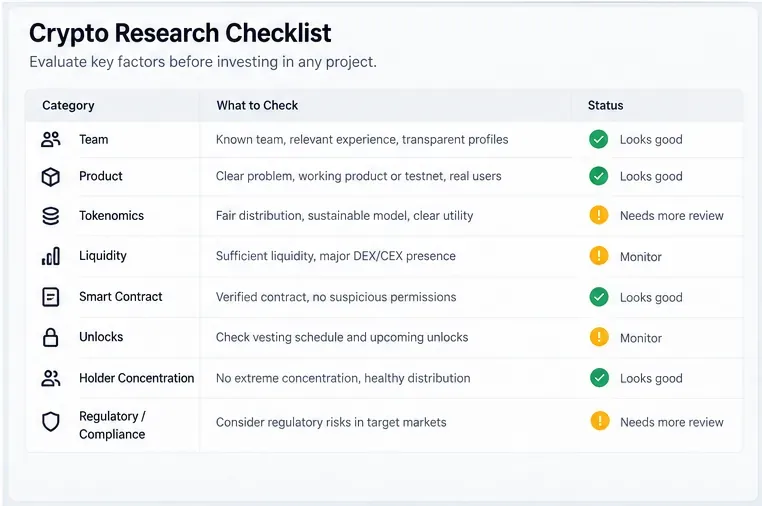
Turn your notes into a simple scorecard so excitement does not override discipline. The exact weights can vary by sector, but the same core questions should be answered every time.
Area
What to verify
Red flags
Team
Relevant experience, accountable contributors, consistent history
Jurisdiction, disclosures, restrictions, risk communication
Promises of guaranteed returns or obvious evasion language
Use a repeatable checklist and require multiple independent signals before treating an early-stage token as a serious research candidate.
A fast screening checklist
Confirm the exact contract address from an official project source.
Read the documentation before looking at price targets.
Verify circulating supply, total supply, and the next major unlock dates.
Check who can mint, pause, upgrade, blacklist, or change fees.
Measure liquidity and realistic exit slippage, not just market capitalization.
Inspect the largest holders and identify known treasury or protocol-controlled wallets.
Compare social growth with on-chain usage and developer progress.
Search official project channels for audits, incidents, migrations, token changes, and governance proposals.
Use Binance Alpha only as one discovery signal; never treat it as a guaranteed listing path.
Decide your maximum loss and position size before buying.
What signals may precede a major exchange listing?
There is no public formula that can reliably identify future Binance listings. Still, certain developments can make a project more research-worthy: sustained user growth, stronger liquidity, broader wallet distribution, consistent shipping, credible integrations, improved documentation, transparent token unlocks, security audits, and visible compliance work.
Binance's published materials are useful here because they describe the exchange's own framework rather than speculation. The April 2025 listing notice says Binance considers areas including fundamentals and performance, tokenomics, technical risk, team background, and compliance. Binance has also described Alpha as a potential pathway for selected early-stage projects, while repeatedly stating that no listing is guaranteed.
Signals that should make you slow down
Some warning signs are straightforward: anonymous teams combined with custodial control, unverifiable partnerships, contracts that cannot be inspected, liquidity controlled by a few wallets, undisclosed token unlocks, fake audits, guaranteed-return language, and pressure to buy before an alleged exchange announcement.
Also treat “insider listing information” claims with extreme skepticism. Binance has warned users about fraudulent third parties impersonating listing intermediaries. A legitimate research process should not depend on private-message promises, paid “listing agents,” or screenshots that cannot be confirmed through official channels.
A simple decision rule
Do not ask, “Will Binance list this token?” Ask, “Would I still consider this project investable if Binance never listed it?” If the answer is no, the thesis is probably based on an event you cannot reliably predict.
A stronger hidden-gem candidate has independent reasons to exist: users, a product, transparent economics, credible builders, measurable demand, sufficient liquidity, and a security model you can understand. A future major-exchange listing can improve access and visibility, but it should be a possible bonus rather than the entire investment case.
Bottom line
The best way to find promising crypto projects early is not to hunt for leaked listing tips. Build a research pipeline that filters thousands of tokens down to a small watchlist using verifiable evidence. Start with primary sources, inspect contracts and token supply, measure liquidity and usage, confirm development progress, and use platforms such as Binance Alpha only as discovery inputs.
Early-stage crypto remains highly speculative. Even a project that scores well can fail, lose liquidity, suffer a smart-contract exploit, face regulatory restrictions, or simply never reach a major exchange. Keep position sizes appropriate for that uncertainty and update your thesis when the evidence changes.