Home
» Project analysis
»
Layer-3 Ecosystem Gems: 5 Under-the-Radar Tokens to Watch in 2026
Layer-3 Ecosystem Gems: 5 Under-the-Radar Tokens to Watch in 2026
The most useful way to approach Layer-3 tokens in 2026 is not to ask which one can pump the hardest. Ask what the token actually controls, secures, or captures—and whether the underlying Layer-3 system is being used. The label “Layer 3” now covers more than one architecture, so treating every L3 token as the same trade can lead to bad comparisons.
There is also a genuinely new reason to revisit the category. In June 2026, Orbs said the Committee Sync MVP for its V5 execution layer was live on Arbitrum and Ethereum. In August, OIP-9 passed and established the first governance layer for the Orbs DAO. Orbs reported more than $14 billion in volume processed across its trading protocols, 30-plus DEX integrations, more than $3.2 million in protocol revenue, and over 1 billion ORBS staked when describing the V5 milestone. Those figures are first-party project disclosures rather than an independent audit, but they show that at least one interpretation of Layer 3 has moved well beyond a purely theoretical scaling narrative. See the official Orbs V5 update and the official OIP-9 result.
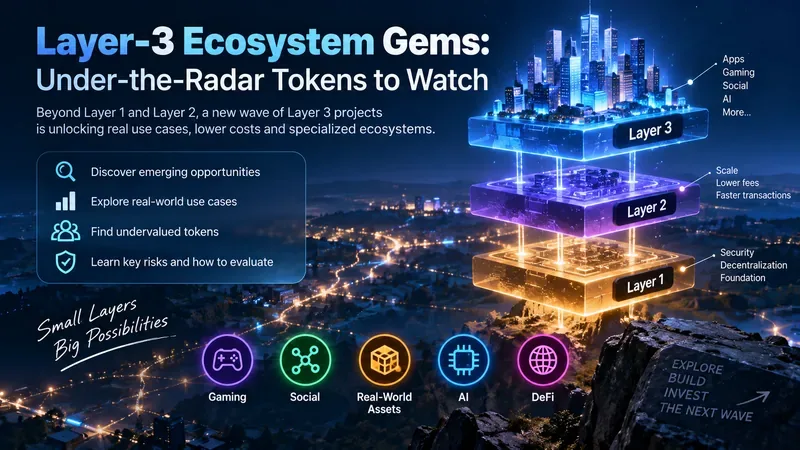
A Layer-3 research framework: the upper execution layer can specialize for applications while still depending on lower layers for scaling, settlement, data availability, or security.
Research snapshot: September 14, 2026. This is a technology and token-utility watchlist, not a ranking, price target, or investment recommendation. Crypto tokens can lose most or all of their value, and project architecture, governance, supply, liquidity, and token utility can change.
What does “Layer 3” actually mean now?
There is no single industry-wide definition. In the rollup model, a Layer-3 chain is commonly a specialized chain that settles to an L2 rather than directly to Ethereum. Arbitrum’s technology supports this kind of architecture, including L1-to-L3 bridging for chains built above Arbitrum. The current Arbitrum documentation describes configurable dedicated chains and the tooling used to launch them.
But Orbs uses the term differently. Its L3 is an enhanced execution layer that works with existing L1 and L2 smart contracts rather than asking applications to move liquidity to another rollup. The Orbs Layer-3 documentation describes the network as a decentralized backend powered by a permissionless validator set.
That distinction matters. B3, Xai, Sanko, and RARI Chain are useful examples of specialized chain-style L3s. Orbs is a useful example of service-style L3 infrastructure. A token can therefore be an L3 token without representing the same technical or economic exposure as another token on this list.
Token
L3 exposure
Primary thesis
Main question to verify
ORBS
Decentralized execution layer
Advanced onchain trading infrastructure
Does protocol usage translate into durable demand for staking and governance?
B3
Base-settled L3 plus appchain ecosystem
Consumer apps and onchain gaming
Can activity spread across appchains without fragmenting users and liquidity?
XAI
Arbitrum-powered gaming L3
Mainstream game onboarding
Do live games generate repeat players rather than incentive-driven activity?
DMT
Sanko’s Arbitrum Orbit L3 ecosystem
Gaming, media, and ecosystem membership
Can Sanko grow beyond its core community and create recurring token utility?
RARI
RARI Chain ecosystem exposure
Creator commerce and enforceable royalties
Does ecosystem value accrue to RARI while governance architecture changes?
1. ORBS: the clearest 2026 execution-layer catalyst
Why it is on the watchlist: ORBS is the strongest example here of an L3 thesis that is tied to production infrastructure rather than simply cheaper blockspace. Orbs positions its network as a decentralized execution layer for advanced onchain trading. Its protocols include dLIMIT, dTWAP, Liquidity Hub, Perpetual Hub, and dSLTP. Validators called Guardians participate in the proof-of-stake network, and ORBS is the staking asset used by that network. The official Orbs documentation explains the validator and staking model.
The 2026 change is meaningful because V5 is intended to upgrade the execution layer under those products, while OIP-9 gives the DAO onchain authority over defined protocol areas, including protocol parameters such as staking reward rates. That creates a more concrete link between tokenholders, network security, and governance than a token whose only role is branding.
What could go right: DEX integrations continue growing, advanced orders and perpetual infrastructure generate recurring protocol use, and ORBS staking remains economically important to network operation.
What could break the thesis: integrations can exist without meaningful fee capture; competitors may commoditize advanced execution; and first-party volume numbers are not the same as tokenholder cash flow. Treat the reported usage as a signal to investigate, not as proof that ORBS is undervalued.
2. B3: a Layer-3 network trying to scale horizontally
Why it is on the watchlist: B3 is unusually explicit about its architecture. Its official whitepaper describes B3 as an EVM Layer-3 blockchain settling to Base, with B3 serving as the first chain in an “Open Gaming” network that can add game-specific and app-specific chains. The B3 whitepaper explains the L3 model, while the current B3 tokenomics documentation describes token supply, governance, staking, ecosystem funding, and vesting.
Current B3 documentation has also broadened the project beyond a simple gaming chain. It now emphasizes B3OS, B3 Labs, and B3 Holdings as an operating loop around applications, workflows, and strategic ecosystem activity. That makes B3 interesting, but it also means investors should separate the token’s legally defined rights from broad ecosystem language. B3’s MiCAR whitepaper explicitly states that the B3 token is a utility token and does not represent ownership, profit-sharing rights, redemption rights, or a claim against an entity or asset.
What could go right: B3 becomes a distribution layer for many consumer apps and gamechains, and staking/governance utility becomes more valuable as the network expands.
What could break the thesis: horizontal scaling can also create fragmented liquidity and attention. In addition, B3 has a 100 billion total supply and meaningful allocations subject to vesting. Token unlocks should be checked before any decision; low unit price is not the same as low valuation.
3. XAI: a gaming L3 where product adoption matters more than the label
Why it is on the watchlist: Xai remains one of the clearest specialized gaming L3 networks. Its official site calls Xai an Arbitrum-powered Layer-3 gaming network and currently lists games including Planet X, Riftstorm, Lost Glitches, Final Form, Tarochi, and others. The project also offers Xai Connect, which abstracts wallets and social login and includes a gas-subsidy experience designed to hide transaction fees from players. See the current Xai ecosystem site and Xai Connect.
XAI also has a governance role. The Xai governance portal states that voting power aggregates owned XAI, esXAI, and staked esXAI into vXAI.
What could go right: one or more games develops durable player retention, Xai Connect meaningfully reduces Web3 onboarding friction, and ecosystem governance becomes more active as network usage grows.
What could break the thesis: gaming chains often show bursts of wallet or transaction activity that do not translate into durable demand. The critical metrics are not only transactions; they are returning users, player spending, developer retention, and whether XAI itself is required for economically important activity.
4. DMT: a small-supply token attached to Sanko’s gaming L3
Why it is on the watchlist: Sanko’s documentation describes the network as an Arbitrum Orbit Layer 3 designed for gaming and interoperable in-game economies. The network is tied to Sanko GameCorp, The Dream Machine, and Sanko.TV. Its official documentation is unusually direct about this L3 positioning.
DMT is the ecosystem token. The current tokenomics page states a total supply of 1,000,000 DMT, with allocations for the public launch, liquidity and staking rewards, Sanko Labs, development, airdrops, and other categories. It also describes DMT staking as a membership mechanism that can gate ecosystem tiers, products, events, and rewards, with a 14-day unbonding period. See the Sanko DMT tokenomics page.
There is an important limitation: as of this September 14, 2026 research snapshot, that page says it was last updated about one year ago. That makes the documented design useful, but not sufficient for a current allocation decision. Current circulating supply, emissions, active staking parameters, treasury wallets, and liquidity should be rechecked onchain.
What could go right: Sanko becomes a recognizable home for onchain games and media, while DMT’s staking and membership functions become recurring rather than promotional.
What could break the thesis: ecosystem activity remains concentrated in a small community, emissions or treasury sales overwhelm demand, or the product roadmap evolves faster than the public token documentation.
5. RARI: an L3 creator-economy thesis with a governance transition to watch
Why it is on the watchlist: RARI Chain is a creator-focused Arbitrum Orbit L3 designed to enforce creator royalties at the node level. The RARI Foundation’s architecture announcement explains why the project chose an L3 and how royalty enforcement is built into the chain. The Foundation’s current site describes RARI as the governance token for the broader Rarible ecosystem and states a 25 million total supply.
The 2026 governance context is just as important as the architecture. A RARI governance RFC proposed consolidating canonical governance on Ethereum and sunsetting the separate RARI Chain governance framework, while keeping the chain itself as infrastructure. The discussion is visible in the official RARI governance forum. Do not confuse a governance migration with a chain shutdown, but do treat it as evidence that token-control assumptions can change.
What could go right: creator commerce, royalties, marketplace activity, and Rarible’s cross-chain products create sustainable demand for governance and ecosystem incentives.
What could break the thesis: creator activity does not translate into token demand, governance becomes less economically relevant, marketplace competition intensifies, or users choose environments where royalties are optional or difficult to enforce across chains.
Which Layer-3 token has the best setup?
There is no defensible answer without defining what you want exposure to. For production DeFi execution, ORBS currently has the most concrete 2026 operating updates in this group. For consumer and gaming infrastructure, B3 and XAI offer broader distribution theses. DMT is a more concentrated Sanko ecosystem bet. RARI is the most specific creator-economy thesis and also the one where governance changes deserve especially close monitoring.
The better comparison is not “which ticker is cheapest?” It is “which token has the strongest measurable link between network success and token demand?” A project can have excellent technology while its token captures little of that success.
What should you verify before adding an L3 token to a watchlist?
Settlement path: identify exactly where the L3 settles and what bridge, data-availability, sequencer, and challenge assumptions users inherit.
Token necessity: determine whether the token secures validators, pays fees, governs parameters, unlocks products, or is merely an incentive asset.
Value capture: distinguish protocol revenue from tokenholder revenue. They are not automatically the same.
Organic usage: prefer recurring users, fees, retained developers, and repeat application activity over one-time airdrop or campaign spikes.
Bridge and sequencer risk: a cheaper execution layer can introduce additional dependencies. Read the chain’s current security model rather than assuming “inherits Ethereum security” means identical risk to Ethereum.
Governance reality: verify who can upgrade contracts, pause bridges, change validators, alter fees, or spend treasury assets today—not what an old roadmap promised.
Liquidity: under-the-radar tokens can have thin order books and large slippage. A strong thesis does not guarantee an executable entry or exit.
The bottom line
Layer 3 is becoming more useful as a category only if you split it into its actual architectures. In 2026, the strongest signal is that specialized execution is moving into production: Orbs is expanding a live trading stack, B3 is building a Base-settled L3 plus appchain ecosystem, Xai continues to target frictionless gaming, Sanko remains a focused gaming and media L3, and RARI Chain continues to test the creator-economy case for application-specific execution.
That does not make ORBS, B3, XAI, DMT, or RARI automatic buys. It makes them useful research subjects. The winning L3 token, if there is one, will need more than low fees and a compelling narrative. It will need durable application demand, a security model users accept, sensible supply dynamics, and a token whose economic role becomes stronger as the network succeeds.
Risk note: This article is for informational and educational purposes only. It does not provide financial, investment, legal, or tax advice. Digital assets are highly volatile and speculative; verify current contracts, token supply, governance, liquidity, and security documentation before taking action.