Home
» Project analysis
»
Sei Explained: Trading-Focused Architecture, Fees, and the Metrics That Show Real Usage
Sei Explained: Trading-Focused Architecture, Fees, and the Metrics That Show Real Usage
What should you understand about Sei before judging it?
Sei is an EVM-compatible Layer 1 blockchain built around a simple product goal: make onchain applications, especially trading and other latency-sensitive financial apps, feel responsive even when many users are active at once. That goal matters more than any single headline throughput number. A good evaluation should answer three practical questions: does the architecture reduce execution bottlenecks, are transaction costs predictable enough for real applications, and do onchain metrics show repeat usage rather than short-lived bursts?
As of September 30, 2026, Sei is also in the middle of a major protocol transition. Parts of the Giga upgrade are already on mainnet, while other parts remain on the roadmap. The network therefore should be evaluated as a live system that is changing in stages, not as if every advertised Giga feature is already fully deployed. The official Sei Giga roadmap is the most useful source for checking which pieces are complete, in progress, or still coming.
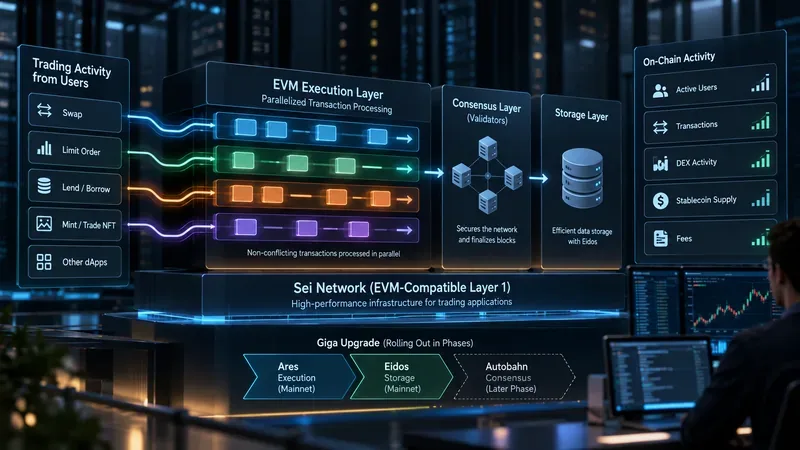
Sei’s design can be read as a pipeline: applications create transactions, the EVM executes work in parallel where possible, validators finalize blocks, storage keeps state and history, and usage should be judged with activity, volume, stablecoin, and fee metrics rather than throughput claims alone.
Why is Sei described as trading-focused?
The trading focus comes from the kind of workload Sei is designed to handle. Trading applications often generate bursts of independent actions: swaps, order updates, liquidations, collateral changes, oracle-driven transactions, and account management. A chain that processes unrelated work one transaction at a time can become a bottleneck during periods of demand. Sei’s EVM uses optimistic parallel execution so transactions that do not conflict on state can execute concurrently. When transactions touch overlapping state, the system detects the conflict and re-executes as needed to preserve deterministic results.
That design was introduced with Sei v2, which went live in July 2024. The official Sei v2 technical overview explains the optimistic-parallel model and the storage changes that accompanied it. For application teams, the important outcome is not merely “more TPS.” The useful result is that unrelated workloads have a better chance of progressing without blocking one another, while developers can still use familiar EVM contracts and tooling.
There is an important limit, however. Parallel execution does not make every application parallel. If many transactions repeatedly modify the same contract storage slots, a large share of that workload may still serialize. A heavily contested order book, auction, or liquidation contract can therefore have very different performance from a workload made of independent accounts and contracts. The right test is to benchmark the actual contract path, not to assume that chain-level parallelism automatically removes application-level contention.
What is live now, and what is still part of the Giga roadmap?
Sei’s current architecture is best understood as a phased migration. In August 2026, the first phase of Eidos reached mainnet as part of v6.6. Eidos is the storage track of Giga, intended to separate and optimize the data paths used for live state, historical data, receipts, logs, blocks, and transactions. The official Eidos mainnet update states that the first phase moved EVM state toward its own database and shipped a rebuilt pruning path, while larger storage changes remain for later releases.
Ares is the execution track. Sei’s July 2026 release announcement says Ares becomes the default execution path in v6.6, while the previous v2 engine remains available as a transaction-level fallback and as a reference implementation for comparison. That is a useful engineering signal because it separates a new performance path from the safety mechanism used when an edge case appears. The official v6.6 Ares and Eidos announcement describes this rollout.
Autobahn, the new multi-proposer consensus design, is not something readers should treat as fully deployed mainnet infrastructure yet. The current Giga roadmap still lists Autobahn testnet and mainnet as later milestones. That distinction matters because some of Sei Giga’s highest headline performance targets depend on the future consensus design, not only the execution and storage upgrades already shipping.
How should you think about fees on Sei?
Sei uses gas to meter computation, and users pay transaction fees in SEI. At a basic level, the user experience still resembles other EVM networks: a transaction has a gas limit, a fee-per-gas setting, and an effective fee based on the work consumed and the network’s fee rules. The official Sei gas documentation recommends estimating gas before submitting transactions and checking live network parameters rather than hard-coding assumptions.
There is a reason to be careful with simple comparisons to Ethereum. Sei’s EVM is compatible with Ethereum tooling, but it is not identical in every protocol detail. The official EVM differences page documents differences in finality, state representation, gas behavior, and transaction handling. In addition, Sei’s open-source code has been changing during the Giga rollout, including fee validation and base-fee handling in the current sei-chain repository.
That creates a practical rule: do not copy an old gas-price constant from a blog post or an older integration. Query the live RPC, estimate gas for the exact call, and monitor the effective gas price actually paid. Documentation written before a major network upgrade can lag implementation details, especially during an active migration. For production systems, record gas used, effective gas price, failed-transaction rate, and p95 transaction cost over time. Those measurements show whether the fee experience is stable enough for the application you are building.
Which metrics best show real usage?
Raw transaction count is useful, but it is not enough on its own. A chain can show very high transaction numbers because of bots, low-cost repetitive calls, airdrop farming, inscriptions, internal maintenance, or a small number of highly active accounts. A better view combines several independent signals.
Metric
What a healthy result looks like
What can mislead you
Monthly active users
Users remain active across multiple months, not only around incentives
Wallet creation campaigns can inflate one-time activity
Daily transactions
Transaction growth is accompanied by user and application growth
Automated bots can create large counts with little economic value
DEX volume
Volume persists across several venues and market conditions
Incentivized or wash-like activity can temporarily raise volume
Stablecoin supply
Supply grows alongside transfers, trading, payments, or lending usage
Bridged supply that sits idle says little about active demand
Fees paid
Fees rise moderately with genuine usage while transactions remain affordable
Very low fees alone do not prove demand
Application concentration
Usage is spread across several meaningful apps
One dominant bot or app can make chain-wide totals look stronger than they are
Sei’s official network pages expose several of these categories, including cumulative transactions, monthly users, stablecoin supply, daily active addresses, daily transactions, and DEX volume. The Sei network data page also discloses the underlying providers used for some dashboards, such as Dune and DefiLlama. Because these figures can change daily, this article does not freeze a current number that may be stale by the time you read it.
How do you tell whether usage quality is improving?
Look for confirmation across multiple time horizons. Over 7 days, watch whether transaction activity and fees are stable or dominated by a single event. Over 30 days, compare monthly active users with transaction count and DEX volume. Over 90 days, check whether stablecoin supply, active applications, and repeat users are moving in the same direction. If only one metric rises while the others stay flat, investigate before treating it as evidence of broader adoption.
For a trading-focused chain, one particularly useful ratio is economic activity per active user. You do not need a universal target. Instead, track whether DEX volume, lending activity, or payment flow per recurring user is becoming more durable without an equally large rise in incentives. Another useful test is application diversity: if three or four independent apps continue to generate real volume and repeat users, the network is less dependent on a single growth engine.
When should you change your evaluation approach?
Change your approach when the network itself changes. During the Giga rollout, old performance assumptions may become less relevant after a major execution, storage, or consensus upgrade. Re-baseline latency, fees, RPC reliability, and contract behavior after each major release. For developers, that means rerunning load tests against the current mainnet client rather than relying on a benchmark produced on an earlier devnet.
You should also change approach if aggregate metrics stop matching application-level evidence. If monthly users rise but your target application category shows no retention, move from chain-wide dashboards to contract-level analysis. If transaction count surges but fees, stablecoin activity, and DEX volume do not, inspect whether the increase comes from low-value automated traffic. If DEX volume rises while active users fall sharply, determine whether a small number of larger accounts are driving the change.
What are the main limits of a Sei evaluation today?
The first limit is version drift. Sei is actively shipping Giga components, so statements about execution, storage, consensus, and fees can age quickly. Always attach a date or network version to technical conclusions. The second limit is that capacity is not the same thing as demand. A chain can process far more activity than users currently generate. Performance headroom is valuable, but it should not be confused with adoption.
The third limit is that third-party usage dashboards use their own definitions. “Active user,” “wallet,” “transaction,” and “DEX volume” can be counted differently across providers. When a number matters to a decision, open the methodology and confirm what is actually being measured. The fourth limit is application contention: parallel execution helps most when transactions do not compete for the same state. High-level throughput figures cannot substitute for contract-specific testing.
A practical standard for judging Sei
A strong outcome from researching Sei is not memorizing a TPS figure. It is being able to explain which performance features are already on mainnet, which remain on the roadmap, how the live fee system behaves for your transactions, and whether usage is broad, repeatable, and economically meaningful. If those four answers are clear, you can evaluate Sei on evidence rather than marketing language.
For current status, start with the Giga roadmap, then confirm EVM behavior in the official Sei EVM documentation, and finally compare technical capacity with the live metrics surfaced on Sei’s official network site. Recheck those sources after major upgrades, because the most useful conclusion about a fast-moving protocol is one tied to the version that is actually running.