Home
» Project analysis
»
Top 5 Micro-Cap Crypto Gems Under $50M with 100x Potential: A Risk-First 2026 Watchlist
Top 5 Micro-Cap Crypto Gems Under $50M with 100x Potential: A Risk-First 2026 Watchlist
Bottom line: no credible analyst can promise that a micro-cap cryptocurrency will rise 100x. What can be done is to identify projects with a small current valuation, a product that already exists, a plausible source of token demand, and clear milestones that would either strengthen or break the investment thesis. Using a market-cap screening snapshot from September 12, 2026 UTC, the five projects below were all below $50 million: Acurast (ACU), Nosana (NOS), ANyONe Protocol (ANYONE), Hivemapper (HONEY), and DIMO (DIMO).
The phrase “100x potential” therefore means a highly speculative upside scenario worth testing, not a forecast. Market caps and prices move continuously, and some names can cross the $50 million line in a single session. Recheck live circulating supply, price, liquidity, and token unlocks before making any decision. Micro-cap tokens can lose most or all of their value, and thin liquidity can make exiting much harder than entering.
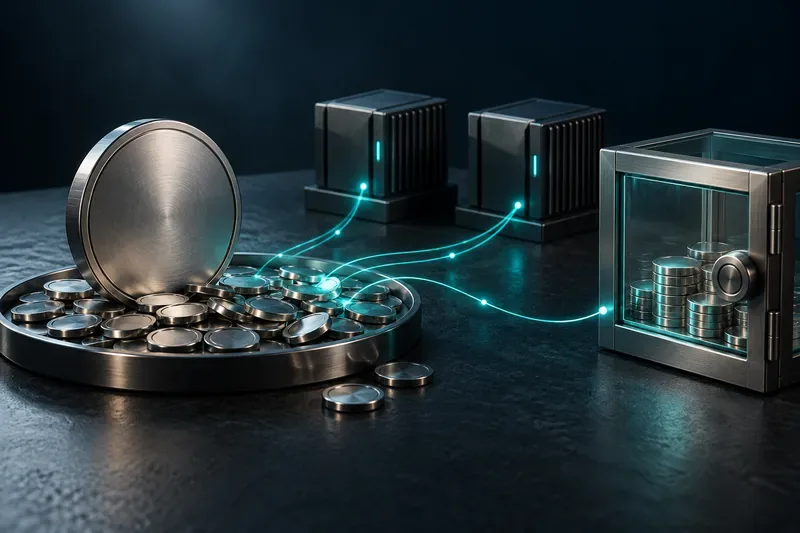
A research-themed view of the central micro-cap trade-off: small valuations can create large upside mathematically, but the outcome depends on utility, execution, token economics, liquidity, and risk control. The category icons are conceptual rather than depictions of the five shortlisted tokens.
Can a sub-$50M crypto realistically rise 100x?
Mathematically, yes. Probabilistically, it is rare. A simple 100x calculation also hides dilution: if circulating supply expands while the token price rises, the future market capitalization could be much larger than today’s market cap multiplied by 100. Fully diluted valuation, emissions, vesting, and treasury releases matter.
Project
Token
Approx. market cap snapshot
Naive 100x market-cap equivalent*
Core thesis
Acurast
ACU
$46.1M
$4.61B
Verifiable decentralized compute from smartphones
Nosana
NOS
$29.2M
$2.92B
Permissionless GPU marketplace for AI workloads
ANyONe Protocol
ANYONE
$19.2M
$1.92B
Decentralized privacy routing and relay incentives
Hivemapper
HONEY
$9.4M
$940M
Decentralized sensor, mapping, and edge-data marketplace
DIMO
DIMO
$4.0M
$400M
Open, permissioned vehicle-data infrastructure
Note: Illustrative multiplication of the September 12, 2026 circulating-market-cap snapshot. It ignores future issuance, burns, vesting changes, and other supply effects. The figures are not price targets.
What questions matter before considering any micro-cap?
The first question is not “how high can it go?” It is “what must become true for the token to be worth materially more?” A useful screen asks whether the product works today, whether customers or developers actually need it, whether token demand grows with network usage, how much supply can still enter circulation, and whether liquidity is deep enough to support a realistic exit.
Product: Is there a usable network, API, app, or developer platform rather than only a roadmap?
Value capture: Does greater usage require, burn, lock, stake, or otherwise create demand for the token?
Supply: Are emissions and unlocks small enough that demand can plausibly outrun dilution?
Evidence: Can usage claims be checked through official documentation, public software, governance records, or on-chain activity?
Failure condition: Is there a specific metric or event that would tell you the thesis is wrong?
1. Acurast (ACU): Can smartphones become credible cloud infrastructure?
Why it made the list: Acurast is unusually differentiated among decentralized-compute projects. Instead of building around traditional data-center GPUs, it uses smartphones as compute providers and relies on hardware-backed Trusted Execution Environments (TEEs) for verifiable and confidential execution. Its current documentation says developers can deploy APIs, scheduled jobs, web workloads, and LLM inference, and can pay with ACU or USDC. Acurast also reports roughly 300,000 compute units onboarded and availability across 175-plus countries. Those figures are project-reported, so they should be treated as claims to monitor rather than independent audits.
The official Acurast documentation is particularly useful because it exposes both developer and compute-provider workflows rather than only marketing pages. The token has concrete roles in deployment fees, network fees, rewards, staking, and network operation. The official tokenomics page states an initial supply of 1 billion ACU and fixed annual inflation of 5%, while also detailing team, early-backer, treasury, liquidity, and community allocations.
What would have to go right for the upside thesis?
Acurast would need to turn device supply into paid workload demand. The strongest signal would not be more registered phones by itself; it would be rising paid deployments, recurring developer usage, and economic activity that makes ACU useful beyond rewards. A multibillion-dollar valuation would require Acurast to become meaningful infrastructure in a competitive cloud and AI-compute market.
What could break the thesis?
Smartphones have real limitations in sustained performance, networking, thermal management, and workload compatibility. Acurast must also prove that demand can grow faster than token inflation and incentive costs. At roughly $46 million in the screening snapshot, it is already close enough to the $50 million cutoff that it may no longer qualify when you read this.
2. Nosana (NOS): Can decentralized GPUs win recurring AI workloads?
Why it made the list: Nosana focuses on an easy-to-understand problem: connecting AI workloads with distributed GPU supply. Its official documentation provides deployment, API, CLI, SDK, and GPU-hosting paths. Users can create and manage inference deployments, while GPU providers can join the grid and earn NOS.
That direct link between compute consumption and the native asset is important. The official NOS token page lists a total supply of 100 million tokens and documents allocations for public sale, airdrops, liquidity, team, company, mining, and backers. The published release schedules give researchers something concrete to model rather than forcing them to guess about supply.
What would have to go right for the upside thesis?
Nosana needs sustained demand from developers who choose its GPU marketplace for cost, accessibility, or workflow advantages—not merely because token incentives make supply cheap. Watch for repeat deployments, higher-value inference workloads, reliable host performance, and evidence that network revenue can support suppliers without excessive token subsidies.
What could break the thesis?
Decentralized compute is crowded. Centralized clouds have mature tooling and service guarantees, while larger crypto compute networks can compete for the same suppliers and customers. At a roughly $29 million market cap, a 100x outcome would imply a multibillion-dollar network. That would require a step-change in real usage, not just a return of speculative interest in AI tokens.
3. ANyONe Protocol (ANYONE): Can decentralized privacy become a mainstream product?
Why it made the list: ANyONe Protocol is building a privacy-routing network in which traffic is encrypted and passed across multiple relays rather than through one centralized VPN operator. The official Anyone site currently reports more than 7,500 active network nodes, more than 4,000 distinct locations or IPs, and more than 66,000 NPM installs. These are self-reported operational metrics, but they are more useful than vague community-size claims because they can be tracked over time.
The official tokenomics documentation describes ANYONE as part of the relay incentive, access, payment, staking, and governance system. Its token reference lists a fixed total supply of 100 million ANYONE on Ethereum. Current documentation also specifies locking requirements for ordinary software relays and a reward system tied to network participation.
What would have to go right for the upside thesis?
The key transition is from an incentivized relay network to a privacy service people and applications pay to use. Growth in active nodes is encouraging only if end-user traffic, SDK integrations, premium circuits, and protocol revenue scale with it. A roughly $1.9 billion naive 100x valuation would require the network to become a recognizable privacy infrastructure layer, not just a niche VPN alternative.
What could break the thesis?
Privacy networks compete on security, speed, reliability, trust, and usability simultaneously. Security claims should be independently audited rather than accepted from marketing alone. Regulatory pressure, abuse by malicious users, weak paid demand, or a relay network that grows faster than actual traffic could all weaken the token thesis.
4. Hivemapper (HONEY): Is the sensor-marketplace pivot creating better token demand?
Why it made the list: Hivemapper began as a decentralized street-level mapping network, but its model has continued to evolve. Its privacy policy, updated May 5, 2026, says the network shifted toward a marketplace in which developers commission data through Work Orders and data can flow directly from contributing devices to developers. That shift matters because it broadens the thesis from “build another map” toward a marketplace for distributed sensors and edge compute.
The official Hivemapper documentation explains how contributors collect data and how developers consume network output. More importantly for token value capture, the HONEY burn-and-mint documentation states that map-data consumption requires Map Credits created by burning HONEY. Under the described model, 75% of HONEY used for data consumption is permanently burned and 25% is re-minted as Map Consumption Rewards, subject to a weekly cap.
What would have to go right for the upside thesis?
Hivemapper needs developer-paid Work Orders and data consumption to become a durable demand engine. If customers repeatedly pay for fresh street imagery, device-model outputs, or other sensor workloads, HONEY has a clearer path from network activity to token demand than many reward-only DePIN tokens. From a roughly $9.4 million market-cap snapshot, the naive 100x equivalent is under $1 billion, but reaching it would still require substantial commercial adoption.
What could break the thesis?
Hardware deployment is expensive, mapping data must remain fresh and accurate, and privacy rules vary across jurisdictions. The network also competes with deeply capitalized mapping and geospatial providers. A token-burn mechanism is useful only when paying customers create enough demand for the underlying data.
5. DIMO (DIMO): Can open vehicle data become a real infrastructure layer?
Why it made the list: DIMO has the smallest market cap in this screen, but it also has a tangible product. The official DIMO site describes a permissioned vehicle-data platform covering more than 50 vehicle brands, with real-time telemetry, vehicle identity, owner consent, GraphQL and REST APIs, and official TypeScript, Python, and C# SDKs. Developers can build applications around signals such as location, battery or fuel level, odometer readings, tire pressure, and diagnostic trouble codes.
A useful piece of evidence is DIMO’s published 2026 methodology for a real vehicle-data case study. It documents 3,938,654 raw signals across 19 signal types collected from one authorized vehicle over a 263-day observation window. That is not proof of network-wide commercial scale, but it does demonstrate that the stack can produce a large, permissioned telemetry dataset in practice.
What would have to go right for the upside thesis?
DIMO needs to become a useful common layer between vehicles and services such as maintenance, charging, insurance, rentals, fleets, and AI agents. The most important evidence would be growing developer usage and paid data access that can be connected clearly to DIMO-token demand. At roughly $4 million in the snapshot, the naive 100x equivalent is about $400 million—mathematically the least demanding valuation leap in this group.
What could break the thesis?
The biggest unresolved issue is not whether connected-car data is useful; it is whether that utility accrues strongly enough to the token. Product adoption and token appreciation are not the same thing. DIMO also has very thin market liquidity relative to larger crypto assets, which increases slippage, volatility, and exit risk. Any serious thesis should separate “I like the product” from “the token captures the product’s value.”
Which project has the clearest path to proving—or disproving—the thesis?
Rather than choosing a “winner” from price narratives, compare measurable evidence. Acurast and Nosana can be judged by paid compute utilization and repeat deployments. ANyONe can be judged by real traffic, application integrations, and paid privacy demand. Hivemapper can be judged by Work Orders, data consumption, and HONEY burned through actual customer use. DIMO can be judged by developer adoption, vehicle sessions, paid data activity, and whether those economics create durable DIMO-token demand.
Project
Best evidence to monitor
Red flag
Acurast
Paid deployments and recurring compute demand
Compute supply grows while customer usage stagnates
Nosana
Recurring AI inference jobs and host utilization
Rewards dominate economics while paid jobs remain weak
ANyONe
User traffic, SDK integrations, premium demand
Relay count rises without corresponding network usage
Hivemapper
Developer Work Orders, data consumption, token burns
Product grows but token value capture remains weak
How should you verify the “under $50M” cutoff before acting?
Do not rely on an article snapshot for a trading decision. Micro-cap valuations can change by tens of percent quickly, and circulating-supply data can be revised. Before considering any token, verify the official contract address from the project’s own documentation, then cross-check circulating supply and price with more than one reputable market-data source or blockchain explorer.
Compare circulating market cap with fully diluted valuation; a cheap-looking circulating cap can hide large future supply.
Read the official vesting and emission schedule. Pay special attention to team, investor, treasury, mining, and reward allocations.
Check actual order-book or DEX liquidity, not only reported 24-hour volume.
Confirm that the official documentation, software repositories, and network dashboards are still active.
Look for security audits and incident history. A working product can still fail because of contract, bridge, wallet, or infrastructure risk.
Define the thesis-breaking condition before entering. If the evidence deteriorates, a low market cap is not a reason to keep holding.
What does “100x potential” really mean here?
It means the starting valuation is small enough that an extreme upside outcome is mathematically possible if the project captures a large market. It does not mean the outcome is likely. A 100x result generally requires several things to happen together: the product survives, adoption compounds, the sector remains relevant, token economics capture that growth, dilution stays manageable, security holds, regulators do not shut down the model, and the broader crypto market supplies enough liquidity and risk appetite.
That is why the best use of a list like this is to build a monitoring dashboard, not a shopping cart. Track product activity and token supply for months. Let the project earn conviction through evidence.
Final take
If the goal is to research micro-cap crypto with asymmetric upside, these five are more interesting because each has a concrete product thesis that can be tested: Acurast for smartphone-powered confidential compute, Nosana for distributed AI GPUs, ANyONe for decentralized privacy routing, Hivemapper for distributed sensors and data, and DIMO for permissioned vehicle infrastructure.
None deserves a 100x assumption. The most valuable question is not “which one will moon?” but “what evidence would justify a valuation 10, 20, or 100 times larger than today?” Keep that question tied to real usage, token value capture, supply, and liquidity, and micro-cap research becomes far more disciplined. This article is educational research, not personalized financial advice or a recommendation to buy any token.