Home
» Project analysis
»
Top RWA Altcoins With Massive Upside Potential? 5 Tokens Worth Watching in 2026
Top RWA Altcoins With Massive Upside Potential? 5 Tokens Worth Watching in 2026
The hardest part of investing in the real-world asset narrative is not finding projects that mention tokenization. It is figuring out whether growth in tokenized Treasuries, private credit, securities, commodities, or other assets can actually create durable demand for the altcoin you are buying. Those are two very different questions.
That distinction matters more in 2026 because tokenization is moving further into regulated finance. In January 2026, the U.S. Securities and Exchange Commission published a statement on tokenized securities explaining that a security does not stop being a security merely because ownership is represented on a crypto network. Investor.gov also emphasizes that tokenized securities can use different legal structures and may give holders very different rights depending on whether the token is issuer-sponsored, custodial, or synthetic.
So the phrase “massive upside potential” should be treated as a research question, not a forecast. An RWA altcoin can rise dramatically, fall dramatically, or underperform even while the underlying tokenization sector grows. This article identifies five tokens with credible exposure to the RWA theme and, more importantly, explains what would have to go right for that exposure to matter to token holders. All project and token information was checked against primary sources on September 14, 2026. This is general information, not individualized investment advice.
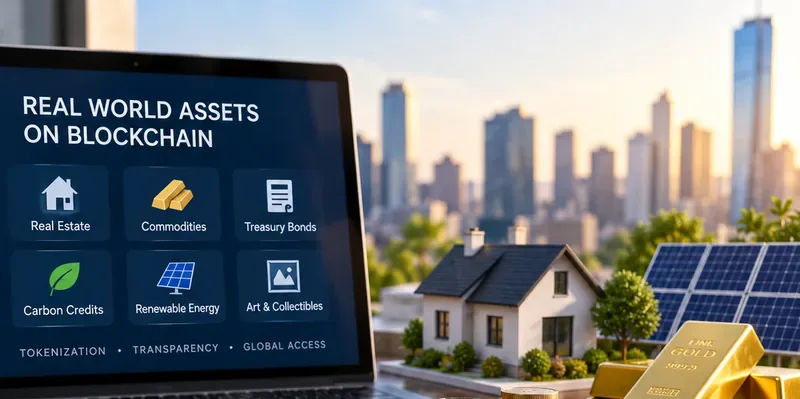
Real-world asset tokenization can cover property, commodities, Treasury securities, renewable-energy infrastructure, and other assets; the investment case for an RWA altcoin depends on how that activity connects back to its token.
An illustrative example: Maya builds an RWA watchlist, not a shopping list
Consider a hypothetical investor named Maya. This is an illustration only, not a real portfolio, testimonial, recommendation, or backtest. Maya already has a diversified financial plan and sets aside a small speculative crypto budget she can afford to lose. She is interested in RWA altcoins, but she refuses to buy a token merely because the project has a partnership announcement or a large “assets tokenized” number.
Instead, Maya gives every candidate five tests: Is there verifiable real-world adoption? Does the token have a credible role in the system? Is there a mechanism that can translate usage into token demand or value capture? Is dilution manageable? And what specific evidence would invalidate the thesis?
That framework produces a more useful shortlist than simply ranking coins by recent price performance.
Service revenue can be converted into LINK through Payment Abstraction and accumulated in the Chainlink Reserve
RWA growth may not translate into enough incremental fee demand to justify the token's valuation
ONDO
Governance around the Ondo ecosystem and Flux; exposure to a major tokenization brand
Ondo is expanding tokenized Treasuries and securities infrastructure
ONDO does not give holders a verified direct claim on Ondo Finance product revenue; large locked supply matters
SYRUP
Maple governance and staking around onchain institutional credit
Maple publishes protocol revenue and token buybacks, giving the token a more observable value-capture path
Credit losses, lower loan demand, or weaker revenue can quickly weaken the thesis
CFG
Centrifuge tokenization infrastructure and ecosystem token
Centrifuge says more than $2 billion in real-world assets have been tokenized through its platform
Value capture and governance remain less direct, while additional CFG is still vesting
PLUME
Native token of an RWA-focused network
Gas, staking, governance, and an ecosystem specifically built around RWA finance
High ecosystem incentives, token supply distribution, and competition can dilute the benefit of adoption
1. Chainlink (LINK): the “picks and shovels” RWA thesis
LINK is not a pure-play tokenized-asset coin. That is exactly why it deserves a place near the top of an RWA watchlist. Tokenized securities and funds need trusted pricing, reserve data, identity/compliance inputs, lifecycle automation, and the ability to move information and value across multiple chains and traditional systems. Chainlink positions its platform as infrastructure for those functions, including data services, Proof of Reserve, CCIP interoperability, and its Digital Transfer Agent standard. Its official tokenized-assets page cites a live UBS Tokenize and DigiFT fund subscription/redemption transaction using Chainlink DTA.
The more important point for an altcoin investor is token economics. Chainlink's economics page says LINK is used for service payments and cryptoeconomic security. Payment Abstraction can convert enterprise and onchain service revenue into LINK, and the Chainlink Reserve accumulates LINK funded by those revenue sources. When checked on September 14, 2026, the page showed more than 5 million LINK in the Reserve, more than 42 million LINK staked, roughly 748 million LINK circulating, and a 1 billion maximum supply.
Common misconception: LINK is not a share of Chainlink, nor is every tokenized RWA transaction automatically a LINK purchase. The bullish case depends on Chainlink winning meaningful paid usage and its economic mechanisms continuing to route enough of that usage into LINK demand.
Maya's action: she would monitor growth of paid services and the Chainlink Reserve, not just partnership counts. If institutional integrations expand while Reserve accumulation and fee-linked demand stagnate, she would downgrade the thesis.
2. Ondo (ONDO): strong RWA exposure, but do not confuse the token with the assets
Ondo is one of the clearest names associated with tokenized Treasuries and tokenized securities. In July 2026, Ondo Finance announced the launch of custodial tokenized U.S. securities in the United States, with Broadridge supporting governance, proxy voting, and shareholder communications. Ondo also operates products such as OUSG and USDY and has built infrastructure for tokenized public securities.
But ONDO itself must be analyzed separately. The Ondo Foundation's token distribution and governance documentation describes ONDO as a governance token for the Ondo DAO, including rights related to Flux Finance, treasury management, emissions, and other DAO functions. It lists a maximum supply of 10 billion ONDO. I could not verify from the cited official materials that holding ONDO gives a contractual claim on revenue from OUSG, USDY, Ondo Global Markets, or Ondo Finance as a company.
Supply is also central to the valuation question. The Ondo Foundation Group disclosed that, as of August 26, 2026, it controlled 4,422,519,707 locked ONDO. That disclosure does not by itself tell you future market selling, but it is a reminder that circulating market capitalization alone can understate eventual token supply.
Common misconception: buying ONDO is not the same thing as buying tokenized Treasuries or tokenized stocks. Those are separate instruments with separate legal rights and risk structures.
Maya's action: she would track whether ONDO receives additional durable utility or value-capture mechanisms and compare that progress with the unlock schedule. If Ondo's asset platform grows quickly but the governance token remains economically detached from that growth, she would not assume the token must follow the business.
3. Maple (SYRUP): an RWA credit token with measurable revenue and buybacks
SYRUP is one of the more interesting RWA-related tokens because Maple publishes operating metrics that can be compared with token activity. Maple focuses on onchain credit and institutional lending rather than tokenized real estate or equities. Its official Transparency page, checked September 14, 2026, displayed about $4.65 billion in assets under management and $22.15 million in revenue over the preceding 12 months. The same page reports monthly SYRUP buybacks, including purchases in June, July, and August 2026.
Maple's August 2026 update also said its newly launched syrupUSDG had expanded and was being used as collateral behind Robinhood Earn. That is relevant because the RWA thesis here is not simply “put a bond onchain.” It is that regulated or institutionally underwritten credit products can become reusable building blocks inside fintech and DeFi distribution.
SYRUP also has governance and staking functionality. However, Maple's own legal documentation makes clear that staking does not carry a contractual or promised return. That distinction is useful: protocol buybacks and governance decisions can support token economics, but they are not the same as a bond coupon or a shareholder dividend.
Common misconception: high AUM is not automatically high token value. Credit protocols can grow assets while margins compress, defaults rise, or incentives increase.
Maya's action: she would watch loan performance, AUM quality, protocol revenue, the net interest margin, and completed buybacks. If AUM keeps rising but revenue quality weakens or credit losses increase materially, the headline growth would no longer be enough.
4. Centrifuge (CFG): institutional tokenization adoption with a less-settled value-capture story
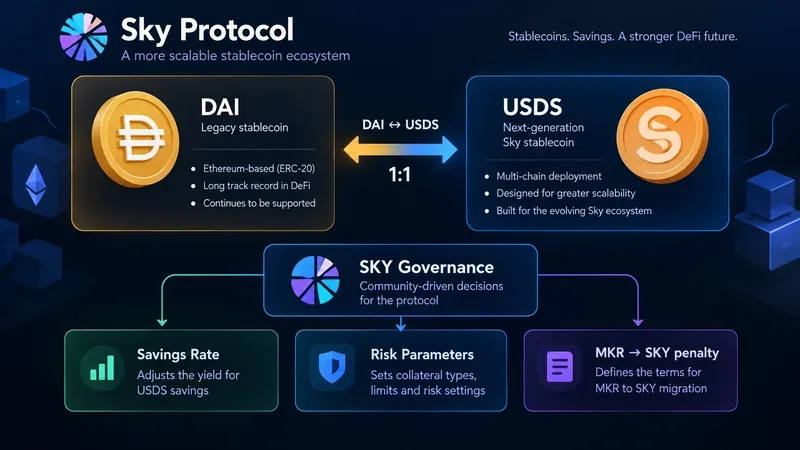
Centrifuge has strong evidence of actual RWA infrastructure adoption. Its current official documentation says more than $2 billion in real-world assets have been tokenized through the platform and names institutional strategies involving Apollo, Janus Henderson, and S&P Dow Jones Indices. It also highlights integrations with DeFi protocols including Sky, Aave, and Morpho.
The token thesis is more nuanced. Centrifuge's CFG tokenomics page states that total supply was 697,164,473 CFG as of June 2026. Of the 115 million tokens introduced under CP149, 100 million vest linearly through April 2029. That is a meaningful dilution variable that should be modeled rather than ignored.
Governance is another area where old assumptions can be wrong. Centrifuge's governance documentation says active DAO governance was paused under CP171 in late 2025, with execution shifted under Centrifuge Network Foundation supervision. A late-August 2026 governance-forum RFC proposed restoring holder approval over a limited set of fundamental decisions, but an RFC is not the same as an implemented change.
Common misconception: “billions tokenized” does not mean billions of dollars of value accrue to CFG holders. Platform adoption, fees, treasury policy, governance rights, and token supply must connect for that to happen.
Maya's action: she would wait for clearer evidence that protocol growth produces recurring economic value for CFG and would model scheduled vesting through 2029. If fee capture remains weak while supply expands, she would reduce the token's score even if tokenized assets continue to grow.
5. Plume (PLUME): a higher-beta bet on an RWA-native network
Plume is the most speculative name in this five-token group, but it has a straightforward thesis: build a blockchain ecosystem where tokenized real-world assets are not a side product but a central use case. The project's February 2026 update said Plume had more than 280,000 RWA holders and about $645 million in RWAs at that time. Its current vault product describes exposure to regulated real-world assets such as U.S. Treasuries and private credit, with different redemption conditions depending on the underlying strategy.
PLUME has a clearer native-network role than a pure governance token. The official token documentation lists gas fees, governance, staking, and ecosystem incentives among its uses. The same documentation states a 10 billion total supply, with 20% initially circulating at the token-generation event; 59% was allocated to community/ecosystem/foundation purposes, 21% to early backers, and 20% to core contributors.
That combination creates both opportunity and risk. If Plume becomes a major venue for RWA issuance, trading, collateral, and yield strategies, native network demand could grow. But large incentive allocations can also support activity that disappears when rewards decline, and token unlocks can overwhelm organic demand.
Common misconception: a network can lead in RWA wallets or TVL without its native token necessarily outperforming. Incentives, gas design, staking participation, fee levels, and supply growth determine how much ecosystem activity translates into token demand.
Maya's action: she would separate incentive-driven activity from organic activity. She would track transaction fees, recurring vault usage, active applications after reward campaigns end, and supply unlocks. PLUME would remain a higher-risk candidate until those metrics show durable demand.
Which RWA altcoin has the best upside?
There is no defensible way to name a universal winner without considering current valuation, future dilution, risk tolerance, time horizon, and the investor's broader portfolio. “Upside” is a ratio between what a token could become and what the market already prices in. A great protocol can be a poor investment if expectations are already too high; a smaller project can produce spectacular returns or fail entirely.
For Maya's hypothetical watchlist, the five tokens represent different bets rather than interchangeable competitors:
LINK is the infrastructure thesis: benefit if tokenized finance needs common data and interoperability standards and paid usage flows into LINK economics.
ONDO is the direct tokenization-ecosystem thesis: benefit if Ondo keeps expanding, but token utility must catch up with product success.
SYRUP is the institutional-credit thesis: benefit if Maple grows high-quality lending revenue and continues transparent value capture.
CFG is the tokenization-platform thesis: benefit if institutional adoption ultimately translates into clearer fees and CFG economics.
PLUME is the higher-beta RWA-network thesis: benefit if ecosystem activity becomes organic enough to outgrow incentives and supply expansion.
How Maya would test the thesis before risking money
The hypothetical example becomes useful only if it produces falsifiable checks. Maya does not set a price target first and search for reasons to justify it. She records a small set of operating indicators and reviews them periodically.
Question
Evidence that strengthens the thesis
Evidence that weakens it
Is RWA adoption real?
Growing assets, transactions, users, issuers, or credit activity confirmed by primary sources
Growth dominated by temporary incentives or unverified announcements
Does the token capture value?
Fees, buybacks, staking security, gas demand, or governance with measurable economic relevance
Platform growth with no observable connection to the token
Is supply manageable?
Transparent emissions and demand growing at least as fast as effective supply
Large unlocks, inflation, or incentive issuance without corresponding organic demand
Is the legal structure understandable?
Clear issuer, custody, redemption, investor rights, and compliance disclosures
Unclear rights, synthetic exposure presented as ownership, or ambiguous redemption
Can the thesis be invalidated?
Specific metrics and dates that would trigger a reassessment
Only narrative-based reasons to keep holding regardless of evidence
RWA does not eliminate crypto risk
One of the most dangerous assumptions is that attaching an altcoin to “real-world assets” makes the altcoin behave like the underlying Treasury bill, loan, building, or fund. It does not. The SEC's 2026 guidance emphasizes that the legal rights attached to tokenized securities depend on structure, while Investor.gov's crypto-asset investor alert warns about volatility, illiquidity, custody failures, technological risks, and the potential lack of investor protections.
There are also risks specific to RWA systems: an offchain borrower can default; a custodian can fail; redemption can be delayed; legal ownership can be different from the token holder's assumption; oracles and smart contracts can malfunction; regulations can limit distribution; and token incentives can produce activity that looks more durable than it is.
This is why Maya's hypothetical process focuses on primary documents instead of slogans. She would verify what the token represents, who owes what to whom, where assets are held, who can redeem, what fees exist, how supply changes, and whether the altcoin has a direct or merely narrative relationship to the RWA business.
Bottom line
LINK, ONDO, SYRUP, CFG, and PLUME are five credible RWA-related altcoins to research in 2026, but they offer very different kinds of exposure. LINK has the clearest infrastructure-and-service-demand angle. ONDO has unusually direct exposure to a leading tokenization ecosystem but a weaker verified link between product revenue and the governance token. SYRUP stands out for observable protocol revenue and buybacks, while carrying real credit-cycle risk. CFG has substantial institutional tokenization adoption but a value-capture and vesting story that still requires proof. PLUME offers the highest-beta network thesis in this group, along with substantial execution and dilution risk.
The useful question is therefore not “Which RWA coin will 10x?” It is: What measurable development would cause real-world asset adoption to create more demand for this specific token than the market already expects? If that question cannot be answered with primary-source evidence, the upside thesis is still mostly a narrative.