Astroport project overview
What is the Astroport Project?
Astroport is a next-generation AMM for Terra, built to improve pricing and trading efficiency. Better pricing and performance will help Astroport attract more liquidity, further improving pricing and efficiency in a self-reinforcing loop. This is important because efficient transactions are at the core of driving adoption and integration with other protocols.
Built on top of the Cosmos SDK, Terra applications such as Astroport can be integrated with Wormhole v2 or other interoperability protocols, thereby extending Astroport's reach to other blockchains. Users on other chains can access Astroport's liquidity without needing a wallet developed on Terra or even realizing they are using Terra.
Witnessing the development of projects and applications on Terra is like looking at 6 years of Ethereum development compressed into a span of just a few months. The platform AMM will assist Terra in transitioning from the beta of Terra 1.0 to promoting mass adoption of Terra 2.0.
What are the highlights of the Astroport project?
Astroport allows users to select different types of pools in a single AMM system . Anyone can join and trade tokens without permission. There is no group leader or official to stop them.
Astroport brings cutting-edge innovations in the field of decentralized exchanges:
- Support many types of pools
- Advanced charting and analysis for liquidity providers and traders
- Dual token rewards for liquidity providers
- Shared fee structure for liquidity providers and securities companies
- Governance levels (xASTRO and vxASTRO) allow different levels of commitment and voting rights
- Exceptional design and user experience make Astroport as elegant and interactive as possible.
Astroport supports two types of liquidity pools:
- Uniswap Constant Product recipe pools
- Curve's StableSwap Invariant recipe pools
It is backward compatible with Terraswap message formats and features as well as next generation user interface.
The trading floor on Astroport is always open. Anyone can set up a trade booth by providing liquidity in a pool. After that, anyone else can trade with those tokens at any time.
LP offers the ability to earn fees. At launch, they can also provide liquidity to earn ASTRO. Since all of Astroport's liquidity is in smart contracts, it's programmable.
Other Terra-based dapps can integrate Astroport's liquidity directly into their platforms. That means traders across the entire Terra ecosystem always have access to your liquidity.
Products of Astroport
Astro pools
The AMM system may use a different algorithm to determine the token price based on the ratio of the two tokens in the pools. As DEXs matured, many new AMM algorithms emerged, each with its own equalizer.
Astroport allows the following pool types to support Astroport for a wide range of token markets:
Constant Product pools
The constant product family pioneered by Bancor and Uniswap, has gained popularity on decentralized exchanges due to their simplicity and flexibility. They are easy to create, easy to encourage, and require minimal active management. No matter how simple, constant product groups have proven that they can be priced competitively with centralized exchanges.
The unchanged product group still has disadvantages. LPs bear price risk in the form of impermanent losses. Therefore, the LP must receive enough fees or other incentives for liquidity operations to be profitable. In addition, most of the liquidity in the constant product groups is not used to support trades under normal conditions. This capital inefficiency results in relatively high slippage (i.e. the difference between the expected and strike prices) relative to other pool types.
However, these pools are a good choice for high volatility pairs (e.g. mBTC-UST), as they facilitate trading at all possible price levels, even in volatile markets. big, sudden. They are also well suited for primary markets, where traders are more likely to speculate and act on outside information despite high slippage.
Stableswap Invariant pools
We have seen above how increasing liquidity into a constant product AMM can help reduce slippage. There are however some situations where the amount of liquidity required to provide a reasonable and low slippage for traders is not feasible. For example, it is the case of token pairs whose exchange rates rarely deviate from 1:1.
USD-pegged stablecoins are a prime example. When exchanging one stablecoin for another, traders expect an exchange rate close to 1:1 because these tokens are designed to represent the same value (1 USD). It is extremely common to exchange one stablecoin for another, so reducing slippage on these types of transactions is a valuable part of the market infrastructure. Other examples of these types of “stable pairs” include different wrapped, synthetic, or staked versions of the same underlying asset (e.g. bLUNA-LUNA).
Stableswap AMM was first introduced by Curve Finance. By modifying the underlying swap formula, the fixed swap AMM "amplifies" liquidity around the 1:1 exchange rate, resulting in a significant reduction in slippage. As a result, swap AMMs are more efficient than their constant product pool, as most of this amplified liquidity is used to facilitate transactions.
Astro Generator
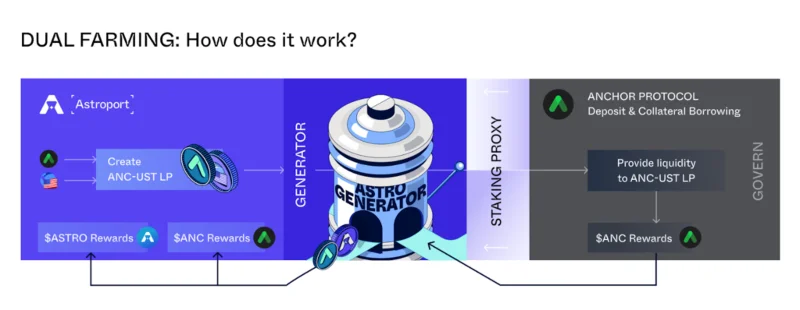
One of the problems faced by liquidity providers (LPs) is deciding which platforms to provide liquidity to, as rewards can vary in quantity or value. Astroport solves this problem with special, proxy-based smart contracts that allow for “dual farming” of the ASTRO token and governance token from another community looking to incentivize LP.
These authorization contracts are connected to the Astro Generator contract, allowing liquidity providers to claim dual governance token rewards (both ASTRO tokens and tokens from other communities, e.g. ANC and MIR). ).
Integration with Astroport Generator will bring more liquidity to Terra projects, and LP will have a better user experience with fewer steps and transactions.
Dual Liquidity Mining
Instead of directly depositing Astroport LP tokens in third-party staking contracts, LPs can deposit their tokens into one of the Astro Generators. Using authorization contracts, Astro Generator forwards LP tokens into relevant third-party staking contracts. As a result, the LP will accumulate two sets of rewards (both ASTRO and third-party protocol tokens).
When an LP wants to claim the accumulated dual rewards from a particular generator, (1) the ASTRO generator transfers their appropriate amount of ASTRO and (2) the authorization contract requests a third party token reward and sends these rewards go to LP's wallet.
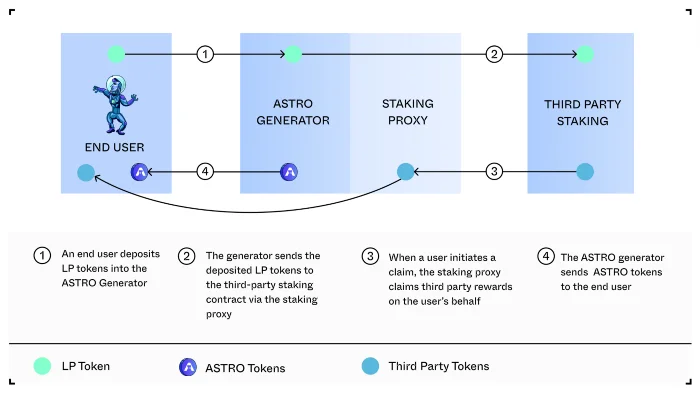
This dual distribution model has several advantages. First, this architecture minimizes development and operational requirements for third-party protocols that want to integrate with Astroport. Second, LPs that continue to stake only on third-party protocol staking contracts will continue to receive those issued tokens.
![What is the Astroport Project? Things to know about Astroport and the ASTRO token]()
Astroport DAO (Astral Assembly)
Astral Assembly will run Astroport. It's Astroport's version of the DAO (decentralized autonomous organization) . Astral Assembly's goal is to operate, maintain, develop and grow Astroport as a user-managed DeFi community. xASTRO and vxASTRO holders will have the right to propose and issue binding votes on smart contract parameter changes, smart contract upgrades, and fund disbursements.
Roadmap of the Astroport project
This information is being updated.
Astroport Developers, Investors and Partners
Development team
Astroport has been developed through a consortium of builders, including Delphi Labs, We3, Attic Labs and Terraform Labs (Astroport Venture).
Investors
Astroport's investors also include Delphi Labs and Terraform Labs, but not much is known about the project's investors.
Partner
Astroport is currently partnering with many other Dapps, protocols, and blockchain platforms to integrate tokens into its DEX. Specifically, XDeFi Wallet, Rango Exchange, Apollo DAO, Nexus Protocol…
Overview of the ASTRO . token
What is ASTRO Token?
ASTRO sits at the heart of the Astroport ecosystem, helping to coordinate and align the incentives of all stakeholders.
Astroport token details:
- Code: ASTRO
- Blockchain: CW20
- Total supply: 1,000,000,000 VND
- Total circulation in the market: 123,997,470 VND
- Market Cap: 228,116,256 USD
Token Allocation:
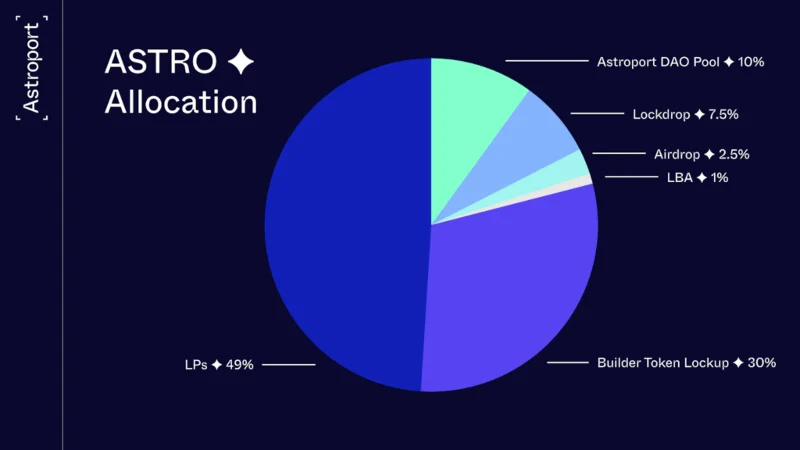
- 49% of ASTRO provides liquidity (LP) to suppliers through ASTRO Generators emissions (adjustable). These 100 million ASTRO tokens (10% of the total ASTRO supply) will be distributed through ASTRO Generators during the first 12 months of distribution. Also, on each ASTRO Generators launch anniversary, the distribution rate of ASTRO Generators will decrease by approximately 20%, until finally there is no longer ASTRO distributed through ASTRO Generators (about 69 years from now).
- 10% of ASTRO gives Astroport DAO Pool or Astral Assembly as a “community reserve” to be used for the benefit of the Astroport ecosystem (e.g. Funding for developers who can create or maintain transactions represent Astroport smart contracts to upgrade or patch Astroport code or fork Astroport to other blockchains). This ASTRO will be made available to the Astral Assembly in a single transaction or around the time of Astroport's launch (instead of being issued to the Astral Assembly over time).
- 7.5% ASTRO provides for Terraswap LPs to migrate Terraswap LP tokens from Terraswap to Astroport.
- 2.5% ASTRO offers to Terra ecosystem participants.
- 1% of ASTRO provides the ASTRO-UST (or LBA) liquidity startup team.
- 30% ASTRO provided to the builder.
![What is the Astroport Project? Things to know about Astroport and the ASTRO token]()
What is the function of ASTRO?
ASTRO staking and locking
ASTRO owners will be able to use ASTRO in two ways to assume administrative responsibilities for Astroport:
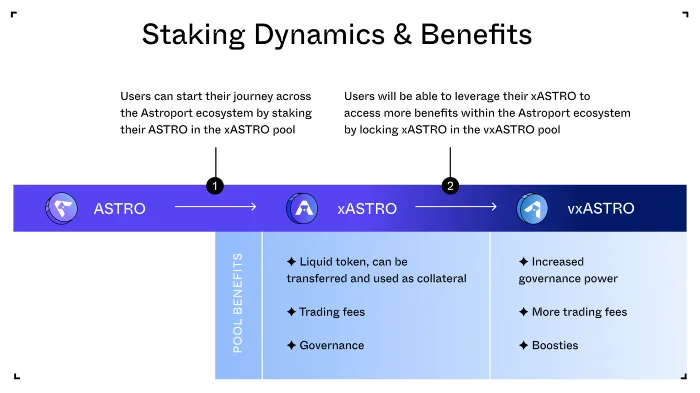
- Staking ASTRO in xASTRO pool: ASTRO holders can staking their ASTRO into xASTRO pool to receive xASTRO tokens, activate their management, and accumulate a portion of trading fees (funded by half of the transaction fee rate) translation of Astral Assembly). xASTRO is inspired by the xSUSHI/xSUSHI pool token of SushiSwap.
- Locking xASTRO in the vxASTRO pool: xASTRO holders can lock their xASTRO in the vxASTRO pool to get vxASTRO points, increase their admin rights, get an extra part of the transaction fee (funded by the other half of the transaction fee portion) Astral Assembly) and access other benefits, such as enhanced liquidity mining rewards. vxASTRO is inspired by Curve's pioneering veCRV model.
xASTRO
- Fee Sharing: xASTRO will be a transferable token that automatically accrues additional ASTRO from Astral Assembly transaction fees proportionally based on the amount of xASTRO in existence. Although adjustable by ASTRO management, initially half of Astral Assembly's transaction fees will be accrued to xASTRO holders.
- Governance: xASTRO holders will be able to vote and submit proposals to the Astroport board, including voting for incentive allocation.
vxASTRO
Otherwise, vxASTRO will not be encrypted. Instead, vxASTRO can be thought of as points that allow users to leverage their xASTRO to access additional benefits within the Astroport ecosystem, namely:
- Enhanced Governance: VxASTRO holders will get increased voting power in the Astroport ecosystem.
- Additional protocol fees: The remaining half of Astral Assembly's transaction fee portion will be distributed proportionally to all vxASTRO holders based on the available vxASTRO stock. It should be noted that, as xASTRO holders, they will also receive some portion of Astral Assembly's transaction fees flowing into the xASTRO pool (they are also xASTRO owners by definition).
- ASTRO Generator Boosties: vxASTRO holders who also mine Astroport pool (ASTRO) LPs through ASTRO Generators will receive a boost (from 1x to 2.5x) towards their ASTRO allocation.
![What is the Astroport Project? Things to know about Astroport and the ASTRO token]()
Where can I buy ASTRO?
ASTRO is now community launched and can be traded on Terraswap, MEXC Exchange and Astroport.
The future of the Astroport project. Should I invest in ASTRO tokens?
Just as Uniswap has become a mainstay of the Ethereum ecosystem, so will the top Terra DEX Astroport.
Optimized for flexibility and adaptability, Astroport is capable of attracting significant volumes of transactions. That means the platform's launch could also have implications for many other upcoming Terra 2.0 projects. It will do it by:
- Integration of liquidity mining programs for new Terra tokens, including dual rewards programs
- Generate oracle key/price data for other projects, including credit protocols like Mars
- Acts as the backbone for index products or token baskets
- Provide liquidity to wallets and transaction aggregators that access liquidity from multiple DEX
- Acts as the underlying liquidity layer for yield farming processes .
In addition, as stated above, thanks to development on Cosmos SDK, it is possible to integrate Astroport with Wormhole v2 or other interoperability protocols to extend the reach of this platform to other blockchains.
summary
In general, Astroport has a fairly reasonable and rhythmic operating mechanism. If the Terra ecosystem continues to grow, and money continues to flow into the system, the project may grow more and more in the near future.
To update the latest information about the Astroport project, follow the project's communication channels:
Website | Twitter | Discord | Telegram | Medium