Home
» Ecosystem
»
Arbitrum (ARB) Project Analysis: Tokenomics, Governance, and the Road Ahead
Arbitrum (ARB) Project Analysis: Tokenomics, Governance, and the Road Ahead
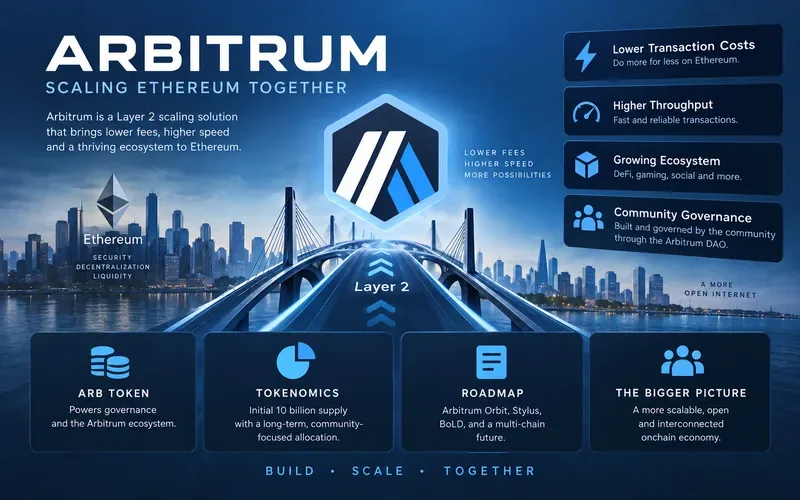
Arbitrum is no longer best understood as just “an Ethereum Layer 2 with a token.” By September 2026, it is a broader technology stack built around Arbitrum One, the Nitro execution stack, Stylus, customizable Arbitrum chains, and DAO-controlled protocol governance. That makes an ARB project analysis more complicated than checking transaction fees or counting token unlocks.
The first question is therefore not “Will ARB go up?” but “What does ARB actually control, what supply can reach the market, and which technical milestones could strengthen or weaken the ecosystem?” This article separates those questions and uses only information that can be tied to official Arbitrum documentation or governance records. It does not attempt to predict the token price.
Arbitrum combines an Ethereum-settled Layer 2, DAO governance through ARB, developer infrastructure, and a roadmap that increasingly extends beyond a single chain.
What is Arbitrum today?
Arbitrum is a scaling platform for Ethereum. Its documentation describes infrastructure for applications, tokenization, and dedicated chains, with configurable execution while retaining Ethereum settlement where applicable. Arbitrum One is the flagship rollup, while the technology stack also lets developers launch customized Arbitrum chains. Developers can use conventional Solidity tooling or Stylus, which adds EVM-compatible smart contracts written in Rust and other languages that compile to WebAssembly.
The most useful starting point is the official Arbitrum developer documentation. It currently groups the platform around building applications, launching chains, running infrastructure, and bridging assets. That structure is important: the investment thesis around Arbitrum increasingly depends on whether its technology becomes infrastructure for many applications and chains, not only on activity inside Arbitrum One.
What does the ARB token actually do?
ARB is an ERC-20 governance token native to Arbitrum One. Its core documented utility is governance. ARB holders can delegate voting power and participate in decisions affecting DAO-controlled parts of the ecosystem, including protocol upgrades, treasury deployment, governance rules, and other Arbitrum Improvement Proposals.
This distinction matters because ARB is not automatically a claim on network fees. Proposals have periodically discussed staking, revenue distribution, and other ways to expand token utility, but an investor should not treat every forum proposal as an implemented feature. The durable, verified function is governance. The original governance framework and subsequent DAO processes can be traced through the official Arbitrum governance forum.
A practical way to evaluate ARB is to separate three layers:
Protocol value: how useful and competitive Arbitrum technology is.
DAO value: the resources, rights, and responsibilities controlled by governance.
Token value capture: what rights ARB holders themselves receive. Today, governance is the clearest direct right; other economic mechanisms require explicit governance decisions.
How is the ARB supply structured?
The official token distribution specification set ARB's initial supply at 10 billion tokens and allows a maximum inflation rate of 2% per year. “Maximum” is important: it describes a protocol limit, not a promise that the full amount will be minted every year.
After AIPs 1.1 and 1.2, the official distribution was:
Allocation
Share of initial supply
Tokens
ArbitrumDAO treasury
35.28%
3.528 billion ARB
Team, contributors, and advisors
26.94%
2.694 billion ARB
Investors
17.53%
1.753 billion ARB
User airdrop
11.62%
1.162 billion ARB
Arbitrum Foundation
7.50%
750 million ARB
DAOs building on Arbitrum
1.13%
113 million ARB
These figures come from the Foundation's official $ARB distribution specification. They are more useful than an exchange's current “circulating supply” number when analyzing structural dilution, because they show who received the original supply and which pools were subject to vesting.
Are ARB unlocks still relevant in 2026?
Yes. Official documentation states that investor and team allocations are subject to four-year lockups: the first unlock occurred one year after the March 16, 2023 token generation event, followed by monthly unlocks over the remaining three years. That schedule therefore extends into 2027. The Foundation's allocation follows its own four-year linear vesting schedule beginning April 17, 2023.
However, a scheduled unlock is not the same as an immediate market sale. It changes what holders are permitted to access, but it does not reveal whether those tokens will be held, delegated, transferred, or sold. For that reason, token unlock calendars are a supply-risk input rather than a standalone price forecast.
Does the DAO treasury create strength or dilution risk?
Potentially both. The DAO treasury gives Arbitrum substantial resources to fund infrastructure, grants, incentives, security, research, and ecosystem programs. It also means a large quantity of ARB can be deployed through governance decisions.
Recent governance demonstrates that treasury allocations are not necessarily one-way spending. In 2026, for example, the DAO approved the wind-down of Arbitrum Gaming Ventures' forward investment activity and the return of unused capital to the treasury. The official proposal described approximately 143.7 million ARB as surplus capital expected to return from the program, with subsequent operational updates documenting transfers back to the DAO.
For analysis, the important metric is not simply “treasury size.” Watch how efficiently the DAO converts treasury resources into durable usage, developer activity, fee generation, infrastructure, or strategic assets. Programs that consume ARB without measurable ecosystem benefit can create dilution pressure; disciplined capital recycling can have the opposite effect.
Which technical roadmap items matter most?
1. Stylus is expanding Arbitrum's developer surface
Stylus lets developers deploy EVM-compatible contracts using Rust and other languages that compile to WebAssembly while remaining interoperable with Solidity contracts. This widens the developer pool and can make more complex or compute-heavy applications practical.
A concrete 2026 milestone is ArbOS 61 “Elara.” The finalized upgrade proposal increases the Stylus smart-contract code-size limit to 96 KB, up from 24 KB, specifically to reduce friction encountered by teams using larger Rust libraries. The proposal also includes WebAssembly compatibility changes. These are tangible engineering changes, not merely roadmap language.
2. Arbitrum is becoming a platform for dedicated chains
Current Arbitrum documentation lets teams launch dedicated chains and configure throughput, gas tokens, data availability, governance, and validation. This is strategically different from competing solely for transactions on one Layer 2.
ArbOS 61 also adds a cleaner interface for alternative data-availability systems for Arbitrum chains. The proposal explicitly says this interface is not intended for Arbitrum One or Nova, which settle to Ethereum, but is designed to reduce the engineering overhead for customized chains using other data-availability solutions.
3. Transaction ordering is still evolving
Arbitrum's sequencing policy is an active area of governance and engineering. In June 2026, Offchain Labs proposed transitioning Arbitrum One from Timeboost toward priority-gas-auction mechanics. By August, the governance post said that work had been consolidated with a separate Fast Feed proposal for a combined constitutional vote. That means readers should distinguish between a proposed direction and a change that is already live.
Similarly, ArbOS 61 adds the capability for Arbitrum chains to collect priority fees, but the proposal explicitly leaves that function disabled on Arbitrum One and Nova unless a later governance action enables it. This is a good example of why roadmap analysis should follow governance status rather than headlines.
4. Protocol economics are becoming a more explicit design problem
ArbOS 61 gives limited authority to adjust Arbitrum One and Nova's minimum L2 base fee within a DAO-defined range. The proposal frames the goal as finding a balance among low user costs, spam resistance, capital-efficient DeFi markets, and sustainable DAO revenue.
This matters to ARB analysis because the DAO controls net fee revenue and finances ecosystem activity. Lower fees can encourage usage but can also reduce revenue per transaction. The economically relevant question is therefore whether network growth can compensate for lower unit fees and whether governance deploys revenue and treasury assets effectively.
What about BoLD and decentralization?
Arbitrum's broader technology program includes BoLD, or Bounded Liquidity Delay, which is designed around permissionless validation of optimistic rollups and bounded dispute resolution. Offchain Labs continues to list BoLD alongside Nitro, Orbit/Arbitrum chains, and Stylus among its core technologies. Decentralization should be evaluated as a process rather than a binary label: sequencer design, validation, governance, Security Council powers, upgradeability, and Ethereum settlement each create separate trust assumptions.
The useful question for users and investors is not “Is Arbitrum decentralized?” in isolation. It is “Which components can fail or be controlled, and is the system reducing those trust assumptions over time?”
What are the biggest risks to the ARB thesis?
Token-value-capture risk: strong network usage does not automatically flow to ARB holders as cash yield. Governance utility and protocol success should not be treated as identical.
Supply risk: team, investor, and Foundation vesting continues into 2027, while DAO governance can deploy significant treasury balances.
Competition: Ethereum scaling includes other optimistic rollups, ZK systems, application-specific chains, and increasingly capable Ethereum mainnet improvements.
Governance risk: treasury allocation, upgrades, fee policies, and delegated operational powers depend on DAO decision quality and participation.
Technical risk: Nitro, Stylus, bridges, custom chains, sequencing, and governance contracts create a large technical surface. Audits reduce but do not eliminate smart-contract or implementation risk.
Roadmap execution risk: a feature discussed in a forum is not guaranteed to ship. Some features can be delayed, redesigned, consolidated with other proposals, or deliberately left disabled.
What should you monitor instead of price predictions?
A disciplined Arbitrum project analysis can be updated with a small set of observable questions:
Is activity on Arbitrum One and the broader Arbitrum-chain ecosystem growing sustainably rather than only during incentive campaigns?
Is Stylus attracting production applications and developers, not merely experiments?
Are dedicated Arbitrum chains creating useful network effects for the broader ecosystem?
How much ARB is entering circulation through scheduled vesting, treasury programs, grants, and incentives?
Does the DAO improve its revenue base and capital-allocation discipline?
Which sequencing, validation, and governance changes are actually approved and activated?
Does ARB gain additional implemented utility, or does governance remain its dominant function?
So what is the clearest way to evaluate Arbitrum?
Arbitrum has two separate stories that should be analyzed together but never confused. The first is a technology and ecosystem story: Ethereum scaling, Nitro, Stylus, dedicated Arbitrum chains, and continued protocol upgrades. The second is a token and governance story: a 10 billion initial supply, continuing vesting, a large DAO treasury, governance rights, and a maximum annual inflation mechanism.
The strongest evidence for the first story is engineering progress that has already reached documentation, code, or finalized governance. The second story requires more caution because ecosystem success does not guarantee proportional economic value for ARB holders.
As of September 16, 2026, the most defensible roadmap view is therefore conditional rather than predictive: Arbitrum is continuing to expand developer capabilities, customizable-chain infrastructure, fee and sequencing design, and DAO operations, while ARB remains primarily the asset through which that ecosystem is governed. Investors who understand that separation are better equipped to judge future proposals without mistaking a technical milestone for automatic token value accrual.