Home
» Ecosystem
»
MEV Protection for Retail Swaps: Private Transactions, Sandwich Risk, and the Trade-Offs to Know
MEV Protection for Retail Swaps: Private Transactions, Sandwich Risk, and the Trade-Offs to Know
A decentralized exchange swap can look simple—choose two tokens, review the quote, and sign—but the route your transaction takes before it reaches a block can affect the price you receive. On Ethereum, a transaction sent through the public mempool can be visible before confirmation. That visibility can create opportunities for maximal extractable value, or MEV: value captured by changing transaction inclusion or ordering. Ethereum’s own documentation defines MEV in terms of including, excluding, or reordering transactions in a block, and specifically identifies sandwich trading as harmful to users. See the Ethereum MEV documentation.
For a retail swapper, the practical goal is not to eliminate every form of MEV. It is to reduce avoidable execution risk while understanding what private routing, slippage controls, and auction-based order flow can and cannot do. This guide focuses mainly on Ethereum Mainnet, where several widely used private-transaction protections are documented. Features and guarantees differ on other chains.
Start with the problem: what is a sandwich attack?
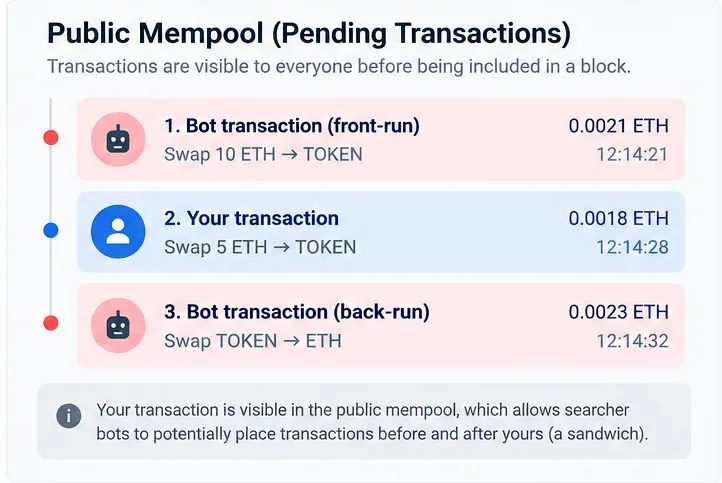
A sandwich attack places one transaction before your swap and another after it. A searcher sees a pending trade, trades ahead of it to move the pool price, lets your trade execute at the worse price allowed by your slippage settings, then trades back afterward. The attacker attempts to capture the difference while you receive a less favorable execution.
A public-mempool example: a searcher may try to place a transaction before and after a visible swap, creating the structure of a sandwich attack.
This risk is not identical for every swap. Larger orders relative to available liquidity can move a pool price more. Thin liquidity can therefore make a trade more attractive to sandwich strategies. Uniswap’s documentation distinguishes price impact—the price movement caused by your own trade—from slippage, the allowed difference between the quoted and executed result. Its support material also notes that larger liquidity pools tend to have lower price impact. Review the Uniswap price-impact explanation and sandwich-attack guidance.
What to prepare before you swap
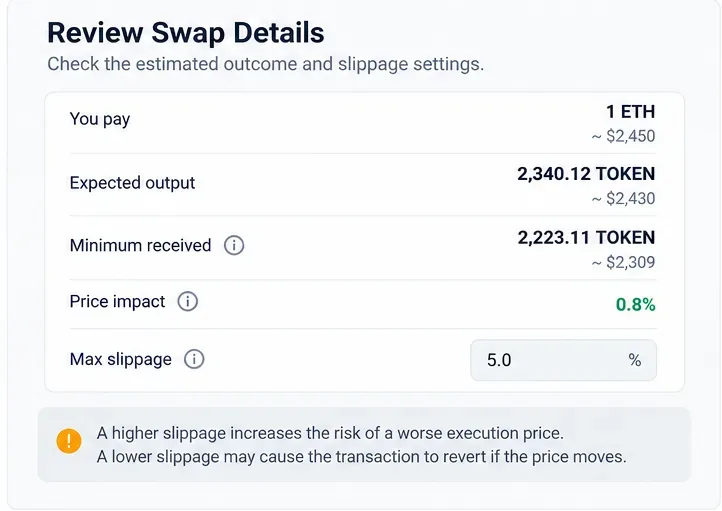
Before changing wallet settings or adding a private RPC endpoint, collect four pieces of information from the swap preview: the network, the route or protocol being used, the expected output, and the minimum amount you are willing to receive. Also check price impact and the slippage setting. These fields matter because MEV protection is only one layer of execution quality.
Network: confirm that the protection method explicitly supports the chain you are using.
Liquidity and price impact: a thin pool can produce poor execution even if nobody sandwiches you.
Maximum slippage: a wider tolerance gives the transaction more room to execute at a worse price; an excessively tight tolerance can cause a revert if the market moves.
Minimum received: treat this as the concrete downside bound shown by the interface, not merely an abstract percentage.
Do not assume “private” means invisible to every participant. A private transaction generally avoids broad public-mempool propagation, but the service routing it may still share transaction data with selected relays, builders, or searchers according to its design. Flashbots, for example, documents configurable privacy hints for private transactions and explains the trust assumptions around builders and relays in its auction documentation. See Flashbots private transaction RPC documentation.
Step 1: choose the protection model that matches your swap
Retail users generally encounter three protection patterns.
Protection model
How it works
Main benefit
Main trade-off
App-integrated private routing
The swap interface automatically sends eligible transactions through a private path.
Low setup burden and reduced public-mempool exposure.
You rely on the app’s current chain coverage, routing rules, and provider.
Private RPC or private transaction service
Your wallet sends the signed transaction to a private endpoint instead of broadcasting it to the public peer-to-peer mempool.
Direct control over how transactions are submitted.
Different inclusion behavior, service trust assumptions, and chain support must be understood.
Intent or auction-based swapping
You sign an order or intent and competing fillers or solvers try to satisfy it under the order’s constraints.
Can reduce exposure to public-mempool front-running and may source liquidity across venues.
Execution depends on the auction/filler design, order parameters, and available liquidity.
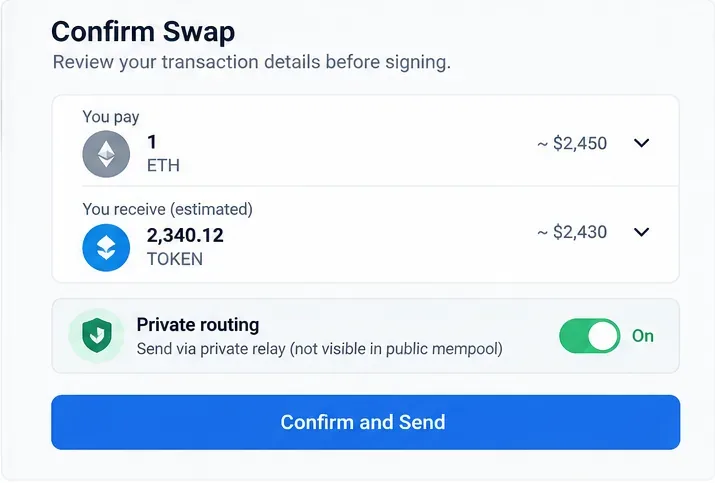
A current example of app-integrated protection is the Uniswap Wallet. Its official support page says swap protection is automatically enabled for Ethereum transactions and uses Flashbots Protect. The setting can be changed in swap settings. See Uniswap’s swap protection documentation. This is an example, not a guarantee that every wallet or every Uniswap interface behaves the same way.
Before signing, verify that the protection option applies to the current network and swap rather than assuming every transaction is privately routed.
For users who deliberately configure private submission, Flashbots Protect documents a private mempool designed to hide transactions from frontrunning and sandwich bots. Flashbots also documents MEV-Share, where selected transaction information may be shared with searchers for backrunning opportunities and potential refunds. The Flashbots Protect overview and MEV-Share introduction describe those mechanics.
Another Ethereum-specific example is MEV Blocker, which documents private RPC endpoints intended to protect against frontrunning and sandwiching while using an order-flow auction for backrun rebates. Its documented supported chain is Ethereum. See the MEV Blocker documentation.
Step 2: set slippage with execution quality in mind
Private routing does not make slippage irrelevant. Slippage is still the tolerance that determines how far execution can move from the quoted result before the transaction fails or the order constraint is violated. A very wide tolerance can leave unnecessary room for a poor fill. A very narrow tolerance can make the transaction fail during normal market movement.
Review expected output, minimum received, price impact, and maximum slippage together; private routing does not replace these execution checks.
Uniswap’s current web-app guidance says its automatic slippage setting varies based on factors including network cost and swap size, and it warns that slippage set too low may cause failure while slippage set too high can result in fewer tokens than expected. See the official Uniswap slippage instructions.
For a beginner, the safest habit is not to pick a universal “good” percentage. Instead, inspect the quoted minimum received, compare it with your acceptable outcome, and understand whether a token’s mechanics require unusual tolerance. Fee-on-transfer, rebasing, or otherwise nonstandard tokens can behave differently from ordinary ERC-20 swaps.
Step 3: submit privately, then monitor inclusion
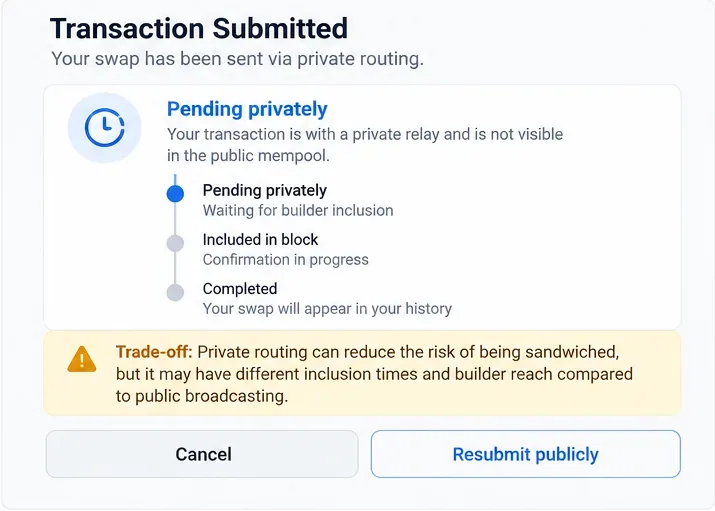
Once the quote, slippage, route, and protection path look acceptable, sign the transaction. With private routing, the transaction may not appear in the public mempool in the same way as a normal broadcast. That is the point—but it also means you should use the wallet or provider’s status tools rather than assuming “not visible publicly” means “lost.”
Private submission can have different inclusion behavior from public broadcasting, so confirm status before canceling or changing the submission path.
Flashbots documents that its eth_sendPrivateTransaction method attempts inclusion over a bounded future block window, and it exposes a cancellation method for private transactions. Specific wallets may abstract those details or use different providers, so follow the documentation for the tool you are actually using. Avoid reflexively broadcasting the same trade publicly just because private inclusion takes longer than expected: doing so can reveal the order to the public mempool and defeat the privacy benefit you were trying to obtain.
Private transactions reduce one risk, but they introduce trade-offs
MEV protection is a routing choice, not a free guarantee. The important trade-offs are practical:
Privacy versus reach: sending to a limited set of builders or relays can reduce public exposure, but inclusion depends on the private path’s access to block builders and validators.
Speed versus information sharing: some private systems can widen builder distribution or selectively share hints to improve inclusion or enable backrun competition. That can change the privacy model.
Protection versus trust assumptions: private relays and builders may see more than the public does before inclusion. Flashbots explicitly notes that current systems do not provide complete privacy from every intermediary.
Price protection versus execution probability: tight slippage or strict order constraints can protect the minimum outcome but reduce the chance of execution in a moving market.
MEV protection versus market quality: no private route can manufacture deep liquidity. Large price impact, a bad token, a malicious contract, or a poor quote can still produce a bad result.
What about auction-based swaps?
Auction or intent-based designs change the execution workflow rather than simply hiding a normal transaction. UniswapX, for example, uses a network of third-party fillers, and Uniswap’s documentation states that the design can protect against front-running; its worked example describes a filler submitting execution through a private relay. See how UniswapX works.
CoW Protocol uses batch auctions and competing solvers rather than asking the user to broadcast a standard AMM swap directly. Its current documentation describes fair combinatorial batch auctions and liquidity sourcing across available on-chain venues. See the CoW Protocol documentation. These designs can reduce some forms of harmful ordering exposure, but users should still verify supported networks, token handling, order expiration, minimum outputs, and who is responsible for final execution.
Common mistakes to avoid
Assuming every “MEV protected” feature works on every chain. Check the provider’s current supported networks before signing.
Increasing slippage just to force a swap through. A failed quote may be telling you something important about liquidity, volatility, token mechanics, or routing.
Ignoring price impact because private routing is on. Price impact comes from your own trade relative to liquidity; private submission does not remove it.
Treating a private RPC as fully trustless privacy. Read what data can be seen or shared by the relay, builder, searcher, or auction participants.
Broadcasting publicly before checking private status. This can expose the same intended trade and undermine the original reason for private submission.
Confusing MEV protection with token safety. It does not validate a token contract, prevent approval scams, or guarantee that a token can be sold.
A simple pre-swap checklist
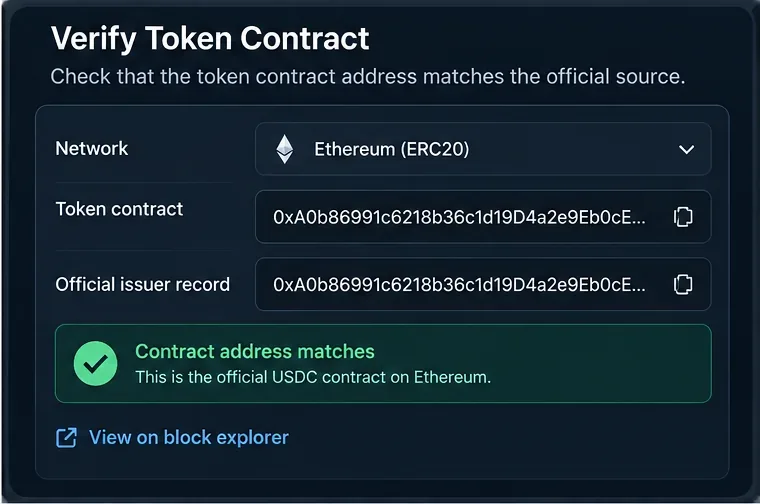
Confirm the network and token contract addresses.
Review route, liquidity, price impact, expected output, and minimum received.
Check whether the wallet or app actually enables MEV protection for this network and route.
Use a slippage tolerance that matches your acceptable minimum outcome rather than a habitual percentage.
Understand whether the transaction is public, privately routed, or represented as an intent/order.
After signing, monitor the provider’s status before canceling, replacing, or switching to public broadcast.
The practical takeaway
For many Ethereum retail swaps, private transaction routing is a useful defense against public-mempool sandwiching, especially when the alternative is broadcasting a price-sensitive trade for searchers to inspect. But the protection is strongest when paired with sensible slippage, adequate liquidity, a clear minimum-received threshold, and an understanding of the provider’s trust and inclusion model.
The most important habit is to evaluate the whole execution path. Ask: Who can see my order before inclusion? What is the worst price I have agreed to? How deep is the liquidity? What happens if the private transaction is not included promptly? Those questions turn “MEV protection” from a checkbox into a practical risk-control process.
Information checked against official documentation in September 2026. Product settings, supported networks, builder relationships, and routing behavior can change, so verify the current provider documentation immediately before relying on a specific protection feature.