Home
» Ecosystem
»
Avalanche Subnets Are Now L1s: What Ecosystem Growth and Enterprise Adoption Really Mean
Avalanche Subnets Are Now L1s: What Ecosystem Growth and Enterprise Adoption Really Mean
The first thing to know about “Avalanche Subnets” in 2026 is that the terminology has changed. Avalanche now calls these application-specific networks Avalanche L1s. The shift is more than branding: the Etna upgrade, activated on Avalanche Mainnet on December 16, 2024, implemented ACP-77 and changed the validator model that had made the original Subnet design expensive and operationally tied to the Primary Network.
That distinction matters when evaluating ecosystem growth or enterprise adoption. Older announcements may still say “Subnet,” while current Avalanche documentation generally says “L1.” This article uses “Subnets” when discussing the historical model or products originally launched under that name, and “Avalanche L1s” for the post-Etna architecture.
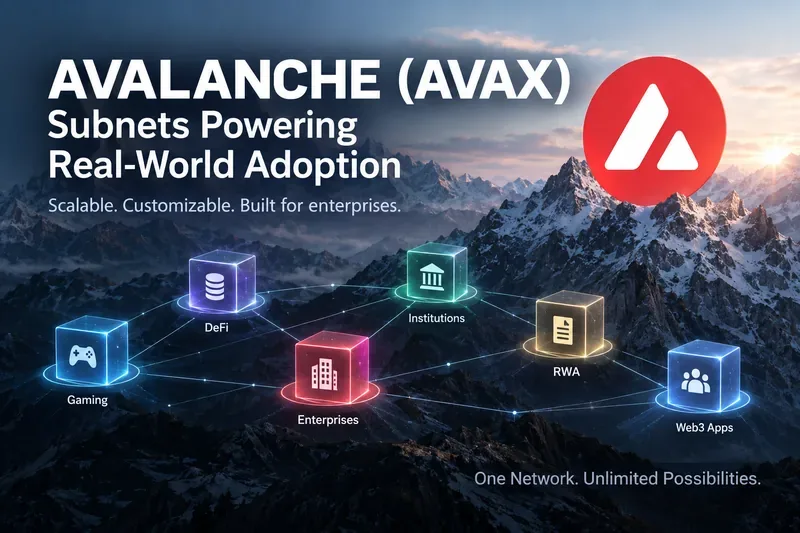
Avalanche’s application-specific network model targets multiple use cases, from gaming and DeFi to institutional finance and tokenized real-world assets; today these networks are generally called Avalanche L1s rather than Subnets.
What changed from Avalanche Subnets to Avalanche L1s?
Under the original Subnet model, a validator participating in a Subnet also had to validate Avalanche’s Primary Network and meet its staking requirement. Avalanche’s technical documentation describes the pre-Etna requirement as 2,000 AVAX per validator, alongside synchronization and validation of the X-, P-, and C-Chains.
Etna changed that model. Under ACP-77, an L1 validator does not need to stake 2,000 AVAX or validate the X- and C-Chains. Instead, it pays a continuous dynamic fee denominated in AVAX and synchronizes the P-Chain state needed for validator-set tracking and interchain communication. Avalanche’s Builder Hub estimated the minimum configuration at activation at roughly 1.33 AVAX per month per L1 validator while the number of active fee-paying validators remains below the protocol target. The fee is dynamic, so 1.33 AVAX should not be treated as a permanently fixed operating price.
The old capital requirement created a meaningful hurdle for a project that wanted several dedicated validators. Etna separated custom-L1 validation from Primary Network staking, lowering the barrier to running an application-specific chain and reducing the amount of Primary Network infrastructure an L1-only validator must operate.
Avalanche’s own Etna documentation describes the change as reducing the upfront economic barrier by more than 99.9% compared with the previous staking model. That figure refers specifically to the validator-related upfront cost comparison described by Avalanche; it does not mean the total cost of building, securing, staffing, auditing, operating, or integrating an enterprise blockchain falls by 99.9%.
The broader design goal is horizontal scaling. Instead of every application competing for execution on one chain, an organization can operate a separate blockchain with its own validator set, execution environment, fee policy, and governance choices. Avalanche’s technical explanation of Avalanche9000 and Etna says the new L1 model also improves fault isolation because L1 validators no longer have to participate in Primary Network consensus.
What can an enterprise customize?
Customization is one of the strongest reasons to consider an Avalanche L1 instead of deploying an ordinary smart contract to a shared public chain. Depending on the chosen architecture, organizations can control validator membership and design permissioned environments, use custom validator-management logic, choose staking or proof-of-authority approaches, and configure application-specific economics.
For teams that want Ethereum compatibility, Avalanche’s Subnet-EVM—still named that way in technical documentation—is an EVM implementation for L1 contract chains. It supports Solidity smart contracts and much of the familiar Ethereum tooling. The official Subnet-EVM overview explains that the VM defines blockchain behavior while individual chains remain logically independent.
Decision factor
Shared C-Chain application
Dedicated Avalanche L1
Infrastructure
Uses shared C-Chain execution
Dedicated validator set and blockchain resources
Validator policy
Inherited from Primary Network
Can be designed for the L1’s requirements
Permissioning
Public network environment
Can support permissioned institutional designs
Execution customization
Uses C-Chain rules
Can use an EVM-compatible or other custom VM design
Operational burden
Lower for the application team
Higher: the team must operate or source chain infrastructure
Best fit
Apps that value shared liquidity and simplicity
Apps needing dedicated capacity, governance, compliance controls, or specialized economics
Is enterprise adoption real, or mostly pilot activity?
There is verified institutional activity, but the word “adoption” needs precision. Some deployments are production-oriented platforms; others are proofs of concept or test environments. Treating every named financial institution as a full production user would overstate the evidence.
Evergreen and institutional finance
Ava Labs introduced Evergreen as a productization of the Subnet/L1 architecture for financial institutions. The design combines permissioned validator sets and institution-oriented controls with the ability to communicate across Avalanche networks. The official Evergreen site describes controls spanning areas such as gas tokens, compliance, privacy, and permissioning.
One early example was Spruce, launched as an Evergreen testnet with T. Rowe Price Associates, WisdomTree, Wellington Management, and Cumberland. Avalanche’s announcement explicitly described Spruce as a test environment for exploring on-chain trade execution and settlement—not as evidence that all of those firms had moved production financial operations onto Avalanche.
Another notable case involved Onyx by J.P. Morgan and Apollo Global in a proof of concept associated with Singapore’s Project Guardian. Evergreen’s current materials state that the PoC used an Avalanche Evergreen network among multiple protocols and infrastructure partners to explore tokenized alternative investments in discretionary portfolios. Again, “proof of concept” is the important qualifier.
Intain shows a more application-specific model
Intain provides a useful example of why dedicated chains appeal to financial infrastructure providers. Avalanche’s Evergreen materials identify Intain as a structured-finance platform using its own network for an on-chain asset-backed-securities market. This is closer to the original Subnet thesis: isolate a specialized workload and give the operator control over the blockchain environment rather than forcing it into the same execution space as unrelated applications.
These cases are documented in Avalanche’s Evergreen institutional materials. Because those materials are published by Avalanche/Ava Labs, they are useful primary sources for identifying deployments and their stated purpose, but claims about business impact should not be treated as independent third-party validation.
Does an Avalanche L1 automatically inherit Avalanche security?
No—not in the simplistic sense that every L1 has the same validator set and economic security as the Avalanche Primary Network. Post-Etna L1s can have distinct validator sets and custom validator-management rules. That sovereignty is a feature, but it also means security analysis must examine the specific L1.
Before relying on an L1, ask who can become a validator, how many independent validators exist, how validator weights are controlled, what happens when validators fail, how upgrades are authorized, and whether critical contracts or bridges have been audited. A permissioned enterprise L1 may intentionally prioritize known counterparties and governance controls over open validator participation. That is a different trust model, not automatically a weaker or stronger one.
How do Avalanche L1s communicate with each other?
Avalanche Interchain Messaging (ICM), evolved from Avalanche Warp Messaging, provides native mechanisms for communication across Avalanche chains. Etna included ACP-118, which standardized the interface used to request and aggregate signatures for interchain messages. A threshold of a chain’s validator set can attest to an event, with signatures aggregated into a BLS signature.
This matters for enterprises because dedicated chains are less useful if they become isolated databases. Interchain messaging can support architectures where separate networks maintain their own rules while exchanging authenticated information. However, interoperability does not eliminate application-level risk: contracts handling messages, assets, permissions, and business logic still require careful engineering and security review.
What are the tradeoffs before launching an Avalanche L1?
A dedicated chain is not automatically better than a smart contract on the C-Chain. The key question is whether the application actually needs sovereignty badly enough to justify operating a network.
Choose a dedicated L1 when isolation matters. High-volume games, institutional workflows, specialized markets, or regulated applications may benefit from dedicated execution and validator policies.
Prefer a shared chain when simplicity matters. A smaller application may gain more from existing liquidity, infrastructure, wallets, and shared security than from controlling its own validator set.
Model validator costs dynamically. The ACP-77 fee has a minimum configuration and adjusts with active L1 validator demand; do not budget forever using a single historical AVAX-per-month figure.
Budget beyond protocol fees. Cloud or bare-metal servers, monitoring, key management, incident response, audits, RPC services, indexers, explorers, integrations, and engineering staff can dominate real operating costs.
Define the trust model before the technology. Enterprises should decide whether validators are permissionless, consortium-controlled, or operated by known entities before choosing the implementation.
What does L1 growth mean for AVAX?
The relationship is more nuanced than “more L1s automatically means a higher AVAX price.” Under ACP-77, active L1 validators pay a continuous fee denominated in AVAX to the P-Chain. That creates a protocol-level use for AVAX as L1 validator activity grows. Primary Network validators still have separate AVAX staking requirements.
But token valuation depends on many other variables: how many L1s become active, how many validators they operate, the dynamic validator fee rate, demand for the C-Chain, token supply dynamics, market liquidity, broader crypto conditions, and whether applications attract sustained users and economic activity. An enterprise pilot announcement by itself does not establish durable AVAX demand.
What should investors and builders watch next?
For builders, the most meaningful indicators are less glamorous than partnership headlines: active L1 validator counts, production launches, validator diversity, sustained transaction activity, cross-L1 messaging usage, operating reliability, developer tooling, and whether organizations move from pilots to recurring production workloads.
For investors, distinguish three layers of evidence. Protocol capability is verifiable in the implemented ACPs and network software. Ecosystem participation can be verified through launched networks and disclosed pilots. Commercial success requires stronger evidence such as sustained usage, measurable business volume, or independently verifiable economic activity.
The central development is therefore not that “Subnets are growing” in the old sense. It is that Avalanche has reworked the Subnet concept into a cheaper and more sovereign L1 architecture. That makes dedicated Avalanche chains more practical for developers and institutions, while shifting more responsibility for security, governance, and operations to each L1. Enterprise experiments such as Evergreen, Spruce, Intain, and the Onyx/Apollo PoC show credible interest in that model—but the next stage of adoption will be judged by how many experiments become durable production systems.