Home
» Ecosystem
»
Bitcoin Mempool Fees Explained: When to Use RBF, CPFP, or Simply Wait
Bitcoin Mempool Fees Explained: When to Use RBF, CPFP, or Simply Wait
Bitcoin Mempool Fees Explained: When to Use RBF, CPFP, or Simply Wait
A Bitcoin payment can show as “pending” even after your wallet says it was sent. Usually the transaction has been broadcast but has not yet been included in a block. Before changing anything, check its status, fee rate, and urgency. Then decide whether to replace the transaction with a higher-fee version, attach a fee-paying child transaction, or wait.
The terms can sound technical, but the decision is practical: RBF is usually the first option for a sender whose wallet supports it; CPFP can help when you control an unconfirmed output and the wallet can construct the required child transaction; waiting can be sensible when timing is flexible and the fee bump would cost more than the delay is worth.
The interface images in this guide are simplified concepts, not screenshots of a particular wallet. Wallet menus and capabilities differ.
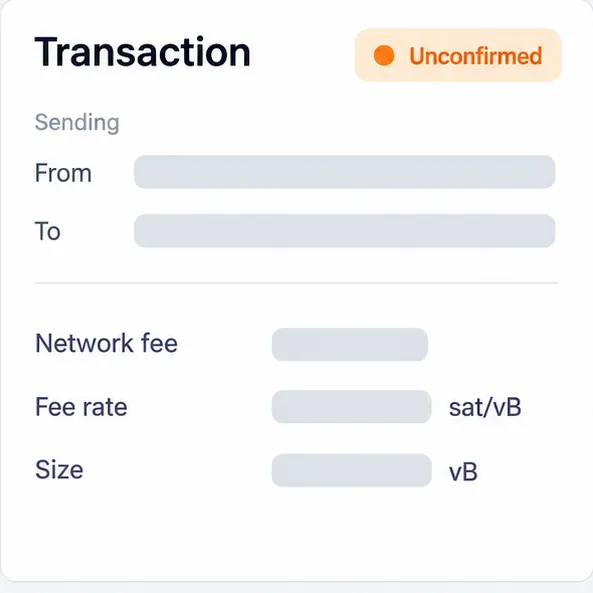
A simplified transaction panel shows an “Unconfirmed” status and the fee fields to review before choosing an action.
First, understand the mempool and the fee rate
A mempool is a node’s local collection of valid transactions that it has received but that are not yet confirmed in a block. There is no single, perfectly synchronized global queue: different nodes can hold different transactions and apply different relay policies. A transaction can be visible in one wallet or explorer and absent from another.
The fee is the total amount paid for a transaction. The fee rate is the fee relative to transaction size, commonly shown as sat/vB: satoshis per virtual byte. Miners generally have an incentive to choose transactions that pay well for the block space they use, so fee rate is more useful than comparing total fees alone. It still cannot promise a particular confirmation time. Demand changes, blocks have limited space, and fee estimates are estimates.
When a transaction remains unconfirmed, open it in the wallet that sent it. Check that it is still pending, whether the wallet shows an RBF or fee-bump option, and whether it identifies an unconfirmed output you can spend. If you use a block explorer, remember that transaction details are public; avoid giving a site your recovery phrase or private keys.
Choose among RBF, CPFP, and waiting
Choice
Best fit
What it changes
Main limitation
RBF
You sent the transaction, control the wallet, and want to pay more for faster inclusion.
Broadcasts a replacement that conflicts with the original and offers a higher fee.
Your wallet must support it, and replacement acceptance depends on node and miner policies.
CPFP
You control a spendable output from the unconfirmed transaction and RBF is unavailable or unsuitable.
Creates a child transaction that spends the parent’s output and adds a fee incentive for miners to confirm both.
You need a usable output and wallet support; the child adds cost, and package relay is not universal.
Wait
The payment is not time-sensitive, the fee increase is not worthwhile, or the current estimate suggests conditions may improve.
Nothing new is broadcast; you monitor the original transaction.
Confirmation time is uncertain, and a transaction can eventually leave some mempools.
When should you use RBF?
Replace-by-fee (RBF) lets a sender replace an unconfirmed transaction with a conflicting version that pays a higher fee. The replacement normally spends the same inputs, and the wallet may cover the added fee by reducing change or using additional inputs. That can alter the amount returned to you as change, so review the replacement’s recipients and total fee before approving it.
In your wallet, select the pending transaction and look for an option such as “Increase fee,” “Bump fee,” or “Replace.” Names vary by wallet. Choose a fee rate based on the wallet’s current estimate and your own time target, check the total fee in bitcoin or satoshis, then review and authorize the replacement. Watch for the replacement transaction ID and confirm that the wallet now tracks the new version.
Older explanations often say a transaction must have opted in to RBF. BIP 125 describes opt-in signaling, but relay policy has evolved: Bitcoin Core 28.0 changed its default to full-RBF, and Bitcoin Core 29.0 removed the configuration option after describing full-RBF as standard behavior for that software. This does not mean every wallet, node, or miner follows identical policy. RBF remains a policy and wallet-capability question, not a guarantee. Bitcoin Core’s version 31.0 bumpfee documentation describes how its wallet creates a replacement and the conditions that can prevent it.
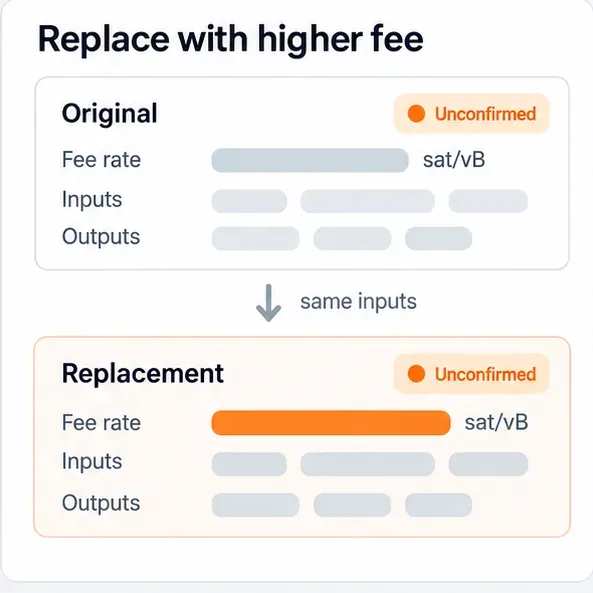
The replacement concept keeps the original inputs while increasing the fee rate; the wallet’s preview should show the actual proposed fee and outputs.
When does CPFP make sense?
Child-pays-for-parent (CPFP) means creating a new transaction—the child—that spends an output from the unconfirmed parent. The child pays a sufficiently high fee so miners have an incentive to include the parent and child together. The relevant incentive is the package’s combined fee relative to its combined size, not just the child’s fee rate viewed in isolation.
CPFP can be useful if you are the sender but cannot replace the original, or if you are the recipient and control an output from the incoming payment. It will not work if you have no spendable output from the parent, if the wallet will not spend unconfirmed funds, or if the transaction package does not meet the receiving node’s policy. Check the child’s amount, change, and total combined cost before signing.
Some wallets offer an “accelerate” or CPFP action; others do not. Advanced users may encounter package-submission tools, but those are implementation-specific. Bitcoin Core’s submitpackage reference says the package is checked against consensus and mempool policy and warns that a successful submission to one node does not guarantee propagation across the network. BIP 331 describes proposed ancestor package relay; it is a draft specification, not proof that every peer supports package relay.
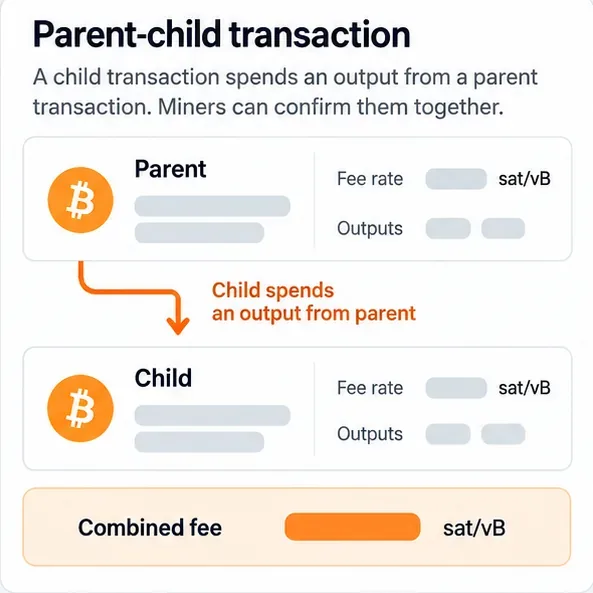
In CPFP, the child spends a parent output, and miners may consider the fee incentive across both transactions.
When is waiting the better choice?
Wait when a confirmation is not urgent, the original fee rate is not far from current wallet estimates, and paying a higher fee would not solve a meaningful problem. Check again later rather than repeatedly rebroadcasting or creating a second ordinary payment. A transaction may confirm as block space opens, but no wallet can promise when.
Waiting has limits. Nodes can remove transactions from their mempools, including when local policies or capacity rules change. If your wallet still shows “pending” but independent transaction lookups no longer find it, the wallet’s display alone may not tell you whether the transaction is still widely available. Follow the wallet provider’s recovery guidance before trying to resend. Bitcoin Core’s getmempoolinfo documentation illustrates that even a node’s mempool and minimum fee are local, changing state.
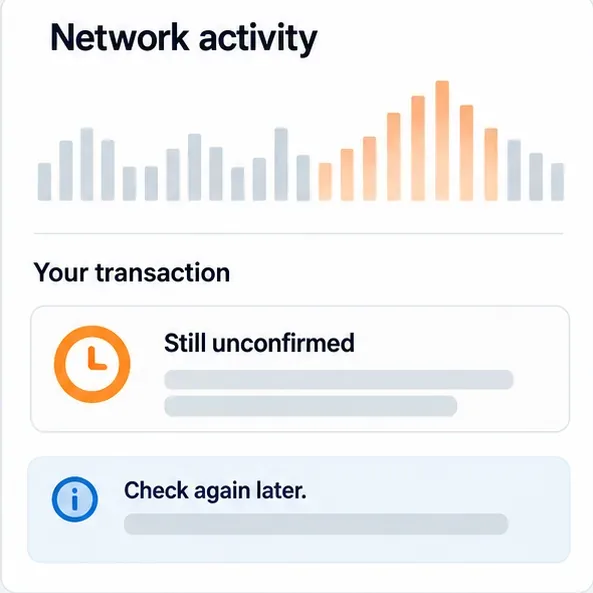
A pending-status concept pairs a reminder to recheck with a network-activity graphic; the bars are illustrative, not live fee data.
A beginner’s checklist before you act
Confirm the correct transaction is still unconfirmed in the wallet that sent or received it.
Check the total fee and fee rate, and compare them with the wallet’s current estimate for your desired confirmation target.
If you sent it and the wallet supports replacement, inspect the RBF preview before approving a higher fee.
If you control an unconfirmed output and the wallet supports CPFP, review the parent-child package and combined cost.
If timing is flexible, wait and check again. Do not approve a duplicate payment just because the first one is pending.
For technical reference, this guide was checked against Bitcoin Core 31.0 RPC documentation and Bitcoin Core release notes available September 29, 2026. The basic choice is straightforward: use RBF when your sender wallet can safely replace the transaction, consider CPFP when you control an eligible output and understand the combined fee, and wait when the delay is acceptable. In every case, verify the proposed transaction in your wallet and treat confirmation estimates as uncertain.