Home
» Ecosystem
»
Celestia (TIA) Deep Dive: How Modular Blockchain Architecture Actually Works
Celestia (TIA) Deep Dive: How Modular Blockchain Architecture Actually Works
Celestia is best understood as a specialized blockchain for consensus and data availability, not as a general-purpose execution chain. Instead of asking every base-layer validator to execute every application transaction, Celestia lets rollups execute elsewhere while publishing their transaction data to Celestia so that anyone can verify that the data was made available.
This article uses one clearly labeled hypothetical example throughout: ArcadeRollup, an imaginary gaming rollup that processes thousands of player actions off the Celestia execution path, settles its state on another chain, and uses Celestia for data availability. ArcadeRollup is not a real deployment, performance benchmark, customer case, or endorsement. It is simply a teaching device for understanding the modular stack.
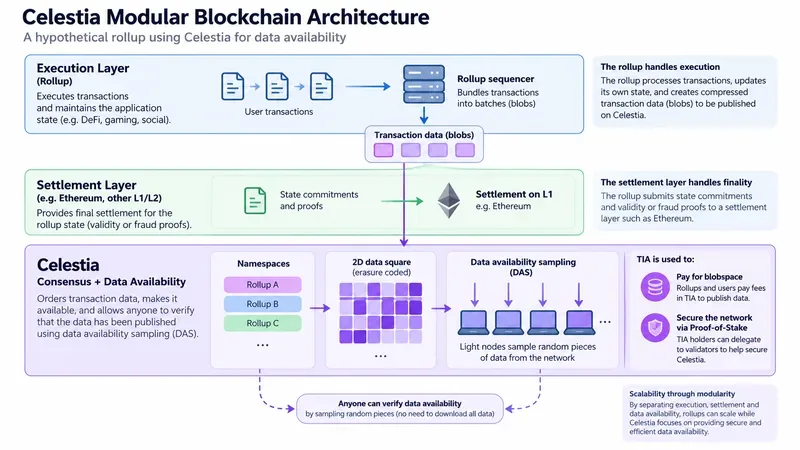
A modular stack can separate execution, settlement, consensus, and data availability. In this example, the hypothetical rollup executes transactions elsewhere, settles state commitments on another layer, and publishes transaction data to Celestia.
The core idea: separate blockchain jobs instead of making one chain do everything
A traditional monolithic blockchain tends to bundle several responsibilities into the same base layer: transaction execution, settlement, consensus, and data availability. Celestia's architecture separates these functions so that specialized layers can do different jobs.
Celestia's own documentation describes the network as a modular data availability layer. Its base layer handles consensus over the ordering of data and makes that data available. Execution and settlement can live above or outside Celestia. This matters because execution is often the expensive, application-specific part of a blockchain stack. A rollup can choose its own virtual machine, sequencing logic, fraud-proof or validity-proof system, and settlement environment without requiring Celestia validators to execute the rollup's application logic.
Hypothetical example: what ArcadeRollup actually sends to Celestia
Imagine ArcadeRollup runs a real-time strategy game. Players submit moves, trades, crafting actions, and match results. ArcadeRollup's sequencer receives those transactions and executes them according to the game's rules. That execution changes the rollup's state: balances move, inventories change, and rankings update.
Celestia does not need to re-run those game rules. Instead, ArcadeRollup packages the transaction data into blobs and publishes them to Celestia. Celestia orders the blobs and makes their data available. A separate settlement layer may receive state commitments and proofs from ArcadeRollup, depending on the rollup design.
This division can be summarized as:
Function
Hypothetical ArcadeRollup stack
What the component does
Execution
ArcadeRollup
Runs game transactions and updates application state.
Settlement
A separate L1 or settlement layer
Resolves the rollup's state commitments and proof system.
Consensus
Celestia validator set
Agrees on the ordering of Celestia blocks.
Data availability
Celestia
Publishes rollup data so participants can verify it was made available.
The important architectural point is that using Celestia for DA does not mean Celestia executes the rollup. The rollup remains responsible for its execution environment and its own state transition logic.
Why data availability is such a big deal
A rollup can only be independently verified if the data needed to reconstruct its state is available. Suppose ArcadeRollup's sequencer publishes a new state root but withholds the transactions that produced it. Users and verifiers may know that a commitment exists, but they cannot independently reconstruct what happened.
That is the data availability problem. Celestia is designed so participants can gain confidence that block data has actually been published without every light node downloading the full block.
Data availability sampling
Celestia uses data availability sampling (DAS). Block data is extended with two-dimensional Reed-Solomon erasure coding. Light nodes then request random pieces, or shares, from the extended data square together with cryptographic proofs. If repeated random samples are returned correctly, the light node gains high confidence that enough of the data is available for the full block to be reconstructed.
The practical consequence is important: a light node can help verify data availability without downloading every byte in every block. Celestia's scaling model therefore relies partly on many participants sampling small portions of the data rather than requiring all verifiers to fully replicate everything.
Namespaces: how multiple rollups share the same DA layer
If hundreds of rollups post data to one DA network, a rollup should not need to download every other application's data just to find its own. Celestia addresses this with namespaced Merkle trees.
Each application's data can be associated with a namespace. In the ArcadeRollup example, its blobs would be placed under the namespace used by that rollup. A node interested in ArcadeRollup can then request the relevant namespaced data together with proofs that the response is complete for that namespace.
This is one of the practical reasons the modular model can support many execution environments on top of the same DA layer: they can share Celestia blockspace while still retrieving the data relevant to their own application.
What a PayForBlobs transaction does
Rollups publish data to Celestia using blob transactions. The current documentation describes a blob transaction as containing a standard Cosmos SDK transaction, MsgPayForBlobs, plus one or more blobs. The payment transaction includes a commitment to the blob data, while the actual data is organized into the block under the relevant namespace.
In our hypothetical case, ArcadeRollup periodically batches player transactions, creates one or more blobs, and pays to publish them. Celestia then includes the transaction and associated blobs in a block, applies its data-availability encoding, and commits to the resulting data.
TIA is Celestia's native asset, but its role is broader than being a speculative market token. According to Celestia's current documentation, TIA is used in several protocol functions:
Blobspace fees: rollups pay fees denominated in TIA when submitting data through PayForBlobs transactions.
Proof-of-stake security: TIA can be delegated to validators that participate in Celestia consensus.
Governance: staked TIA participates in governance over network parameters and the community pool.
Optional rollup currency: a new rollup can choose to use TIA as a gas token or currency rather than issuing a separate token immediately.
Celestia's official TIA overview documents these roles. From an analytical perspective, however, token utility should not be confused with a guaranteed relationship to token price. Demand for blobspace, staking economics, issuance, validator incentives, ecosystem adoption, and broader market conditions can all affect economic outcomes differently.
Blobstream: connecting Celestia DA to EVM settlement environments
One challenge in a modular stack is proving to a settlement-layer contract that data was actually published on Celestia. Blobstream is designed for this bridge between Celestia's DA layer and EVM environments.
Celestia's documentation describes Blobstream as a system where Celestia validators attest to commitments over data, those attestations are relayed to a target EVM chain, and a smart contract can verify that a particular Celestia data commitment was included.
For ArcadeRollup, imagine that settlement happens on an EVM chain. The rollup's settlement contract needs evidence that the transaction data behind a state update was published to Celestia. Blobstream can provide the relevant verification path without forcing the settlement chain itself to store all of ArcadeRollup's raw transaction data.
Availability is not the same as permanent historical storage
This is one of the most important nuances in understanding Celestia. A DA layer proves that data was published and available during the relevant verification window. That does not automatically mean every piece of historical data will be stored forever by every Celestia node.
Celestia's current retrievability documentation states that, as of celestia-app v6, light-node sampling uses a rolling seven-day window. Older data may be pruned by non-archival nodes. Applications that need long-term historical reconstruction therefore need an explicit retrievability strategy, such as archival nodes or external data providers.
For ArcadeRollup, this means the team cannot simply say, "Celestia has our data, so historical syncing is solved forever." It must decide how new nodes will recover old rollup history months or years later.
What modularity improves—and what it moves elsewhere
The modular architecture is attractive because it allows specialization. ArcadeRollup can optimize its execution engine for a game, choose its own sequencing policy, and avoid competing with unrelated applications for execution capacity on a monolithic base chain. Celestia can specialize in consensus and DA.
But modularity does not eliminate complexity. It redistributes it. A production rollup still has to make decisions about:
sequencer design and censorship resistance;
fraud proofs, validity proofs, or other state verification;
the settlement layer and finality assumptions;
historical data retention and node synchronization;
bridges and cross-chain messaging;
upgrade governance and emergency procedures;
fee exposure to Celestia blobspace and any settlement-layer costs.
In other words, Celestia can simplify one major infrastructure problem—scalable data availability—but it does not automatically provide every component needed for a secure rollup.
Celestia's current network state in 2026
As of September 2026, Celestia's official network documentation lists Mainnet Beta as active and still experimental. The current Mainnet Beta page lists approximately three-second block times, a maximum transaction size of 8 MiB, and software versions celestia-node v0.32.1 and celestia-app v9.0.6. Mainnet Beta activated the v9 upgrade on July 1, 2026, and the official upgrade page states that v10 has not yet been scheduled.
The network has changed substantially since launch, so older Celestia articles may describe parameters that are no longer current. For example, the Matcha upgrade increased limits and introduced a path toward much larger blocks, while later versions continued protocol development. Always check the current Mainnet Beta parameters and official network-upgrade history before designing around a particular limit.
How to evaluate a rollup that says it "uses Celestia"
The phrase alone does not tell you enough. Returning to ArcadeRollup, a useful technical review would ask several separate questions:
What is actually posted to Celestia? Full transaction data, compressed batches, commitments, or something else?
How often is data posted? The posting cadence affects latency, batching, and fee behavior.
Where does execution happen? Celestia does not answer this for the rollup.
Where does settlement happen? A sovereign rollup and a rollup settling to an external L1 have different trust and dispute models.
How is availability verified? Does the stack rely on native Celestia DA verification, Blobstream, a bridge, or another mechanism?
How is old data retained? A credible design should explain historical retrievability rather than assuming all light nodes are archival.
What fails if Celestia is temporarily unavailable? The rollup should have a documented liveness and recovery model.
These questions help separate "Celestia integration" as a marketing phrase from the actual architecture.
Bottom line
Celestia's modular design is easier to understand once the responsibilities are separated. A rollup executes transactions. A settlement layer may resolve the rollup's state and proofs. Celestia provides consensus over its own blocks and a specialized data availability layer where rollups can publish blobs. Data availability sampling lets light nodes verify availability probabilistically without downloading entire blocks, while namespaces let applications retrieve their own data efficiently.
In the hypothetical ArcadeRollup example, Celestia is not the game engine and it is not necessarily the settlement court. It is the shared publication and availability layer that allows the rollup's transaction data to be independently checked as published.
That specialization is the central thesis behind Celestia: blockchains do not have to be one machine doing every job. They can be stacks of specialized components. The trade-off is that developers and analysts must understand the interfaces—and the security assumptions—between those components rather than treating "modular" as shorthand for automatic scalability or security.