Home
» Ecosystem
»
Ethereum Blob Fees vs. Gas Fees: What Layer 2 Users Actually Pay in 2026
Ethereum Blob Fees vs. Gas Fees: What Layer 2 Users Actually Pay in 2026
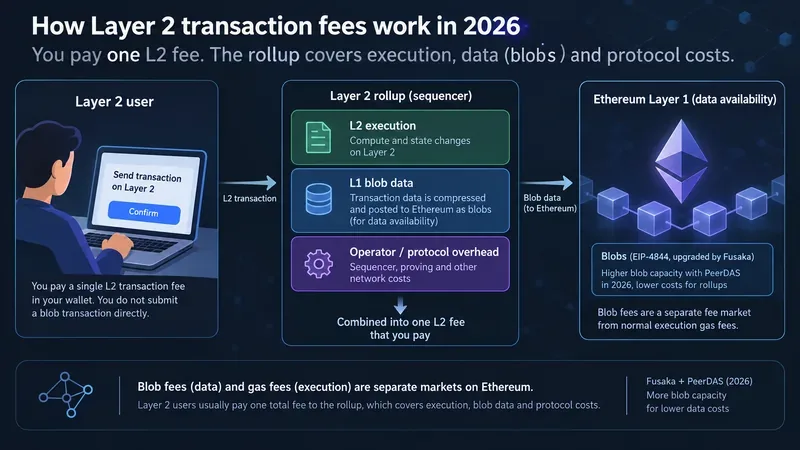
The short answer: most Layer 2 users in 2026 do not pay an Ethereum blob fee directly. They pay a transaction fee to the Layer 2. That fee usually reflects several underlying costs: executing the transaction on the L2, publishing enough data to Ethereum for data availability, and any chain-specific operator or protocol charges. Blob fees matter because they influence the data-availability portion of many rollup fees, while ordinary gas fees still price computation and state changes in a separate market.
This distinction matters because “Ethereum gas is cheap” and “blob fees are cheap” are not the same statement. A rollup can face low blob costs while its own execution demand is high, or the reverse. The final fee shown by a wallet depends on the L2's fee formula, transaction type, congestion, compression, and how the chain passes infrastructure costs through to users.
A Layer 2 wallet usually presents one transaction fee, while the rollup separately accounts for execution, Ethereum data availability through blobs, and chain-specific overhead.
Blob fees and gas fees are two different Ethereum fee markets
Ethereum introduced blob-carrying transactions with EIP-4844. A blob is temporary data intended primarily for rollups. Blob data is not ordinary EVM calldata and is priced with its own unit, blob gas. The EIP-4844 specification explicitly defines blob gas as independent from normal execution gas and gives it a separate base-fee mechanism.
Normal Ethereum gas still prices execution on Layer 1: running EVM operations, touching storage, and processing regular transaction data. Blob gas prices the special data-availability capacity used by blob-carrying transactions. Ethereum exposes the current blob base fee separately from the ordinary base fee; the Ethereum opcode reference documents both BASEFEE and BLOBBASEFEE.
Cost
What it prices
Who usually pays it directly
What an L2 user sees
Ethereum execution gas
L1 computation and state changes
The sender of an L1 transaction
Usually only indirectly, when the rollup has L1 settlement or verification costs
Ethereum blob fee
Temporary blob data availability
The rollup batch submitter sending the blob transaction
Usually an embedded data-availability component of the L2 fee
L2 execution fee
Computation and state changes on the L2
The L2 user
Part of the transaction fee shown by the wallet
Operator/protocol fee
Chain-specific overhead, proving, sequencing, or configured charges
The L2 user when the chain includes it
May be folded into the total or exposed separately by tooling
What changed by 2026: much more blob capacity
The important 2026 change is not that blobs replaced gas. They did not. The change is that Ethereum increased the amount of blob data the network can safely carry.
Fusaka went live on December 3, 2025 and introduced PeerDAS, which lets nodes sample portions of blob data instead of requiring every node to download every blob in full. Ethereum's PeerDAS documentation explains that this architecture is designed to expand data-availability capacity while limiting per-node bandwidth requirements.
Ethereum then used Blob-Parameter-Only, or BPO, forks to raise capacity without bundling the change into another large protocol upgrade. As of September 29, 2026, the latest finalized mainnet parameters documented in the canonical BPO2 record are a target of 14 blobs per block and a maximum of 21. BPO2 activated on January 7, 2026. See EIP-8135 and the Ethereum Foundation's January 2026 protocol checkpoint.
A draft BPO3 document exists, but as of this date it does not contain finalized activation parameters. That means readers should not assume a higher mainnet target simply because Ethereum's architecture can support more capacity. The draft status is visible in EIP-8138.
What a Layer 2 user actually pays
For a typical rollup transaction, a useful mental model is:
That is a model, not a universal formula. Different rollups calculate and allocate these pieces differently.
1. L2 execution cost
Your swap, transfer, mint, contract call, or account-abstraction operation still consumes resources on the Layer 2. A simple ETH transfer normally uses fewer L2 execution resources than a complicated DeFi transaction. This portion can rise even when Ethereum blob fees are near their minimum if the L2 itself is congested or the transaction performs expensive computation.
2. L1 data-availability cost
A rollup must make enough information available so that its state can be independently reconstructed or verified according to its design. For many Ethereum rollups, that means publishing compressed transaction or state data to Ethereum blobs. The batch submitter pays the blob fee on L1, then the rollup's fee mechanism allocates or estimates that cost across L2 transactions.
The OP Stack provides a concrete example. Its official execution-engine specification says the L1-cost fee is added to the L2 execution fee and, after the Ecotone upgrade, incorporates both the Ethereum L1 base fee and the L1 blob base fee through configured scalars. This is why the number shown to an OP Stack user is not simply “blob fee times transaction size.” Compression and chain parameters matter.
3. Operator or protocol overhead
Some chains add explicit or implicit charges for operating the network, proving, or other services. OP Stack's Isthmus specification, for example, added an operator fee that can be configured alongside the standard L2 gas fee and L1 data fee. Other rollup architectures account for costs differently.
ZKsync illustrates another model. Its official fee-model documentation explains that users pay for L2 computation while the system also accounts for “pubdata,” the public data needed on Ethereum. ZKsync is state-diff based, so the amount of pubdata can depend more on the state changes a transaction creates than on the raw size of the original transaction.
Example: why two L2 transactions can cost differently even with the same blob fee
Consider two transactions submitted while Ethereum's blob base fee is unchanged.
Transaction A: a simple token transfer with little execution and a small compressed data footprint.
Transaction B: a multi-hop DeFi trade that touches several contracts, updates more state, and produces more data that the rollup must account for.
Transaction B can cost more because its L2 execution component is larger, its data footprint may be larger after compression, or both. The blob fee is only the market price for Ethereum's blob capacity; it is not a flat per-user toll.
The reverse can also happen. Suppose the L2 is quiet, but blob demand across Ethereum rises because many rollups are posting data at once. The data-availability portion of fees can rise even if execution on your chosen L2 has not become more computationally expensive.
When blob fees matter most to you
Blob fees are especially relevant when you are making many low-computation transactions whose cost is dominated by publishing data, or when you are comparing rollups that settle to Ethereum but use different compression and pricing policies. They also matter to applications such as payments, social transactions, gaming actions, and other high-throughput workloads where per-transaction data overhead can be a significant fraction of the total fee.
Blob fees matter less as a direct user-facing concept when the transaction's dominant cost is execution, when the chain subsidizes data costs, when a wallet abstracts fees through sponsorship, or when the network uses a different data-availability design. In those situations, checking only Ethereum's blob base fee can give a misleading picture of what the wallet will charge.
How to judge whether an L2 fee is “high” in practice
Start with the fee quote in the wallet or dapp, because that is the amount relevant to your transaction. Then, if the fee is unexpectedly high, check which component moved.
Compare a simple transfer with the contract interaction you actually want to perform. A large gap points toward execution complexity.
Check whether the L2's documentation exposes L1 data fees, blob-related parameters, or operator fees.
Remember that compression means transaction byte count is not always the billable data footprint.
For zk rollups, look for documentation about pubdata, state diffs, and proof-related accounting rather than assuming the OP Stack formula applies.
If a fee estimator shows a sudden spike, retrying later can help only if the expensive component is congestion-sensitive. It will not make an inherently complex transaction cheap.
Common misunderstandings to avoid
“Blob fees replaced gas fees.”
No. Blobs added a separate data-availability fee market. Ethereum execution gas still exists, and L2s still have their own execution pricing.
“If blob fees are near zero, every L2 transaction should be near zero.”
No. The L2 still has execution costs and may have operator or protocol charges. Complex contract interactions can remain materially more expensive than simple transfers.
“The user sends a blob transaction from the wallet.”
Usually not. The L2 user submits an ordinary transaction to the rollup. The rollup's batcher or operator later packages many transactions and posts data to Ethereum, often using blobs.
It increases data-availability supply and can reduce pressure on the data component, but it does not guarantee a particular user fee. Demand, L2 execution load, compression, configured scalars, proving costs, subsidies, and operator policies still matter.
The practical takeaway for 2026
When you use an Ethereum Layer 2 in 2026, think of the wallet fee as a bundled price rather than a single Ethereum gas number. Blob fees price the rollup's access to Ethereum data availability. Gas fees price execution. Your L2 combines those economics with its own rules and infrastructure costs.
The most useful question is therefore not “What is the Ethereum blob fee right now?” but “Which part of this Layer 2 transaction is driving my quoted fee?” For a simple transfer, data availability may be a meaningful share. For a complex contract call, L2 execution may dominate. For a chain with an explicit operator fee, there may be a third visible component.
That framing remains accurate even as Ethereum continues scaling blobs: blob capacity can grow, and blob prices can fall, without eliminating execution gas or making every rollup transaction equally cheap.