Home
» Ecosystem
»
How Optimism Superchain Interoperability Works—and What Users Should Verify in 2026
How Optimism Superchain Interoperability Works—and What Users Should Verify in 2026
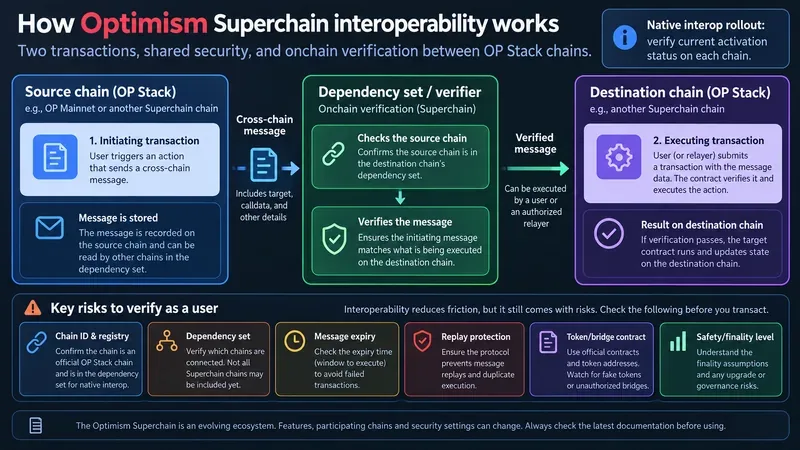
The most important point in September 2026 is that “part of the Superchain” does not automatically mean “native Superchain interoperability is live between these two chains.” Optimism has published the protocol design for low-latency cross-chain messaging, and the OP Stack specifications define the messaging, dependency-set, bridge, and verification rules. But Optimism’s September 25, 2026 update on Upgrade 20 says that the current fault-proof upgrade is preparing the system for interoperability, while a future hard fork will actually enable native cross-chain messages. Users should therefore verify the live status of the exact source chain, destination chain, asset, and route before treating an interchain transfer as “native interop.” See Optimism’s Upgrade 20 interoperability update and the OP Stack interoperability specification.
A conceptual view of the native Superchain interoperability design. Activation is chain-specific, so users should verify that the route shown by a wallet or app is actually enabled for the source and destination chains they intend to use.
What a good interoperability outcome looks like
For an end user, interoperability is successful when the intended asset or action arrives on the intended destination chain, through a route whose security model is understood, at an expected cost and within an expected time window. A fast transaction alone is not enough. The user should also be able to confirm the destination chain, token contract, bridge or messaging contract, and the status of the cross-chain action.
Before approving a transfer, you should be able to answer five questions:
Which exact source and destination chain IDs are being used?
Is this route native OP Stack interoperability, a canonical L1 bridge path, or a third-party bridge or omnichain protocol?
Which token contract will be burned, locked, minted, or released on each side?
What safety or finality level does the app wait for before it considers the transfer complete?
What happens if the message is delayed, expires, or cannot be relayed?
If the interface cannot make those answers reasonably clear, that is a signal to switch to a better-documented route rather than simply proceeding because two networks both use the OP Stack.
How native Superchain interoperability is designed to work
1. A source-chain transaction creates an initiating message
In the native interop design, a cross-chain action starts with a transaction on the source chain. A Solidity event, or log, emitted by that transaction can serve as an initiating message. The OP Stack identifies that message using information including the source chain, block number, timestamp, log index, and message payload. The specification deliberately separates “a message exists” from “a message has been executed elsewhere.” Details are defined in the OP Stack messaging specification.
2. The destination chain receives a separate executing transaction
A second transaction is submitted on the destination chain. It references the initiating message and asks the destination-side contracts to execute the corresponding action. This two-transaction model matters because a source transaction does not directly mutate the destination chain. The destination must independently validate that the referenced source message is valid.
The low-level system contract is the CrossL2Inbox. For general application messaging, the OP Stack specifies an L2ToL2CrossDomainMessenger on top of it. The messenger adds protections that application developers would otherwise need to implement themselves, including destination-domain binding and replay protection. The interop predeploy specification documents those contracts and their invariants.
3. The source must belong to the destination’s dependency set
Native interop is not “all OP Chains can read all other OP Chains by default.” The protocol uses a dependency set: a defined group of chains whose messages may be accepted as dependencies by one another. The OP Stack specification says chains in the same dependency set form a mesh, but adding a chain is itself a network upgrade. The current specification also says chains cannot simply be removed from a dependency set after inclusion.
That means users should distinguish two facts that are easy to conflate: a chain can be listed in the Superchain ecosystem, while not being in the same active native-interoperability dependency set as another chain. The Superchain Registry is the official index of Superchain chains and their configurations; the dependency-set specification explains the additional rule that determines which cross-chain messages are valid.
4. Cross-chain validity becomes part of fork choice
The security mechanism is deeper than a bridge UI checking a transaction hash. OP Stack derivation rules require an executing message to correspond to a valid initiating message from an allowed dependency chain. A block containing an invalid executing message must not become safe. It can temporarily exist as an unsafe block, but the protocol is designed to reorg invalid cross-chain execution out of the canonical view.
This is why “I saw the destination transaction immediately” and “the destination result is safely cross-verified” are not identical statements. For higher-value transactions, the quality of the result improves when the application exposes and waits for an appropriate safety level instead of treating the earliest visible inclusion as final.
Token transfers add another layer of checks
Messaging and token interoperability are related but not identical. The OP Stack specification defines a SuperchainERC20 standard and a SuperchainTokenBridge. In that model, a compatible token is burned on the source chain and minted on the destination chain, with the cross-chain messenger providing authentication, replay protection, and destination binding. The standard also requires compatible deployments to use the same token address across participating chains.
However, users should not infer from a familiar ticker symbol that a token is a native SuperchainERC20, or that a particular app is using the official Superchain token bridge. Some assets use third-party omnichain systems or custom bridges. Others may have legacy representations that are not directly compatible with native interop. The official token-bridging specification describes the SuperchainERC20 model, including burn-and-mint behavior and compatibility requirements.
The user risk checklist: what to verify before sending
Check
Why it matters
What a satisfactory result looks like
Native interop activation
The protocol may be specified but not yet activated for that chain pair.
Current official docs or chain configuration explicitly show the route is active.
Chain ID and network
Names and branding can be copied, and chain-ID mistakes can send users to the wrong network.
The wallet, app, explorer, and official chain configuration agree on source and destination chain IDs.
Dependency set
A destination chain cannot natively execute messages from an arbitrary source chain.
The source chain is part of the active dependency set for the destination route.
Token contract
Identical symbols can represent different assets or bridge wrappers.
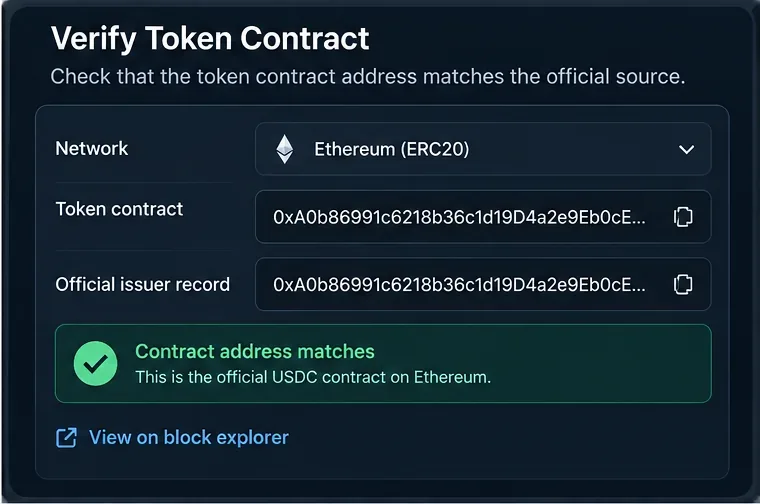
The token address and representation match the issuer or official bridge documentation on both chains.
Bridge or messaging contract
A polished UI can still point to an unofficial or malicious contract.
The app’s contract addresses match official documentation or a trusted chain registry.
Message expiry
The native messaging specification has a seven-day expiry window for execution.
The app relays well within the window and documents how to resend or recover if it does not.
Replay and destination binding
Custom cross-chain executors can introduce mistakes if they do not bind a message to one destination or prevent reuse.
The route uses the standard messenger or clearly documents equivalent protections.
Safety/finality
An unsafe block is not the same as a cross-verified safe or finalized result.
The application states what confirmation level it uses and when funds can safely be spent again.
Fees and slippage
“Native” does not mean “free,” and third-party routes may add liquidity or relayer fees.
The interface shows the fee model and, for swaps, the expected output and slippage before approval.
Failure recovery
Cross-chain flows have more failure states than a single-chain transfer.
There is a documented way to inspect, retry, resend, refund, or obtain support for a stuck message.
Message expiry is a real operational constraint
The interop messaging specification sets a seven-day expiry window. An executing message must be included no later than seven days after the initiating message’s timestamp. The purpose is to keep historical validation tractable. If a message has not been relayed before expiry, the specification anticipates that it can be resent rather than executed indefinitely from old history.
For most normal app flows, seven days is a large margin. But it matters during outages, paused bridges, relayer failures, or periods when an application is not actively monitoring a pending transfer. A good interface should therefore show pending status and recovery instructions instead of leaving the user to assume that an old message will remain executable forever.
When to use another route
Native Superchain interoperability is a strong fit when the exact chain pair is activated, the token or application is designed for it, and the interface exposes enough information to verify the transaction path. It is not the right choice merely because both networks are OP Stack chains.
Consider using a canonical L1 bridge route, a well-documented asset-specific route, or waiting for native activation when any of the following is true:
The official Optimism material says native messages are not yet activated for the chain pair.
The app does not identify which bridge or messenger contracts it uses.
The destination token address cannot be verified with the issuer or official bridge.
The transfer depends on a third-party liquidity network whose security model you have not reviewed.
The amount is large enough that you prefer slower settlement with clearer finality and recovery procedures.
For a new route, a small test transfer remains useful. It does not prove the route is risk-free, but it can catch wrong-network, wrong-address, unsupported-token, and unexpected-fee mistakes before a larger transfer.
Three assumptions to avoid
“Every Superchain member is already natively interoperable.” Not necessarily. Membership in the Superchain Registry and activation in an interop dependency set are different conditions.
“The same token symbol means the same asset.” Not necessarily. Verify the contract and bridge model. Native SuperchainERC20, legacy OP Stack tokens, issuer-managed omnichain assets, and third-party bridged tokens can have different trust assumptions.
“Fast destination inclusion means final settlement.” Not necessarily. Cross-chain execution can appear at an unsafe level before it reaches stronger cross-verified or finalized status.
Bottom line
Optimism’s native Superchain interoperability is designed to make OP Stack chains behave more like a coordinated network: one chain emits an initiating message, another executes it, and protocol-level verification checks that the dependency is valid. Standard messengers and token bridges add destination binding, replay protection, and common asset-transfer rules.
But in 2026, the quality of the user outcome depends on one discipline above all: verify the live route, not the roadmap. Check the exact chain IDs, dependency-set status, contracts, token representation, safety level, expiry behavior, and recovery path. If those pieces are clear and current, native interop can reduce cross-chain friction. If they are unclear, switching to a better-documented route is a better outcome than assuming that “Superchain” branding alone guarantees interoperability.