An issuer reserve attestation can help answer a narrow but useful question: at a specified date, did the assets included in the report meet or exceed the specified stablecoins in circulation under the report’s stated criteria? It cannot, by itself, prove that every holder can redeem instantly, that assets remain unchanged after the cutoff, or that an issuer has no other financial or operational risks. A sound review begins by matching the report’s date, token scope, and definitions before comparing the headline totals.
This guide focuses on fiat-referenced stablecoins and issuer-published third-party attestations. The SEC Division of Corporation Finance’s April 4, 2025 statement describes one category of USD stablecoins that it addressed; the statement is staff views, not a Commission rule, and its scope is limited. Other tokens, currencies, legal regimes, or redemption structures can differ. See the SEC staff statement on stablecoins for its scope and caveats.
What should a reserve attestation let you conclude?
At minimum, a useful report should identify the issuer or reporting entity, the named token, the measurement date and time, the outstanding-token amount or related liability, the reserve assets and their measurement basis, the criteria used, and the independent accountant’s conclusion. The conclusion should connect the amount of reserve assets to the amount of tokens in circulation for the same reporting scope.
The AICPA’s Stablecoin Reporting Criteria provide a framework for presenting information about outstanding stablecoins and the assets backing them. A separate report or criteria section may address operational risks and controls. These are different questions: a point-in-time reserve comparison does not automatically establish that issuance, redemption, custody, cybersecurity, or reporting controls operated effectively throughout a period.
How to verify the numbers without comparing unlike figures
1. Open the issuer’s original report
Start from the issuer’s official transparency or regulatory-reporting page. Follow the link to the actual accountant’s report or reserve statement instead of relying on a press release, exchange dashboard, token tracker, or a search-result snippet. Confirm that the report names the token you are researching and that the accountant’s report is attached to the figures. A reserve page can contain useful daily or weekly data, while the independent attestation may be monthly; do not treat the two as the same evidence.
For example, Circle’s transparency page distinguishes reserve disclosures from monthly third-party assurance, while Paxos directs readers to monthly reports for its issued assets. Those pages are examples of issuer disclosure patterns, not proof that another token follows the same process. Use the relevant issuer’s own report for the asset under review.
2. Match the reporting date, not just the publication date
Find the report’s “as of” date and, where given, the exact cutoff time and time zone. Then find the date attached to every figure you plan to compare. A report released this week may describe month-end balances. A live dashboard may have refreshed more recently. Comparing current circulating supply with reserves measured at an earlier month-end can create a false shortfall or a false cushion.
Write down the two dates before doing arithmetic. If the token amount and reserve value do not refer to the same cutoff, locate a matching report or clearly label the comparison as an approximate cross-date check. For operational monitoring, check whether the issuer has published a newer report and whether meaningful issuance, redemption, or reserve changes occurred after the attestation date.
3. Confirm that the token and supply definitions match
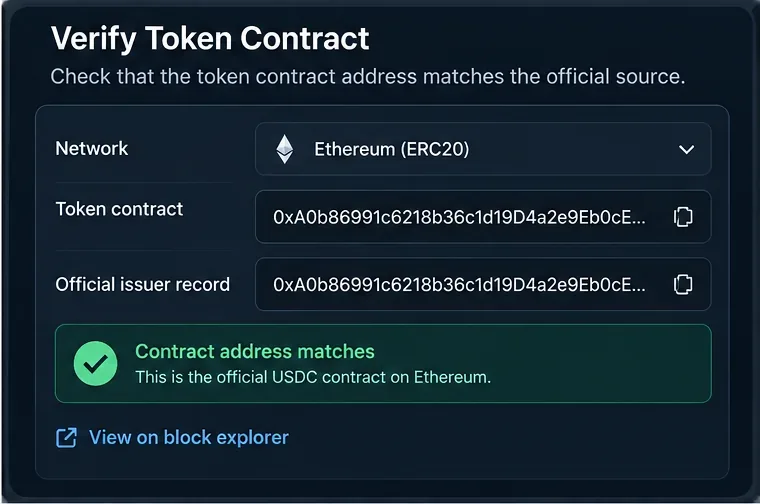
Read the report’s definition of “outstanding,” “in circulation,” or “tokens subject to redemption.” These terms can depend on the criteria and issuer’s methodology. Check which legal issuer and token contract are covered, whether the report includes every supported blockchain, and how it treats tokens held by the issuer, burned tokens, bridge representations, or other excluded balances. Do not assume that a number from one chain explorer equals the report’s total liability.
Also check whether a reserve pool backs one token or several. If assets are shared or allocated across multiple products, identify the report’s method for assigning assets to the token being assessed. A company-wide reserve total is not a valid numerator for one coin unless the report shows that the assets are attributable to that coin and are not being counted twice.
4. Read the accountant’s opinion and criteria
Locate the independent accountant’s report, not only the issuer’s management statement. Identify the accounting firm, the subject matter examined, the criteria applied, and the conclusion. Check for qualifications, exceptions, a scope limitation, a modified conclusion, or language that says the accountant did not examine particular assets or information. If the opinion refers to an accompanying schedule, make sure you have that schedule too.
“Attestation” is not a magic synonym for “full audit.” The engagement’s scope, procedures, and assurance level matter. A report examining a management assertion at a specified point in time is narrower than a full audit of the issuer’s financial statements and does not test every future redemption. The AICPA describes its reporting criteria as a framework for consistent disclosure; its January 2026 update also added criteria related to controls over stablecoin operations. Read the actual report to see which parts apply.
5. Reconcile reserve assets to token obligations
Use the reserve total and token amount as defined by the report, on the same date and currency basis. A simple coverage calculation is:
Reserve coverage = eligible reserve assets at the reported measurement value ÷ covered tokens outstanding under the report’s criteria.
For a one-dollar token, compare the dollar value of eligible assets with the dollar value of covered token obligations. Coverage at or above one means the stated reserve value is at least as large as the stated obligation within that report’s boundaries. It does not mean every asset is cash available at every instant or that the report covers events after its cutoff.
Next, inspect the asset schedule instead of stopping at the total. Separate cash from Treasury bills, money-market fund shares, repurchase agreements, or other permitted instruments. Read whether values are fair value, amortized cost, face value, or another defined amount. Review maturity, liquidity, custodian, concentration, and any notes about liens, lending, or restrictions. An asset’s category and access path can matter even when its reported value contributes to a sufficient total.
Common ways readers misread a “fully backed” number
- Mixing dates: a current supply figure and a month-end reserve figure may not be directly comparable.
- Mixing scopes: a consolidated issuer total may include other tokens, currencies, entities, or products.
- Confusing face value with measurement value: a bond’s principal amount is not necessarily the figure used in an attestation.
- Ignoring exclusions: the report may define circulation or eligible assets more narrowly than a public dashboard.
- Treating reserve coverage as redemption access: holders may face eligibility rules, fees, minimums, banking hours, or intermediary requirements. Read the redemption terms separately.
- Assuming a snapshot is continuous proof: a point-in-time report cannot establish what happened before or after its measurement date.
These checks help explain why two apparently official numbers may differ without either being an error. If the report’s definitions do not let you reconcile the difference, treat that as an unresolved limitation and seek the issuer’s methodology or a newer, clearer report.
How to judge the result and when to change your approach
A stronger result has a recent, clearly dated report; a named independent accountant; an identifiable standard or criteria; a clear conclusion; token and asset definitions that reconcile; and enough reserve detail to understand asset type and custody. Keep a short review note with the report link, measurement date, token contract or issuer entity, denominator, eligible reserve value, coverage calculation, opinion wording, and any open questions. That record makes the assessment repeatable when the next report arrives.
Pause and investigate when the report is missing or stale, the report excludes a material part of circulation, several tokens appear to share reserves without a clear allocation, the accountant’s conclusion is qualified or unclear, or the reported assets cannot be reconciled to the token obligation. Look for an issuer clarification or subsequent report. If the issue concerns access to redemption, legal rights, or asset custody, reserve arithmetic alone is not enough; examine the governing terms and applicable regulator disclosures, and consider qualified legal or financial advice for a consequential decision.
Do not switch to a third-party “proof” dashboard as a substitute unless you can independently understand its data sources, timing, and methodology. On-chain balances can help confirm token supply at an address or contract, but they do not establish ownership, lack of encumbrance, off-chain bank balances, or the legal availability of reserve assets. Use them as a separate cross-check, not as a replacement for the accountant’s scope and source records.
What an attestation cannot settle
An attestation is evidence about a defined subject, under stated criteria, at a stated time. It does not guarantee a stable market price, instant redemption, freedom from bank or custodian failure, or the issuer’s solvency in every respect. It may not cover reserves after the cutoff, all operational controls, every related company, or the rights of every secondary-market holder. Even a favorable report should therefore be one input in a risk review alongside redemption terms, jurisdiction, custody arrangements, operational disclosures, and the reader’s own need for liquidity.
Sources checked September 29, 2026: the Circle Transparency & Stability page (page stated reserve information as of September 24, 2026 and described weekly disclosures and monthly assurance); the AICPA Stablecoin Reporting Criteria and its January 2026 update; the SEC Division of Corporation Finance statement dated April 4, 2025; and Paxos’s regulatory and transparency page. Issuer pages and reporting practices can change; verify the report currently linked for the specific token before relying on it.