Home
» Ecosystem
»
Sui vs. Aptos: What Their 2026 Growth Plans Reveal About Two Move Layer 1s
Sui vs. Aptos: What Their 2026 Growth Plans Reveal About Two Move Layer 1s
The current answer: the comparison is moving from raw speed claims to product fit
Two verified 2026 developments sharpen the Sui versus Aptos comparison. Aptos Foundation said in May 2026 that it and Aptos Labs were committing more than $50 million across trading and AI initiatives. Sui’s official materials have simultaneously emphasized identity, decentralized storage, on-chain market infrastructure, and institutional-facing use cases. These are ecosystem directions, not proof that either chain will outperform the other in users, fees, total value, or token price.
The practical takeaway is that Sui and Aptos are no longer best understood only as “fast Move chains.” Both use Move-derived technology and pursue parallel execution, but they organize state differently and are making different product bets. Sui is especially distinctive for its object-centric model; Aptos is especially distinctive for parallel execution over account-based resources. For builders, the better choice depends on the application’s state pattern, toolchain fit, liquidity and integration needs, and ability to operate securely—not on a headline throughput number.
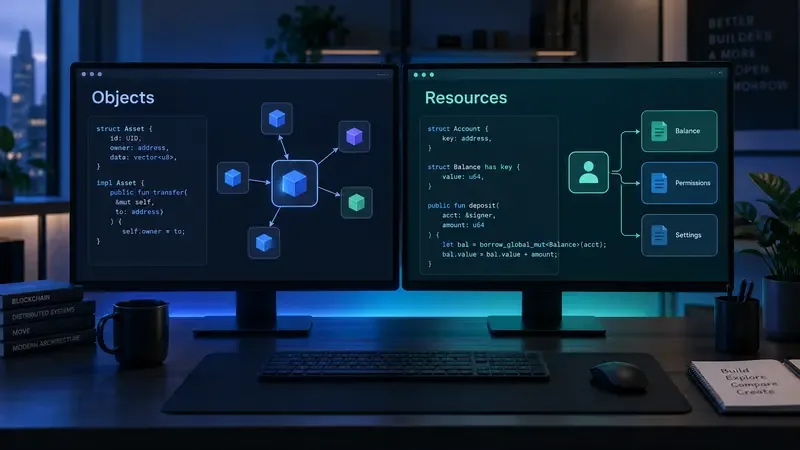
A conceptual comparison of object-oriented and resource-oriented state models; it is not a screenshot of either network’s software.
Shared roots do not mean identical developer experience
Both networks draw from the Move language lineage, which was designed around digital assets as resources that should not be copied or accidentally discarded. That safety-oriented foundation matters: it can make ownership rules explicit at the language level. Yet “Move” is not a single interchangeable runtime. Smart contracts, framework APIs, wallet standards, transaction construction, indexing, and deployment tooling differ between Sui and Aptos. Porting code should be treated as an engineering project, not assumed to be a copy-and-paste exercise.
Aptos documents its model as accounts and resources running on MoveVM. Its official Move overview describes Move objects, resource accounts, tables, and the network’s execution model. Sui’s object-model documentation describes on-chain objects that have metadata, a type, and ownership. This difference changes how teams reason about shared state.
Technical comparison: object ownership versus account resources
Dimension
Sui
Aptos
Why it matters
Primary state lens
Objects with ownership and references
Resources stored under accounts, plus objects and tables
It shapes data modeling, access control, and transaction inputs.
Parallelism approach
Can distinguish independent owned objects from shared objects; shared access can add coordination pressure
Block-STM executes transactions in parallel and re-executes conflicts
Real performance depends on contention in the specific application.
Consensus documentation
Mysticeti is a DAG-based protocol with validators proposing blocks in parallel
Consensus orders transactions before execution; execution is handled by Block-STM
Consensus and execution should be evaluated together, not as isolated TPS marketing.
Native product surfaces
DeepBook, zkLogin, Walrus and digital-asset tooling are prominent in official docs
Move tooling, resource accounts, ecosystem integrations, and trading/AI initiatives are prominent in official materials
Native primitives can shorten a product’s integration path.
On Sui, an application can model a user-owned asset or a game item as an object. Transactions that touch unrelated owned objects may be easier for the network to treat independently. In contrast, an application centered on a heavily shared object—such as one global pool or registry—must be designed carefully because many transactions contend for the same state.
On Aptos, Block-STM starts from a consensus order, attempts parallel execution, then re-executes transactions that conflict. The Aptos execution documentation explains this multi-threaded, in-memory approach. Aptos also warns in its resource documentation that hot global resources can serialize writers, while per-user state usually parallelizes better. That is a useful design lesson for either chain: a network’s capability does not remove contention created by the application itself.
What Mysticeti changes—and what it does not
Sui’s current consensus documentation says Mysticeti is a directed acyclic graph-based protocol in which multiple validators can propose blocks in parallel; it states that three rounds of messages are required for a commit. Read the Sui consensus documentation for the protocol description.
That is a meaningful architectural distinction, but it should not be converted into a blanket user promise such as “every Sui transaction is instantly final.” End-user experience also depends on the wallet, RPC provider, application design, transaction type, congestion, and whether the transaction touches shared state. Likewise, an advertised benchmark is not the same thing as the cost, reliability, or latency that a particular decentralized exchange or game will deliver at peak demand.
Ecosystem growth: evaluate the direction, not a single dashboard number
Recent official announcements show both ecosystems targeting financial and institutional use cases, but they approach growth from different angles. Aptos Foundation’s 2026 ecosystem updates include its announced commitment of more than $50 million across the stack for trading and AI, along with news about tokenized securities and projects in its broader ecosystem. Funding announcements indicate intent and available support; they do not guarantee adoption or revenue.
Sui’s developer documentation highlights DeepBook for on-chain trading, Walrus for decentralized storage, zkLogin for onboarding with existing Web2 logins, and a digital-asset stack. See the Sui documentation home page. Its 2026 blog also reports developments involving tokenized funds and identity infrastructure. These are potentially relevant to teams building trading, consumer, media, or identity-adjacent products, but a project should independently verify which tools are production-ready, supported in its region, and appropriate for its compliance obligations.
Which chain fits which builder?
Sui may fit better when
Your core product is naturally a collection of user-owned assets, collectibles, tickets, game items, or composable objects.
You want to assess Sui-native building blocks such as zkLogin, DeepBook, Walrus, or its object model before assembling third-party alternatives.
Your team can design carefully around shared-object contention rather than assuming all state is independent.
Aptos may fit better when
Your state model is more naturally organized around accounts, resources, resource accounts, and tables.
Your team values Block-STM’s optimistic parallel execution model and can benchmark its own conflict patterns.
Your roadmap aligns with Aptos ecosystem support for trading, tokenization, payments, or AI-related product development.
These are starting hypotheses, not a scorecard. A developer should build the smallest real transaction flow on both test environments: create an account or wallet, submit representative transactions, handle failures, inspect indexer output, test upgrades, and measure the user journey. A working prototype will reveal more than a generic “TPS” comparison.
Questions investors and users should ask before treating ecosystem news as a verdict
Is the claimed growth supported by primary documentation, a live product, or only an announcement?
Are there independent applications with repeat usage, not just incentives or launch activity?
What security assumptions do the bridge, wallet, RPC provider, and smart contracts add beyond the base chain?
Can the application handle a congested shared state path or a failed transaction gracefully?
Does the project need a particular stablecoin, venue, custody integration, jurisdictional approval, or developer library that is already available on one chain?
Token price is a separate and highly speculative question. Network upgrades, grants, or partnerships can affect attention without determining long-term token value. Neither SUI nor APT ownership should be inferred from an assessment of developer technology.
Bottom line
Sui and Aptos share the Move heritage but offer meaningfully different ways to structure on-chain state and parallel work. Sui’s object model and Mysticeti-based design make it compelling to evaluate for asset-heavy and consumer-facing applications, especially where its native product stack helps. Aptos’s account-and-resource model with Block-STM is compelling for teams that want optimistic parallel execution and ecosystem momentum around markets and AI.
The verified 2026 updates are significant because they clarify each ecosystem’s priorities, not because they settle the contest. The durable comparison is application-specific: model your state, test your high-contention path, confirm the integrations you need, and treat ecosystem announcements as inputs to diligence rather than investment conclusions.
This article is general education and not investment, legal, tax, or security advice.