Home
» News
»
AI-Generated Smart Contracts: Where They Help, Where They Fail, and How to Use Them Safely
AI-Generated Smart Contracts: Where They Help, Where They Fail, and How to Use Them Safely
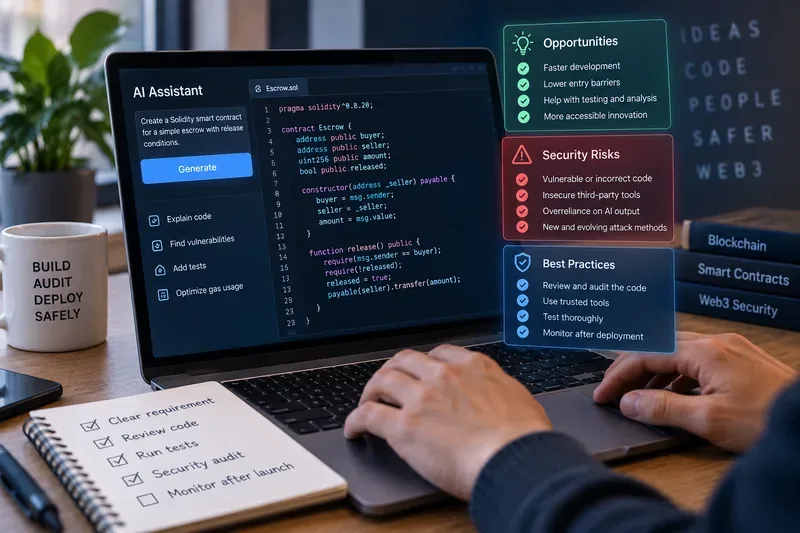
AI-generated smart contracts can shorten the distance between an idea and working Solidity code, but that convenience changes the risk profile of development rather than removing it. The strongest use case today is not “ask a model for a contract and deploy it.” It is using AI as an assistant inside a disciplined engineering process that still treats specifications, tests, access control, dependency choices, audits, and deployment governance as human responsibilities.
That distinction matters because smart contracts can hold assets and enforce irreversible state changes. Ethereum's security guidance, last updated February 26, 2026, emphasizes that deployed contract code is difficult or impossible to patch directly and recommends independent review, testing, static analysis, compiler warnings, documentation, and careful access control. The current Ethereum smart contract security guidance therefore remains a useful baseline even when code is produced with AI assistance.
AI can accelerate drafting, explanation, testing, and review, but production smart contracts still require clear specifications, independent verification, trusted libraries, and deployment controls.
What has changed with AI-assisted smart contract development?
The major change is speed. A developer can now describe an escrow, vesting schedule, NFT minting rule, role system, staking contract, or test case in plain English and receive a plausible implementation within seconds. Models can also explain unfamiliar code, suggest edge cases, generate unit tests, translate between framework patterns, and help document interfaces.
What has not changed is the security burden. Solidity's own security documentation still warns that contracts interact with hostile callers, public state, external contracts, compiler behavior, and execution environments that can create unexpected outcomes. The Solidity security considerations continue to highlight reentrancy, external-call risks, public visibility of state, and the importance of patterns such as Checks-Effects-Interactions.
A 2026 preprint titled Evaluating the Vulnerability Landscape of LLM-Generated Smart Contracts reported recurring serious flaws in contracts produced by several current language models. Because it is a preprint rather than a finalized industry standard, its exact findings should not be treated as universal defect rates. It is still useful evidence for a practical conclusion: syntactically valid and functionally complete AI output is not equivalent to production-ready security.
Where does AI provide the most value?
1. Rapid prototyping
AI is particularly useful when the goal is to explore design choices quickly. A team can compare a minimal escrow contract with a role-based version, an upgradeable version, or a pull-payment design before committing to one architecture. This can reduce the cost of early experimentation.
The tradeoff is that prototypes often omit controls that matter in production: emergency pause logic, explicit role boundaries, event coverage, failure modes, upgrade authorization, token compatibility, or edge-case handling. The faster the prototype is created, the more important it becomes to prevent prototype assumptions from silently becoming production assumptions.
2. Boilerplate and well-understood standards
AI can save time on repetitive code when the desired behavior already maps to established standards. For example, it can help assemble an ERC-20 or ERC-721 implementation using trusted components rather than rebuilding basic token logic from scratch.
This is where library choice matters. OpenZeppelin describes its current Contracts package as a library of community-vetted components for standards, permissions, and reusable smart contract building blocks. Its documentation also distinguishes audited stable releases from development releases. See the OpenZeppelin Contracts documentation. For many production projects, asking AI to compose reviewed library components is safer than asking it to invent equivalent primitives from scratch.
3. Test generation and review assistance
AI can be effective at generating ordinary unit tests, adversarial scenarios, property ideas, documentation, and review checklists. It is also useful for explaining why a suspicious function might be vulnerable and for proposing additional tests around access control or external calls.
The limitation is that AI-based review can miss exactly the business-logic error that matters most. A model may recognize textbook reentrancy but fail to understand that a protocol's economic assumption, price source, accounting sequence, or governance transition is wrong. Research published in 2025 also found that LLM-based vulnerability detection can suffer from both false positives and low recall for some modern Solidity weakness classes. That is a reason to combine AI review with execution-based tests, static analysis, fuzzing, invariants, and expert review rather than replacing them.
What security risks are most important?
Risk
Why AI can make it worse
Practical control
Access-control mistakes
Generated code may use overly broad ownership or forget role checks on sensitive functions.
Define privileges before coding; use vetted access-control components; test every privileged path.
Logic errors
The code can compile and still implement the wrong business rule.
Write a human-readable specification and test invariants against it.
Reentrancy and unsafe external calls
A model may produce familiar-looking transfer logic without considering callback behavior across contracts.
Use established patterns, guards where appropriate, and adversarial tests.
Oracle and pricing assumptions
Generated code may trust a spot price, stale feed, or manipulable pool without understanding the economic context.
Specify price-source requirements, freshness rules, fallback behavior, and manipulation resistance.
Upgrade mistakes
AI may mix constructor patterns with proxy patterns or modify storage layout unsafely.
Use upgrade-specific libraries and automated storage-layout checks.
Dependency risk
Generated imports may be outdated, unaudited, or incompatible with the intended deployment.
Pin reviewed dependencies and verify versions manually.
The OWASP Smart Contract Top 10 for 2025 lists access-control vulnerabilities, price-oracle manipulation, logic errors, missing input validation, reentrancy, unchecked external calls, flash-loan attacks, arithmetic issues, insecure randomness, and denial of service among major classes of smart contract weakness. The full list is available from the OWASP Smart Contract Security project. AI-generated code can encounter any of these categories; there is no separate security exemption because the source was produced by a model.
Is AI safer when it uses trusted libraries?
Usually, but only if the integration is correct. Using established components can reduce the amount of custom security-sensitive code, which is valuable. It does not guarantee that roles, parameters, inheritance, initialization, upgrade logic, or external integrations are correct.
Consider access control. OpenZeppelin notes that access control determines who may mint, vote, freeze transfers, or perform other sensitive actions, and provides both simple ownership and more granular role-based mechanisms. Its access-control documentation makes clear that the choice of mechanism should match the application. AI can insert an Ownable contract quickly, but a protocol with several administrators, delayed operations, emergency roles, and governance responsibilities may need a more structured authority model.
What about upgradeable contracts?
Upgradeability creates a clear tradeoff. Immutable contracts reduce the ability of an administrator to change behavior after deployment, but they also make defects harder to repair. Upgradeable proxy systems make fixes and feature changes possible, but add storage-layout constraints, privileged upgrade paths, initialization rules, and governance risk.
OpenZeppelin's current upgrade documentation explains that proxy-based upgrades preserve the proxy address and state while switching implementations, and warns that storage layout cannot be changed arbitrarily. This is a poor area for blind AI generation because code that looks reasonable in isolation can corrupt state when used as an upgrade. If upgradeability is required, use tooling that checks storage compatibility and have a reviewer who understands the proxy model.
Which development approach fits which need?
Need
Reasonable AI role
Recommended verification level
Learning Solidity
Explain syntax, generate small examples, compare patterns.
Compile locally, read official docs, use test networks only.
Prototype or hackathon
Draft contracts and tests rapidly.
Static analysis, unit tests, limited-value deployment, no assumption of production safety.
Help prepare implementation changes and migration tests.
Storage-layout checks, upgrade authorization review, testnet rehearsal, governance review, independent audit for material changes.
How should teams review AI-generated contracts?
Start with requirements, not code. Write down who can call each sensitive function, what assets move, what must always remain true, what external contracts are trusted, how prices are obtained, what happens on failure, and whether the contract is upgradeable. Then compare the generated code against those requirements.
Next, treat the output like code from a new contributor whose work has not been reviewed. Compile with an appropriate stable compiler, resolve warnings, run unit tests, fuzz inputs, test invariants, run static-analysis tools, review external calls, inspect permissions, and verify dependency versions. Ethereum's current security guidance explicitly recommends version control, pull-request review, static analysis, warning-free builds, documentation, and independent review before deployment.
Finally, separate generation from approval. The person or system that produces a contract should not be the only mechanism deciding whether it is safe. For high-value contracts, independent review is a control, not bureaucracy.
When should AI-generated code be rejected rather than repaired?
Rewriting is often better than patching when the generated architecture is difficult to explain, contains unnecessary complexity, mixes incompatible patterns, invents dependencies, or cannot be mapped cleanly to a written specification. Security review becomes harder as reviewers spend more time reverse-engineering what the code is trying to do.
A smaller contract built from understood components may be preferable to a sophisticated generated design that nobody on the team can confidently maintain. Solidity documentation has long recommended keeping contracts small and understandable for exactly this reason.
How do you know AI is improving the development process?
Measure outcomes that matter. Useful indicators include reduced time to produce reviewed code, greater test coverage, more edge cases identified before deployment, fewer review cycles for routine work, and better documentation. Do not use “lines of code generated” or “time to first compile” as the main success metric; both can improve while security quality gets worse.
Also track escapes: defects found after review, vulnerabilities discovered in testing, deployment rollbacks, emergency pauses, and audit findings. If AI makes coding faster but produces more severe review findings, the workflow needs adjustment.
Bottom line
AI-generated smart contracts are most useful as an acceleration layer for developers who already have a secure development process. They can reduce repetitive work, speed up prototyping, produce tests, explain code, and help teams explore alternatives. They are least reliable when treated as an autonomous security authority or a substitute for understanding business logic.
For low-stakes experimentation, AI can do more of the drafting. For production systems that hold meaningful value, the safer tradeoff is narrower: let AI assist with code and analysis, while humans retain responsibility for specifications, architecture, permissions, dependency choices, testing, audits, upgrades, and deployment. The standard for success is not whether the contract compiles. It is whether the contract does exactly what was intended under adversarial conditions, and whether the team can demonstrate that with evidence.