หน้าแรก
» ความรู้
»
Red Flags in Crypto Whitepapers and Roadmaps You Must Never Ignore
Red Flags in Crypto Whitepapers and Roadmaps You Must Never Ignore
A polished website can make a crypto project feel more mature than it really is. A colorful whitepaper, a multi-year roadmap, and a countdown to a token sale may look like evidence of progress, but they are still claims made by the project. For a beginner, the first skill is not predicting price. It is learning which claims can be checked and which gaps should stop you before you connect a wallet or send money.
Research note: the information and links in this guide were checked on September 16, 2026. Crypto assets, project documents, contract addresses, and legal requirements can change. This is an educational due-diligence checklist, not a recommendation to buy or sell any asset.
What a whitepaper and roadmap actually tell you
A whitepaper is a project document that describes a proposed problem, technical design, token or network role, and operating assumptions. A roadmap is a plan for future milestones. Tokenomics means the economic design of a token: supply, distribution, utility, incentives, and unlock schedule. A smart contract is a program deployed on a blockchain that can control token transfers, permissions, and other actions.
These documents are useful because they show what a team says it is building. They are not independent proof that the product works, that the team will deliver, or that the token will retain value. Ethereum’s own documentation describes its roadmap as a plan that is expected to change, while the current Ethereum site warns that its original whitepaper no longer reflects the network after years of development. That is a useful lesson: even a serious project’s documents have a date and a scope.
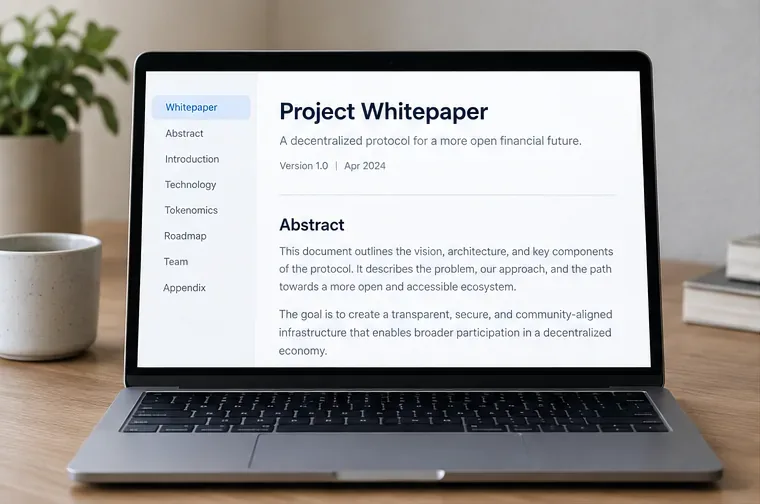
An illustrative whitepaper screen shows an abstract, a version date, and sections such as technology, tokenomics, roadmap, and team; use these sections as an initial reading checklist.
Beginner action: before thinking about price, record the document title, version, publication date, project name, blockchain, token contract address, and official links. If the project cannot provide a stable versioned document or a consistent contract address, pause immediately.
Step 1: Read for a testable explanation, not impressive vocabulary
Start with the problem statement. What user problem exists today? Who has it? Why does a blockchain or token improve the solution? A credible explanation should connect the problem, the proposed mechanism, and the way users would actually interact with the product. Technical terms are not automatically a sign of quality. A document can be long and still avoid explaining what the token does.
Red flag: the document is mostly slogans
Be cautious when the whitepaper repeats phrases such as “revolutionary,” “next-generation,” or “global adoption” but gives no measurable mechanism, assumptions, limitations, or test results. A short document is not automatically bad, and a detailed document is not automatically good. The question is whether you can translate the main claim into something that could later be checked.
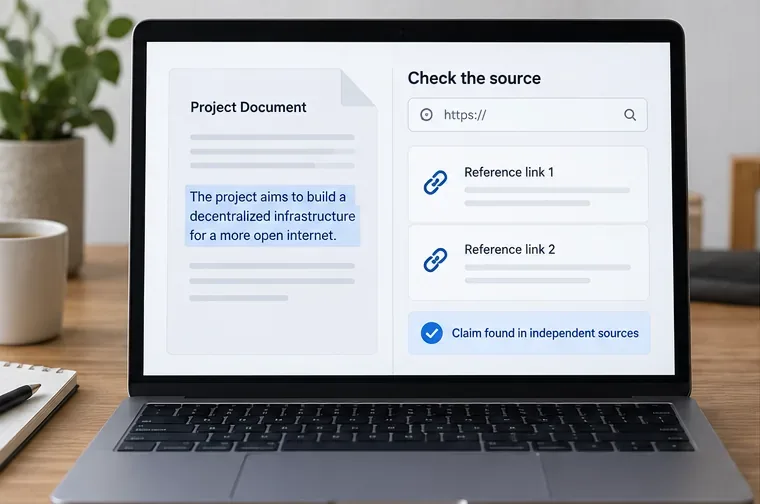
Check this: highlight three factual claims. For each one, write what evidence would prove or disprove it: a public testnet, a working repository, a deployed contract, a customer integration, or a published dataset. If no evidence could ever settle the claim, treat it as marketing rather than analysis.
Red flag: copied or inconsistent material
Look for unexplained changes in the token name, chain, supply, launch date, team names, or terminology. Plagiarized text, broken citations, references to another project, or a document that has no version history are serious quality warnings. The CFTC has specifically advised people considering digital coins or tokens to conduct extensive research and to investigate the individuals and entities connected with an offering.
Check this: search a distinctive sentence in quotation marks, compare the current document with an archived version when available, and ask the project to explain any changed numbers. Do not treat a fast answer in a chat group as evidence; look for a public correction and a consistent update log.
Step 2: Inspect tokenomics before you study the price chart
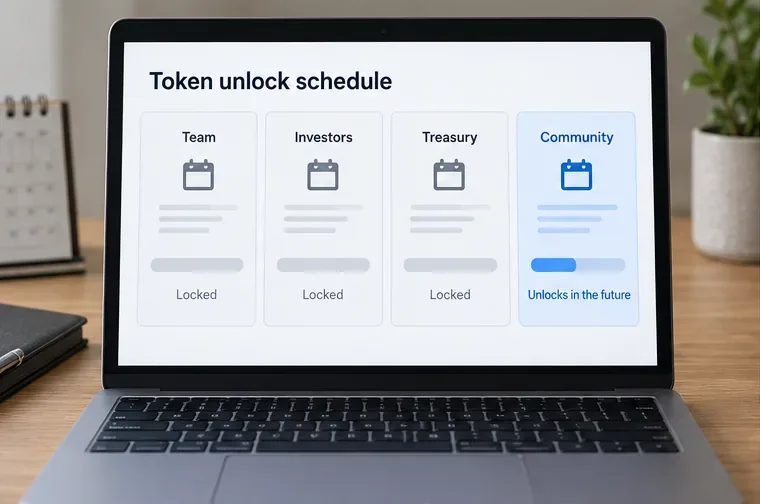
Token allocation tells you who may receive supply and when those tokens may become transferable. Find the maximum or initial supply, current circulating supply, allocations for the team and investors, treasury holdings, market-making arrangements, staking rewards, emissions, and any minting authority. “Community allocation” is too vague unless the document explains recipients, distribution rules, and timing.
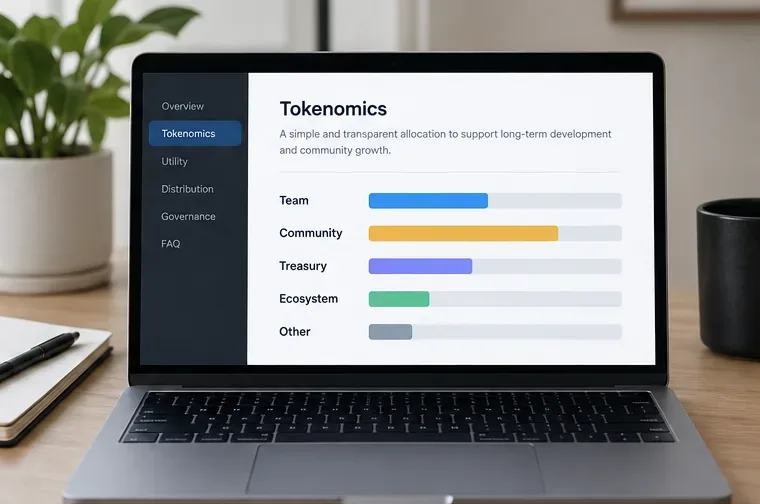
An illustrative tokenomics screen separates team, community, treasury, ecosystem, and other allocations; the reader should look for exact numbers, wallets, and unlock rules in the real documents.
Red flag: large or unclear insider allocations
A large team or private-investor allocation is not automatically fraudulent. It does create a concentration and selling risk. The problem becomes more serious when the project does not publish wallet addresses, vesting terms, or a schedule for unlocking. A low circulating supply can also make early price movement look stronger than the fully diluted supply would suggest.
Check this: build a simple table with four columns: holder category, percentage or number of tokens, wallet or custodian, and unlock date. Mark every field that is missing. Missing information is not proof of a scam, but it is a reason not to rely on the project’s market-cap narrative.
Red flag: utility is defined only as “the token will go up”