หน้าแรก
» ความรู้
»
Understanding Ethereum Gas Fees: How to Save Money on Transactions
Understanding Ethereum Gas Fees: How to Save Money on Transactions
Short answer: Ethereum gas fees are the cost of the computation required by a transaction. You can often reduce what you pay by choosing the right network, waiting when demand is lower, accepting a reasonable priority fee, and reviewing the wallet’s estimated total before signing. The safest savings usually come from using a suitable Layer 2 for supported activity, not from blindly changing advanced fee fields.
Gas is not the same thing as the price of ETH. Gas measures computational work, while the gas price is the amount of ETH paid per unit of that work. The final fee depends on both the amount of gas the transaction uses and the price per unit. A simple ETH transfer generally uses less gas than a swap, NFT mint, liquidity operation, or other smart-contract interaction.
This article separates verified facts from circumstance-dependent guidance and from points that cannot be known in advance. Ethereum’s fee market and Layer 2 ecosystem can change, so the current wallet estimate and the network’s own documentation should always take priority over an old screenshot or a fixed fee table. The technical references were checked on September 16, 2026.
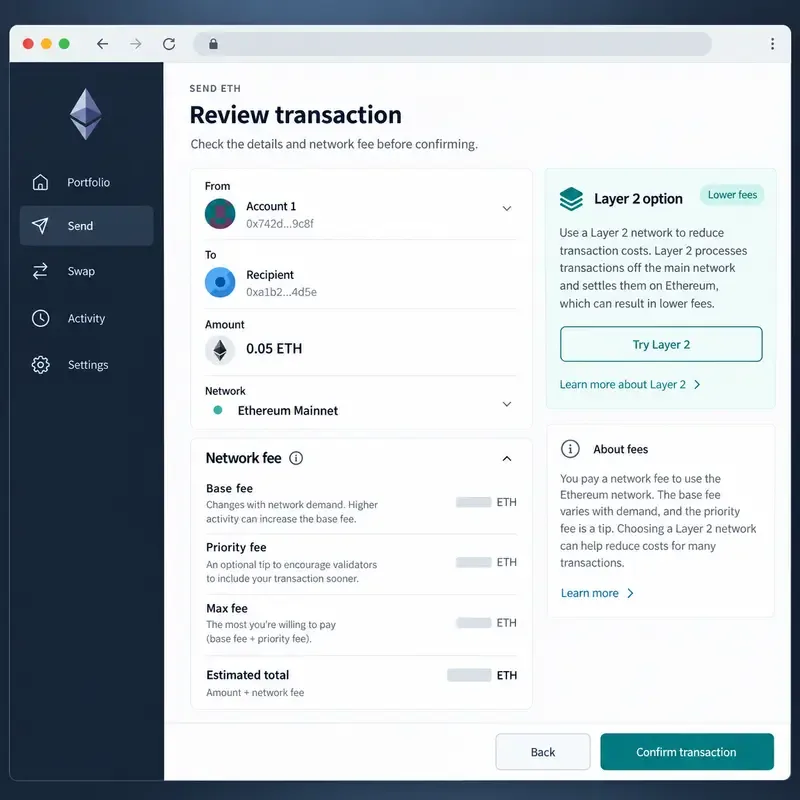
A generic wallet review screen separates the base fee, priority fee, maximum fee, estimated total, and a Layer 2 option; it is an illustrative interface, not a live fee quote or a real wallet screenshot.
What is an Ethereum gas fee?
Every Ethereum transaction asks the network to perform work. That work may be as simple as updating an account balance or as complex as executing several smart-contract operations. Gas is the unit used to measure the computational effort. The fee is calculated from the gas used multiplied by the effective price per gas.
Gas prices are normally displayed in gwei. One gwei is one-billionth of an ETH, or 0.000000001 ETH. Using gwei makes small fee amounts easier to read, but the wallet ultimately deducts ETH from the sender’s account.
Verified fact: Ethereum.org states that the fee is paid for the work of a transaction even when the transaction fails. There is an important technical distinction: a transaction rejected during validation because its gas limit is too low may consume no gas, while a smart-contract call that starts execution and then reverts can still consume gas for the work already performed.
Useful action: before signing, confirm that the destination, contract action, token amount, and network are correct. Do not treat a failed transaction as a harmless test, especially when interacting with an unfamiliar contract.
How the fee is calculated after EIP-1559
For the modern fee market, the most useful simplified formula is:
Transaction fee = gas used × (base fee + effective priority fee)
The base fee is set by the protocol according to recent block demand. It is not paid to the validator; it is burned. The priority fee, also called the tip, is an additional amount intended to make the transaction more attractive for inclusion. The max fee per gas is the most the sender authorizes paying per unit of gas. It is a ceiling, not automatically the amount that will be charged.
The Ethereum gas and fees documentation explains that the base fee can rise when blocks are used above their target and fall when demand is lower. The EIP-1559 specification describes the same mechanism and confirms that the base fee is burned while the priority fee is retained by the block proposer.
Common misconception: setting a high max fee does not necessarily mean paying that entire amount. The sender pays the applicable base fee plus the effective priority fee, within the authorized maximum, and the difference is not charged. Unused gas is also returned under the normal transaction accounting rules.
Useful action: read the wallet’s “estimated fee” and “maximum fee” separately. Treat the maximum as a protection limit, but check that the estimated total is acceptable before confirming.
Which fee settings actually affect cost?
Base fee: the part you usually cannot negotiate away
The base fee reflects demand for Ethereum block space. When many users compete for limited capacity, it can rise. A lower priority fee cannot eliminate the base fee. If the activity is not urgent, waiting for a less congested period may reduce the price per gas, but this is not guaranteed because demand can change suddenly.
Situation-dependent: there is no universal “cheapest hour” that works every day. Network demand is influenced by market moves, popular mints, liquidations, application launches, and other events. A quiet period can become expensive before a pending transaction is included.
Useful action: compare the wallet’s current estimate with a reputable live network view immediately before signing, then decide whether the transaction is urgent enough to send now. Do not rely on a fixed gas price copied from a previous day.
Priority fee: speed versus cost
The priority fee is a tip that signals urgency. A higher tip may improve the chance of prompt inclusion when transactions compete for space, but it does not always produce a meaningful speed improvement. If the base fee is the main source of cost, increasing the tip can add expense without solving the real problem.
Common misconception: the highest possible priority fee is not automatically the best choice. Ethereum.org notes that the appropriate tip depends on current network usage. A transaction that is not time-sensitive may not need an aggressive tip.