หน้าแรก
» ความรู้
»
What Is Impermanent Loss in DeFi Liquidity Pools and How Can You Reduce It?
What Is Impermanent Loss in DeFi Liquidity Pools and How Can You Reduce It?
You add two tokens to a DeFi liquidity pool, trading volume looks healthy, and the pool keeps paying fees. Then one token rallies sharply. When you check your position, you discover that it is worth less than if you had simply held the same two tokens in your wallet. That gap is impermanent loss.
Impermanent loss is not a mysterious fee charged by a protocol. It is an opportunity cost created by the way an automated market maker (AMM) rebalances a liquidity provider’s assets as relative prices move. Fees can offset it, but they do not guarantee a profit. The practical goal is therefore not to pretend the risk can always be eliminated, but to understand when it becomes large, choose pools that fit your risk tolerance, and compare fee income with the value you would have had by simply holding.
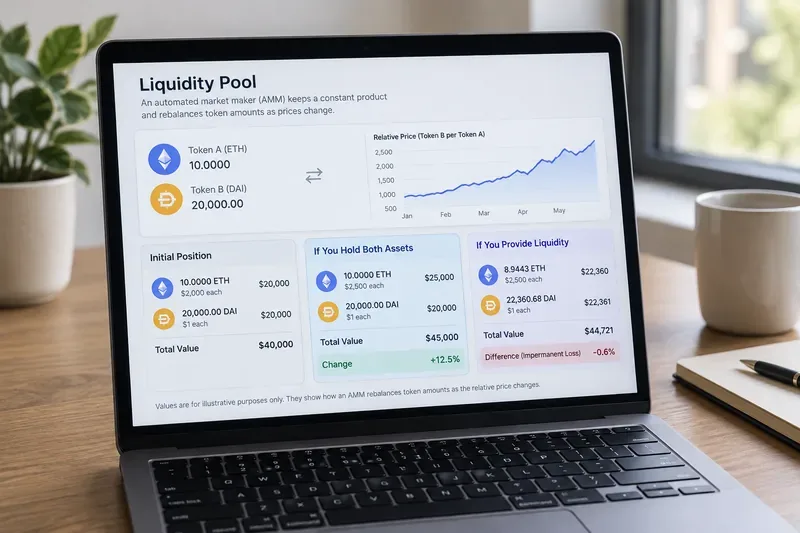
An example of the core trade-off: when the relative price changes, an AMM rebalances the token amounts, so the liquidity-provider position can lag a simple hold strategy even while both positions gain in dollar value.
What is impermanent loss?
Impermanent loss, often shortened to IL, is the difference between the value of assets supplied to a liquidity pool and the value those same assets would have had if they had simply been held outside the pool. Uniswap’s current glossary describes it as the opportunity cost experienced by liquidity providers when token prices change relative to holding the tokens. See the Uniswap Protocol Glossary.
The word “impermanent” comes from the fact that the gap can shrink or disappear if the relative price returns to the level at which liquidity was added. But the label can be misleading. If you withdraw while a gap exists, the difference is effectively realized. And even if you do not withdraw, there is no guarantee the price relationship will ever return to its starting point.
Why does impermanent loss happen?
For a classic constant-product AMM such as Uniswap v2, pool reserves follow the relationship x × y = k. Here, x and y are the reserve balances of the two tokens and k is the invariant. As traders swap against the pool, the reserve ratio changes. Arbitrage traders then tend to trade against price differences between the pool and outside markets, pushing the pool toward the broader market price. Uniswap explains this mechanism in its How Uniswap Works documentation and in the Uniswap v2 whitepaper.
ผลสำคัญสำหรับ LP ก็คือ พูลจะเปลี่ยนแปลงสัดส่วนการถือครองโทเค็นแต่ละประเภทโดยอัตโนมัติ หากโทเค็น A มีราคาสูงขึ้นเมื่อเทียบกับโทเค็น B กิจกรรมการเก็งกำไรมักจะทำให้พูลเหลือโทเค็นที่มีราคาสูงขึ้นน้อยลง และมีโทเค็นอีกประเภทหนึ่งมากขึ้น หากโทเค็น A มีราคาลดลง พูลก็มีแนวโน้มที่จะสะสมโทเค็นที่มีราคาลดลงมากขึ้น เมื่อเทียบกับผู้ถือครองแบบไม่แทรกแซง LP จึงได้ขายโทเค็นที่มีผลการดำเนินงานดีกว่า หรือซื้อโทเค็นที่มีผลการดำเนินงานแย่กว่าเพิ่มขึ้นในระหว่างทาง
ตัวอย่างง่ายๆ ของการสูญเสียที่ไม่ถาวร
สมมติว่าคุณนำ ETH และโทเค็นที่ผูกกับดอลลาร์มาลงทุนในพูลแบบผลคูณคงที่ 50/50 ในมูลค่าเท่ากัน โดยที่ ETH มีราคา 2,000 ดอลลาร์ คุณลงทุน 10 ETH และ 20,000 หน่วยของสเตเบิลคอยน์ ดังนั้นมูลค่าเริ่มต้นจึงอยู่ที่ 40,000 ดอลลาร์