main content
- Casper is a public Layer 1 (L1) blockchain geared towards enterprise adoption.
- Casper's core technology stack includes a consensus protocol built using the Casper Correct-by-Construction (CBC) framework, scalable smart contracts, and weighted key management.
- The ecosystem has several enterprise applications; Personal DeFi and NFT operations have yet to start.
- Casper 2.0 is scheduled for Q3 2023 and seeks to improve the blockchain's consensus mechanism, account structure, and smart contract, and NFT capabilities.
Enterprise blockchain use cases have been introduced a lot, but they have been implemented much less often than retail and crypto use cases, as businesses are generally slower to move and require a more secure, managed, and customized infrastructure.
The Casper Network is a public Layer 1 blockchain that aims to provide a trusted infrastructure for businesses. Its core technological differentiators, including upgradeable smart contracts and weighted key management, are designed for enterprise adoption. Its core technology and evolved partnerships make Casper a leading blockchain for enterprise use cases.
About Casper
CasperLabs was co-founded in Q4 2018 by chief executive officer Mrinal Manohar, who previously worked in private equity and was an early Bitcoin adopter, and CTO Medha Parlikar, who previously held positions senior positions at various software engineering organizations.
![Casper Project Status – Business-friendly Layer 1 Platform]()
Casper gets its name from the Casper Correct-by-Construction (CBC) consensus mechanism, which is based on Casper's own consensus mechanism, Highway. CBC Casper was designed by Ethereum researcher Vlad Zamfir as a potential proof-of-stake (PoS) design of Ethereum. Zamfir published a whitepaper for CBC Casper in late 2017, but the Ethereum Foundation and its developers ultimately chose to pursue an implementation of Casper the Friendly Finality Gadget (FFG), a related consensus protocol. In early 2019, Zamfir joined CasperLabs as the lead consensus protocol architect, but has since left.
In mid-2019, CasperLabs raised US$14.5 million in a Series A funding round. The project released an official Highway report in Q4 2019, detailing the implementation. CBC Casper. After two testnets, two private token sales and a public token sale on CoinList by the Swiss nonprofit Casper Association, the Casper Mainnet launched on March 31, 2021. Along with CasperLabs, the network is supported Sponsored by the Casper Association, a Swiss non-profit organization.
Technology
CBCCasper . consensus mechanism
Casper Correct-by-Construction (CBC) is a consensus mechanism framework that uses mathematical proofs to define a consensus protocol with certain properties. If other consensus protocols were designed according to its blueprint, they could assume properties without having to re-prove them.
![Casper Project Status – Business-friendly Layer 1 Platform]()
CBC Casper attributes include “low cost and secure asynchronous blockchain consensus protocols, Byzantine fault tolerance… traditional consensus protocols” (Source: CBC Casper v0.1). Security is one of the two main security attributes of a consensus mechanism. It ensures that the protocol does not make inconsistent decisions.
Highway
Highway is an extension to CasperLabs' Casper CBC framework. It is a partially synchronous, leadership-based BFT consensus protocol, similar to Hotstuff or Tendermint. However, Highway uses a direct acyclic graph (DAG) for its data structure, which has advantages in throughput and latency. Highway leverages the CBC Casper framework in two main ways:
First, Highway makes sure that the final protocol makes the decision.
In addition, Highway improves finality and flexibility. In Highway, finality is considered a spectrum, depending on the percentage of the total stake of validators who complete each block. The staking amount on completion of a block is the amount of staking that will have to be cut in order for a block to be reverted. Block lengths are dynamic, lasting from thirty seconds to eight minutes.
Validator Economics
Validator bids every epoch, lasting about two hours, to participate in consensus. Top 100 bidders are selected to participate. The limit of 100 validators helps to reduce the cost of sending messages, which is very high on Highway (minimum 20,000 messages per block). The winning bid becomes the validator's stake, and the validator's voting weight is proportional to their stake.
![Casper Project Status – Business-friendly Layer 1 Platform]()
Validators are rewarded with block rewards if they follow the protocol and send messages on time. Inactive or malicious validators will be deactivated until they signal to reactivate. There is currently no severance mechanism, but there are plans in the future to penalize inactive or malicious validators by locking their stakes for an extended period of time.
Calculate
The computation is completed in the WebAssembly (wasm) compiler, and the developer can write smart contracts for Casper in any language that compiles to wasm. In addition, CasperLabs is developing a Solidity to Rust compiler called Caspiler. Casper-JS-SDK allows Dapp developers to communicate with smart contracts.
In contrast to other blockchains, Casper supports upgradeable smart contracts. Casper smart contracts are immutable in the past but subject to change in the future. This feature is geared towards businesses that prefer flexibility in applications. It removes the need for complex migration processes and makes it easier to patch smart contract vulnerabilities.
Accounts
Another key Casper feature geared towards enterprise adoption is support for weighted keys. Accounts can have one or more keys associated with them, and each key can have its own weight. Accounts can set different key thresholds for “deployment” (token transfer, smart contract calling, etc.) and for key management. This allows users and businesses to create wallets with a higher security threshold for key management than implementations.
Current status of Casper Network
Network Activity
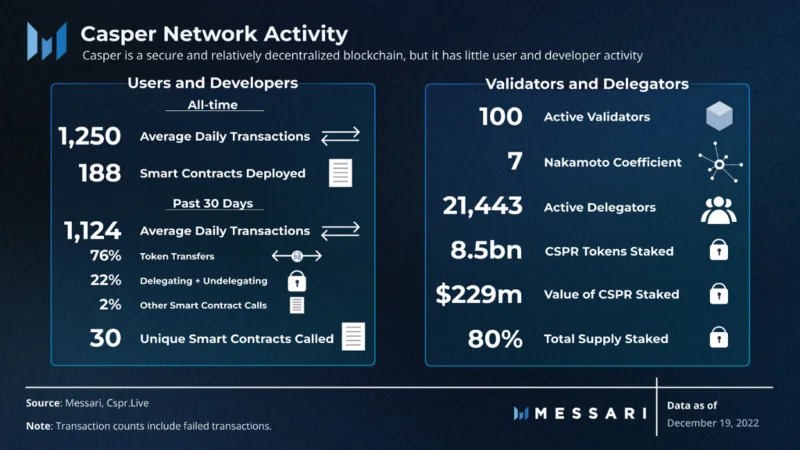
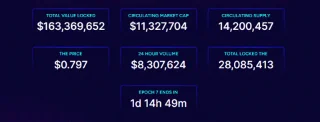
Below is an image depicting Casper's network activity. We will explore each parameter in the next part of the article.
![Casper Project Status – Business-friendly Layer 1 Platform]()
Users and Developers
Since the mainnet launch, there have been a total of more than 785,000 transactions (including failed transactions). On average there are about 1250 transactions per day. In total, 188 unique smart contracts were deployed to Casper.
In the last 30 days:
- The average number of transactions is 930.
- Token transfers accounted for 75% of transactions.
- Authorization and de-authorization accounted for 23% of transactions.
- Smart contracts that do not involve authorization accounted for 2% of transactions.
- 32 different smart contracts were called.
For comparison, the average number of transactions over the past 30 days for the top L1 blockchains is 1 million transactions (Ethereum), 3 million transactions (Polygon), 19 million transactions (Solana), and 2 million transactions. (Avalanche).
Validators and Delegators
The network has a fixed number of 100 validators participating. There are currently 21,443 delegators. Validators and delegators contribute a total of 8.55 billion CSPR ($229 million as of December 20, 2022). The network has a nakamoto coefficient of 7, around the average of the chains aggregated on nakaflow.io.
Ecosystem
Partnerships and business use cases
CasperLabs and Casper have focused on growing the Casper ecosystem regarding partnerships and enterprise use cases.
IPWE: IPWE is a global IP (Intelligent Property) platform. With help from CasperLabs, they are building tools on the Casper Network to enable businesses and governments to better manage patents. These patents are minted as NFTs on Casper, allowing them to be verified, stored, traded, and licensed at a lower cost and with greater transparency than in traditional patent marketplaces. The partnership was announced in early 2021. Since then, 143 patents have been created on Casper. IPWE plans to significantly increase their Casper usage, details to be announced soon.
![Casper Project Status – Business-friendly Layer 1 Platform]()
Metacask: Metacask partnered with CasperLabs to build an NFT marketplace for investments in premium whiskey casks. By bringing this marketplace on-chain, Metacask aims to increase transparency and eliminate operational inefficiencies in the premium whiskey market. Metacask is also building a solution to help brands manage and track their inventory.
The first auction held by Metacask in October 2021 sold a barrel for US$2.3 million on the Ethereum blockchain. Due to scalability issues and the desire for upgradeable smart contracts, Metacask migrated and launched the marketplace on Casper in March 2022. Since then, Metacask has held several sessions Auction. The project team is also working on an improved website that will represent all wine barrels as NFTs on the blockchain but allow customers to pay their payments off-chain.
DeFi
Friendly Market: Friendly Market is Casper's first decentralized automated marketplace, launching in mid-2022.
![Casper Project Status – Business-friendly Layer 1 Platform]()
Users can trade tokens or provide liquidity. The largest pool on the DEX is dUSDC-CSPR, which has about 100,000 USD of liquidity. This DeFi platform also plans to build an NFT marketplace, launchpad, prediction market, and options market.
NFT
CEP-78 Standard: In Q3 2022, Casper developers released the CEP-78 NFT standard. Many new features designed for the enterprise, including upgradeability, mutable metadata, streamlined management, advanced testing, native whitelist functionality.
CSPR.studio: CSPR.studio is an NFT mint platform developed by the same team behind CSPR.live block explorer (MAKE). The platform allows users to easily cast an NFT from an uploaded image, video or audio file. Since its launch a month ago, there have been 468 mints and transfers on the platform.
CasperPunks: To celebrate its third birthday, the Casper Association launched the CasperPunks NFT collection during NFT.NYC in late 2021. The Association held a free giveaway for NFTs. Despite over 90,000 participants, only 62 out of 100 winners received their CasperPunk. The association promises “future benefits and conveniences” to CasperPunk owners, but so far they have not had any benefits or conveniences. NFTs also cannot currently be transferred or sold.
![Casper Project Status – Business-friendly Layer 1 Platform]()
The Casper team is hoping to revive the project with the upcoming minting of 10,000 Gen 1 CasperPunks and Generation 0 holders will be able to automatically claim a whitelist spot. The roadmap outlines future benefits, including CasperPunks in-game utility, IP rights, access to live events, and the metaverse…
Roadmap
Technical improvement
In September, CasperLabs announced plans to upgrade Casper 2.0. The upgrade will include a new consensus protocol, changes to the account and smart contract structure, and NFT improvements. The event was originally announced for Q1 2023, but the upgrade is now delayed until Q3 2023.
Zug Consensus Protocol: Zug is a new consensus mechanism that will be implemented in Casper 2.0. The full article detailing it is still under review, but a recent blog post compared the mechanism to Highway. Zug's main improvement over Highway is to reduce messaging costs, which will allow Casper to increase the validator set limit from 100.
Unified Contracts and Accounts: Under Casper 2.0, a smart contract will have all the properties of an account, including its own token pool that it can use to pay transaction fees and staking for the network. This will allow the app to subsidize gas fees for users.
CasperLabs is also working to improve Casper's data infrastructure. However, this affected the Casper 2.0 upgrade.
Finally, CasperLabs is working on building a hybrid network package. This package will allow businesses and governments to run a private instance of Casper that has sidechain-like checkpoints for the public Casper network. The solution is still under development but a minimum viable product (MVP) release is coming.
Growth strategy
As an enterprise blockchain, Casper's success will depend on attracting quality developers to build apps and form key partnerships with businesses.
To attract developers, Casper Association and DEVxDAO will continue to roll out their available tokens for grants, hackathons, and other developer incentives. The Casper Association recently announced a $25 million funding accelerator program to reward ecosystem builders.
CasperLabs also aims to continue working with businesses exploring blockchain use cases to enhance their business, such as with the IPWE and Metacask projects. Partnerships with China's blockchain-based service network (BSN) in early 2021 and IBM in early 2022 have also been announced. In early January, CasperLabs plans to announce a partnership with Google.
Epilogue
Casper's flexible and secure consensus protocol, scalable smart contracts, and weighted key management make this blockchain platform suitable for enterprise applications. Enterprise applications like IPWE and Metacask brought real-world use cases to Casper. However, on-chain metrics indicate that their adoption has been slow due to a lack of market-appropriate product. Furthermore, with a focus on enterprise adoption, individual activity on Casper is low compared to leading blockchains.
However, the Casper 2.0 upgrade planned for Q3 2023 will improve adoption for businesses and individuals, especially if applications choose to subsidize gas fees under the new smart contract structure. If Casper developers can successfully deploy Casper 2.0 and attract high-impact ecosystem partners and developers, then Casper will be ready in the battle for market share among Layer enterprise blockchains. first.