Home
» Knowledge
»
How to Read a Crypto Whitepaper: A Practical 8-Step Guide
How to Read a Crypto Whitepaper: A Practical 8-Step Guide
The most important rule for reading a crypto whitepaper is simple: treat it as a set of claims to verify, not as proof that the project works. A good whitepaper should tell you what problem the project is trying to solve, how its system is supposed to work, why a token is needed, what assumptions the design depends on, and what risks or trade-offs remain. Your job is to turn those statements into questions you can check against current documentation, source code, on-chain data, governance records, and independent security evidence.
This matters because whitepapers can age quickly. Ethereum’s own website explicitly warns that its 2014 whitepaper no longer reflects Ethereum as it exists after more than a decade of development, even though the document remains useful for understanding the original vision. That is a strong reminder that a whitepaper is often a historical design document, not a continuously updated specification. See the Ethereum whitepaper page for that warning and the original text.
What should you understand before you finish reading?
By the end of your review, you should be able to explain the project in plain English without repeating its marketing language. You should know who needs the system, what changes when they use it, which component creates the claimed advantage, what can fail, where the token fits, who controls upgrades or treasury funds, and which claims you have independently verified.
If you cannot answer those questions after reading the paper, do not compensate by assuming the missing details are favorable. Mark them as unresolved and look for better evidence.
Step 1: Start with the abstract, contents, date, and version
Do not begin by reading every page linearly. First locate the title, publication date, version number, abstract, table of contents, and any legal or technical disclaimer. This gives you a map of the document and tells you whether you are reading an original proposal, a later revision, or an outdated snapshot.
Start by identifying the whitepaper’s version, date, abstract, and section structure before evaluating individual claims.
A date is especially important when a project has already launched. Compare it with current protocol documentation. Solana’s published whitepaper, for example, is a technical proposal that includes a legal disclaimer stating that plans can change and that future outcomes are not guaranteed. You can review the original document at Solana’s official whitepaper PDF.
Quick questions
When was the paper published or last revised?
Is the project already live?
Does the project provide newer technical documentation?
Are the token, governance, or roadmap sections still current?
Step 2: Rewrite the problem and solution in your own words
Find the problem statement and the proposed solution. Then rewrite each in one or two sentences. Avoid the project’s preferred adjectives such as “revolutionary,” “frictionless,” “next-generation,” or “infinitely scalable.” Replace them with concrete nouns, actions, and measurable outcomes.
Separate the claimed problem, proposed solution, assumptions, and trade-offs instead of reading them as one marketing narrative.
For example, Bitcoin’s original paper did not merely say that digital payments should be decentralized. It proposed a peer-to-peer electronic cash system designed to allow online payments to move directly between parties without relying on a financial institution, then described a proof-of-work-based mechanism for ordering transactions. The original paper is available from Bitcoin.org.
After summarizing the problem and solution, ask whether the problem is real enough to require a blockchain or token at all. A project that could work just as well with a conventional database may still be useful, but the whitepaper should explain what decentralization adds and what costs it introduces.
Step 3: Identify the mechanism that makes the project different
Now move to the technical core: consensus, execution model, data availability, privacy mechanism, oracle design, liquidity model, bridge architecture, storage model, or whatever actually creates the project’s claimed advantage. You do not need to understand every equation immediately. You do need to understand the chain of cause and effect.
Translate architecture and consensus sections into a checklist of components, dependencies, security assumptions, and claimed performance benefits.
A useful test is to complete this sentence: “The project claims to achieve X because it uses Y, which works only if Z remains true.” The “Z” part often reveals the most important assumption.
When performance figures appear, check the conditions. A theoretical throughput calculation under a stated network bandwidth, hardware configuration, or idealized workload is not the same as sustained production performance under congestion. Treat every speed, cost, finality, and scalability number as incomplete until you know how it was measured.
Step 4: Audit the tokenomics as a system of incentives
A tokenomics section should answer more than “What is the maximum supply?” You need to understand allocation, issuance, vesting, unlocks, fee flows, staking or security incentives, governance rights, treasury control, and the source of any yield.
Check whether allocation percentages add up, when supply enters circulation, who receives it, and what concrete function the token performs.
Work through the numbers. If insiders, investors, foundations, or ecosystem funds control a large share, ask when those tokens unlock and who can move them. If staking rewards are advertised, ask whether rewards come from protocol revenue, new token issuance, fees paid by users, or another source. High nominal yield funded mostly by dilution is economically different from yield supported by external demand.
Also distinguish token utility from token value capture. A token may be required for fees or governance without automatically gaining value as usage grows. The whitepaper should not be allowed to jump from “the network uses this token” to “therefore the token should appreciate.”
Step 5: Compare the whitepaper with current code and documentation
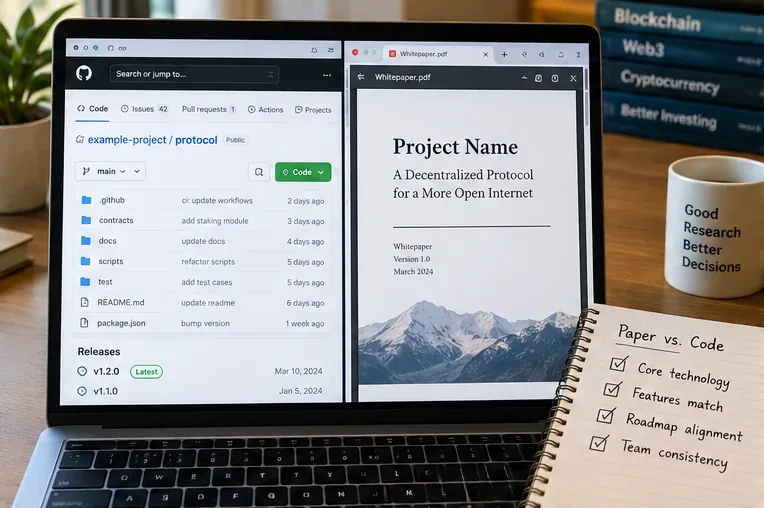
Once you understand the paper, stop treating it as the primary source of truth. Compare it with the project’s current technical docs, public repositories, release notes, deployed contracts, and protocol specifications. Look for features that were removed, renamed, postponed, or materially redesigned.
Compare the paper with current code, releases, and documentation to see whether the implementation still matches the original design.
This step is where outdated whitepapers become obvious. Ethereum is again a useful example: the project’s own whitepaper page tells readers that the original document predates launch and major upgrades. The correct conclusion is not that the old paper is useless; it is that historical design intent and current implementation must be evaluated separately.
For protocol mechanics, favor primary technical sources. Uniswap, for example, publishes its technical material through official documentation, including the Uniswap v2 whitepaper, which describes core design choices such as ERC-20 pairs, price-oracle behavior, flash swaps, and protocol fee mechanics.
Step 6: Verify token and protocol claims on-chain when possible
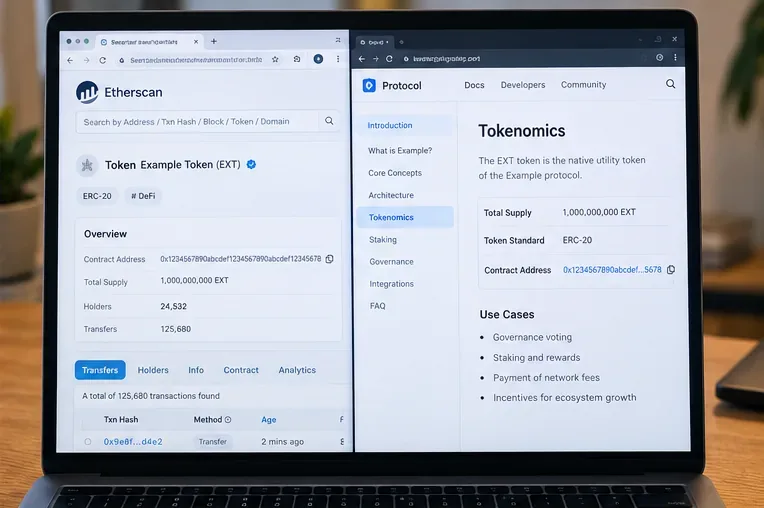
If the project is live, many important facts are no longer theoretical. Confirm the deployed contract address from an official source, then examine verified contract code, supply, holders, minting permissions, upgradeability, treasury wallets, and transaction activity using the relevant chain’s explorer.
Use official contract addresses and on-chain records to check whether supply, token standard, and utility claims match the live system.
Do not trust a contract address copied from a random social post or search result. Start from the project’s official documentation and follow the address to a reputable block explorer. If the whitepaper says supply is capped, look for minting functions or privileged roles that could change supply. If governance is described as decentralized, identify who can upgrade the contracts or change critical parameters.
Step 7: Map governance, admin keys, and real control
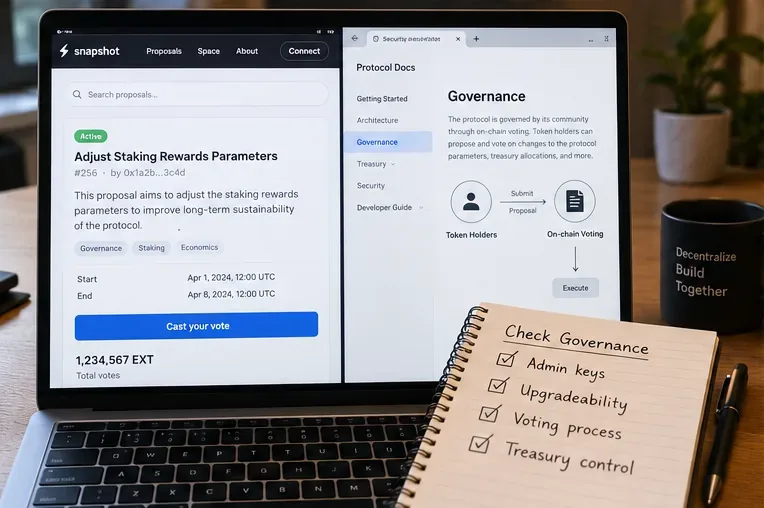
“Decentralized governance” can mean very different things. Determine who can propose changes, who can vote, what determines voting power, whether votes are binding, whether a multisig can override outcomes, how upgrades happen, and who controls the treasury.
Trace how proposals become executable changes and identify any admin keys, upgrade privileges, multisigs, or treasury controls.
Pay special attention to emergency powers. A pause function or upgrade key can be sensible for a young protocol, but it changes the security model. The important question is not whether centralized controls exist; it is whether they are clearly disclosed, appropriately constrained, and consistent with the project’s claims.
Step 8: Finish with a red-flag and evidence check
Before deciding that a project deserves more of your time, separate your notes into three columns: verified, plausible but unverified, and contradicted or unclear. This prevents polished writing from turning into assumed facts.
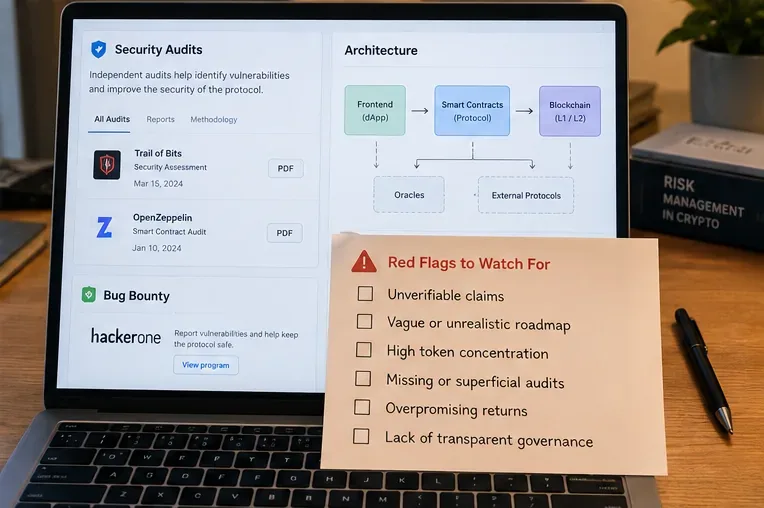
End the review by checking security evidence, architecture dependencies, concentration, governance transparency, and unsupported promises.
Red flags that deserve extra scrutiny
Claims of guaranteed or unusually high returns without a clear economic source.
Performance numbers with no test conditions, methodology, or reproducible evidence.
A token allocation that concentrates control without transparent vesting or governance safeguards.
Anonymous or unverifiable contributors presented as a substitute for technical evidence.
A roadmap full of outcomes but little explanation of dependencies or engineering milestones.
Security claims that rely on the word “audited” without linking to the actual audit report and scope.
Governance language that ignores admin keys, multisigs, upgradeability, or emergency powers.
A whitepaper that conflicts with current code, docs, or deployed contracts.
Regulators also warn investors not to treat crypto materials as a substitute for understanding risk. The U.S. SEC’s Investor.gov notes that crypto asset investments can be highly speculative and may involve volatility, illiquidity, opaque ownership or control, technical failures, and limited investor protections. Read the Investor.gov caution on crypto asset securities for the agency’s investor-focused risk discussion.
A simple whitepaper scoring framework
Area
What good evidence looks like
What should worry you
Problem
Specific users, measurable pain point, clear reason decentralization helps
Vague market-size claims or a problem that does not require the proposed system
Buzzwords without causal explanation or unrealistic performance claims
Token
Allocation, issuance, vesting, utility, fee flow, governance rights
Unclear unlocks, concentrated control, or utility that exists only to justify a token
Implementation
Current docs, public releases, deployed contracts, reproducible behavior
Whitepaper and live product materially disagree without explanation
Governance
Documented proposal, voting, execution, admin, upgrade, and treasury processes
Hidden or poorly disclosed privileged control
Security
Published audit scope, fixes, bug bounty, known limitations
“Audited” as a marketing badge with no accessible report or unresolved findings
How deep should you go?
Your level of review should match your intended exposure. If you are only trying to understand a protocol concept, the whitepaper plus current documentation may be enough. If you plan to use a protocol with meaningful funds, add contract verification, security audits, governance analysis, and operational risk review. If you are evaluating a token as an investment, add supply dynamics, unlock schedules, treasury behavior, legal disclosures, market structure, custody risk, and the possibility of total loss.
You do not need to become a cryptographer to read a whitepaper well. You do need to notice where the paper moves from evidence to assumption. The best outcome is not “I understood every formula.” It is “I know what the project claims, what makes those claims possible, which parts are live today, which parts I verified, and which risks remain unresolved.”
Final takeaway
Read a crypto whitepaper as the beginning of due diligence, not the end. First understand the problem and mechanism. Then test token incentives, compare the paper with current implementation, verify live claims on-chain, identify who really controls upgrades and funds, and finish with an explicit evidence-and-risk checklist. A technically impressive document can still describe a poor investment, and a promising idea can still fail in implementation. The whitepaper is useful precisely because it gives you claims you can challenge.