Home
» Knowledge
»
Sniping Meme Coins at Launch: Tools, Timing, and Risk Controls That Matter
Sniping Meme Coins at Launch: Tools, Timing, and Risk Controls That Matter
Buying a meme coin in the first seconds or minutes after launch is usually called sniping. The goal is simple: enter before most of the market notices the token. The execution is not simple. A launch can combine thin liquidity, rapidly changing prices, congested blocks, bots competing for ordering, malicious token settings, and sellers who are already waiting for new buyers.
That means the most important question is not “How do I buy first?” It is “Can I buy early without accepting risks I cannot measure?” Speed can improve execution, but it cannot turn a bad token into a good trade. This guide focuses on the tools and decisions that matter before, during, and immediately after a launch.
Risk note: meme coins can lose most or all of their value quickly. Launch trading is highly speculative, and blockchain transactions are generally irreversible. The examples below are educational and use illustrative token values rather than live investment recommendations.
What exactly are you trying to gain by sniping?
A launch sniper is trying to reduce the time between a token becoming tradable and the trader's order reaching the market. That can matter when the first few buys move the price sharply. But the advantage is narrower than it sounds: you are competing not only with other people, but also with automated searchers, professional infrastructure, validators or block builders, and traders who may have known about the launch earlier.
On Ethereum-style public mempools, transaction ordering also creates MEV risks. Ethereum's own documentation explains how generalized frontrunners and sandwich traders can observe pending transactions and attempt to place transactions around them. That can worsen execution for a buyer even when the token itself is legitimate. See the Ethereum.org MEV documentation.
On Solana, paying a priority fee can increase the likelihood that the current leader schedules a transaction ahead of competing transactions, but it is not a guarantee of first execution. Solana's current documentation describes the transaction fee as a base fee plus an optional prioritization fee, and notes that requested compute units affect the fee. See the Solana fee documentation.
Which tools do you actually need before a launch?
You do not need the largest possible tool stack. You need a small set of tools that answer different questions quickly:
Tool category
Question it should answer
What to verify
Launch venue
Is this the real token and has trading actually started?
Contract or mint address, launch time, official project links, pool or bonding-curve status
Market scanner
Is liquidity and trading activity real enough to enter?
Liquidity, pool age, price impact, volume, holder concentration, recent transactions
Security checker / explorer
Can the token's authorities or contract settings create unusual risk?
Mint authority, freeze authority, transfer fees, ownership, top holders, token standard
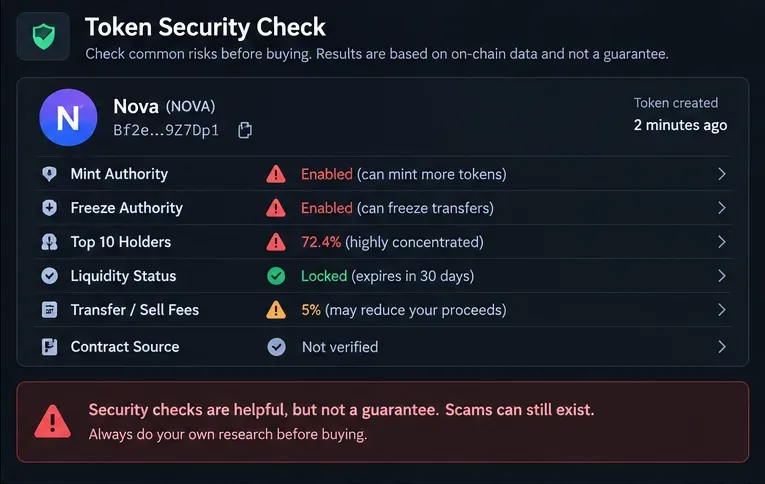
For example, Birdeye documents a token security endpoint and Security Check that can surface signals such as mint authority, freeze authority, transfer fees, liquidity status, owner data, and holder concentration. Birdeye explicitly says these checks are decision inputs rather than guarantees. Review its Security Check documentation and token-security API documentation.
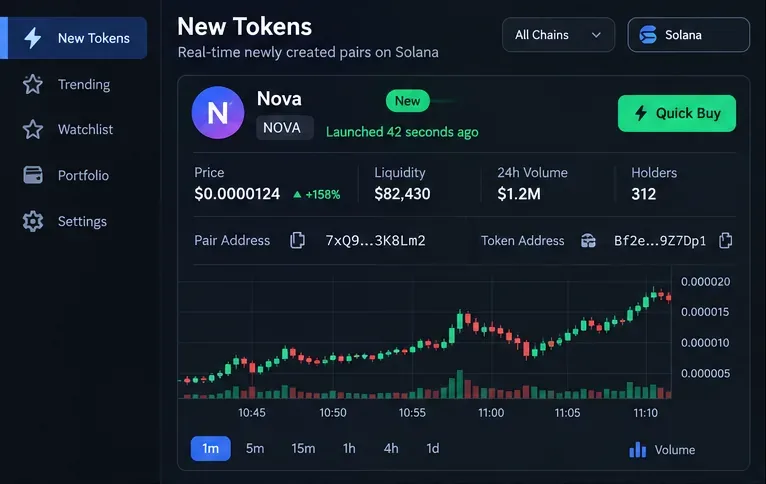
Example launch-scanning view: the useful information is not the green “new” badge but the token address, pool age, liquidity, holder count, and live price behavior.
Should you use an automated sniper bot?
Automation can reduce reaction time, but it introduces another trust boundary. A bot may need a private key, signing permission, an API key, a remote server, or access to a trading wallet. If you cannot independently verify how it handles those credentials, the bot can be a larger risk than the launch itself.
A safer way to think about automation is to separate detection from execution. Detection can monitor new token listings, pool creation, liquidity changes, or preselected contract addresses. Execution should still enforce hard rules: maximum order size, approved token address, maximum slippage, maximum priority fee, and a clear failure condition. A bot that simply buys every new token faster is not a strategy.
For most individual traders, a fast manual workflow with prepared tools is easier to audit than a third-party bot with opaque routing or custody. If you do automate, use a dedicated low-balance wallet and never expose the seed phrase of your primary wallet.
What should you verify before pressing Buy?
The first check is identity. Search by the exact contract or mint address, not only by ticker or token name. Meme coin names are easy to copy, and a fake token can appear before or beside the intended one. Phantom's current scam guidance specifically warns users not to rely on token names alone for trending assets. See Phantom's common token scams guidance.
Then check whether the token has properties that can change your exit assumptions. On Solana, relevant questions include whether mint authority or freeze authority remains enabled and whether Token-2022 transfer-fee features are present. On EVM networks, look for unusual transfer restrictions, owner privileges, taxes, blacklist logic, or upgradeability. A “pass” from one scanner is not enough; use it to decide what needs deeper inspection.
Security checks should be read as risk flags, not a safety certificate. Authority controls, concentrated ownership, fees, and liquidity conditions can materially change a launch trade.
How much liquidity is enough?
There is no universal liquidity number because the relevant metric is your order size relative to the pool. A $200 order can be small in one pool and market-moving in another. What matters is the quoted price impact and how much output you are willing to lose if the pool moves before confirmation.
As a practical rule, reject a trade when your planned order meaningfully changes the price before you even consider network competition. If the quoted impact is already uncomfortable, faster inclusion will not fix the economics.
How should slippage and priority fees be set?
Slippage is not a speed control. It is the maximum execution deterioration you are willing to accept relative to the quote. Raising slippage can make a rapidly moving trade more likely to execute, but it also gives the market more room to fill you at a worse price and may increase exposure to adverse ordering or MEV.
Start with the smallest slippage that has a realistic chance of execution for the pool's volatility and liquidity. If the trade repeatedly fails, do not automatically keep raising the tolerance. Recheck whether the price has moved, whether liquidity has changed, and whether the original entry thesis still makes sense.
Priority fees are different. On Solana, the optional priority fee is designed to improve scheduling priority. The official documentation also warns that the fee calculation for current legacy and v0 transactions depends on the requested compute-unit limit, so over-requesting compute can mean paying for unused capacity. Solana recommends simulating transactions and using an appropriate compute limit rather than simply maximizing it. See the Solana compute-budget documentation.
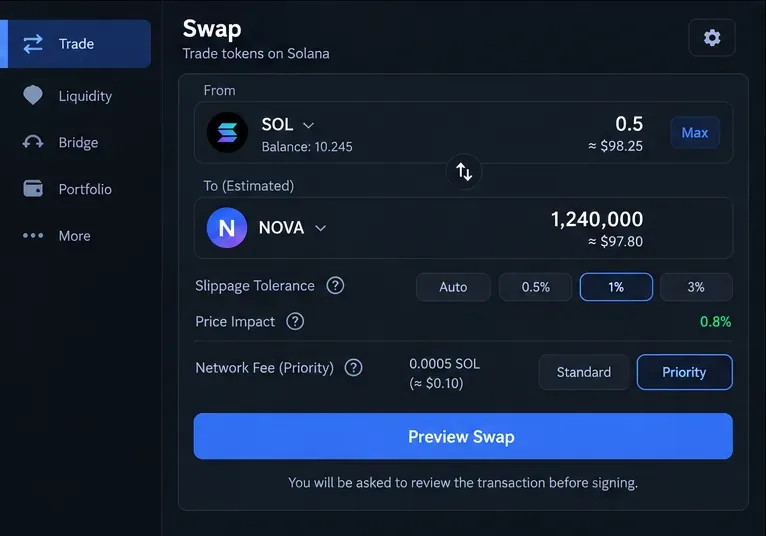
Before signing, separate the controls: slippage limits execution price, price impact reflects pool depth, and a priority fee affects transaction scheduling rather than token quality.
Is buying in the first block actually better?
Not necessarily. The first block can offer the earliest price, but it also contains the least information. You may not yet know whether the pool remains liquid, whether early buyers can sell normally, how concentrated the initial holders are, or whether a creator wallet immediately distributes or sells supply.
A useful alternative is a confirmation-based entry: wait for a small amount of observable trading, verify that sells are occurring, confirm liquidity has not disappeared, and then enter only if the price and risk profile remain acceptable. You sacrifice some theoretical upside in exchange for more information.
That trade-off is especially important on launch platforms where anyone can create a token. Pump's current creation page states that anyone can create coins and warns that prices can move quickly. Its terms were updated September 11, 2026. Review the platform directly at Pump's token creation page and Pump's Terms of Use rather than relying on copied social-media launch links.
What position size makes sense for a launch snipe?
The position should be small enough that a total loss does not affect your broader portfolio or your ability to trade rationally. That is more important than the percentage gain you hope to capture. A token can gap down faster than a stop order can execute, liquidity can disappear, and a contract or token setting can make selling difficult.
Use a dedicated launch wallet with only the funds needed for the trade plus network fees. Phantom recommends a separate wallet or account with limited funds for new or unverified projects. It also notes that disconnecting a decentralized app does not necessarily revoke token permissions. Review the Phantom token-approval guidance.
When should you exit instead of waiting for a bigger move?
Decide this before entry. A launch plan should specify at least three exit conditions:
Thesis failure: liquidity falls sharply, a risky authority becomes relevant, creator or concentrated wallets sell aggressively, or the token no longer matches the launch you intended to trade.
Risk limit: the loss reaches the amount you agreed to risk. Do not increase the position merely because the token is cheaper.
Profit realization: scale out according to a predefined rule rather than assuming a vertical move will continue indefinitely.
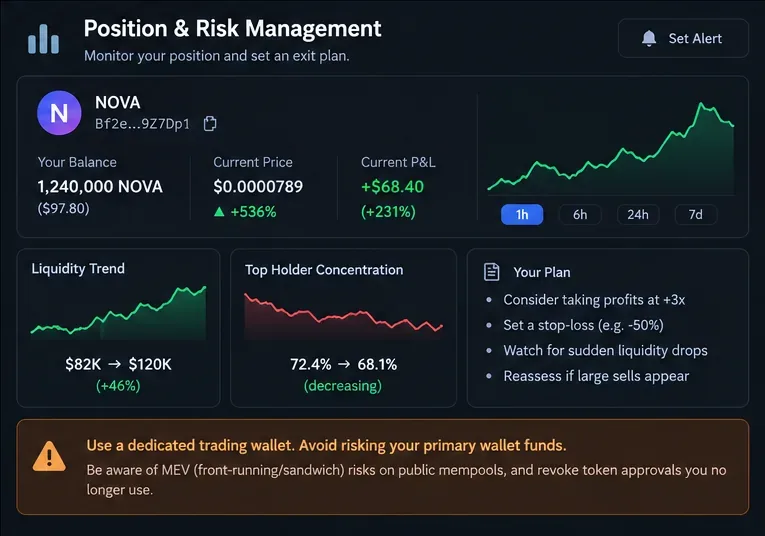
For thin pools, percentage returns shown on a screen can be misleading if your full position cannot be sold near the displayed price. Track executable liquidity, not only mark-to-market profit.
After entry, the job changes from “get filled” to “protect capital.” Monitor liquidity, holder behavior, executable exit size, and the conditions that would invalidate the trade.
A practical launch workflow
Prepare before launch. Fund a dedicated wallet, open the launch venue, explorer or security checker, market scanner, and swap interface.
Verify the exact address. Match the contract or mint address from a trusted first-party project or launch source.
Check token controls. Review authorities, transfer restrictions or fees, holder concentration, and any scanner warnings.
Check the market. Confirm liquidity, pool age, price impact, and whether normal buy and sell transactions are occurring.
Set a fixed maximum spend. Treat it as money that could go to zero.
Set slippage deliberately. Do not use extreme tolerance simply to force a fill.
Use only the priority fee you need. More fee can improve scheduling probability on supported networks, but it does not guarantee ordering or profitability.
Preview and verify again. Confirm the token address, amount, minimum received, route, and wallet request before signing.
Monitor the exit immediately. Watch liquidity and holder behavior, not just price.
Clean up permissions. Disconnect unused apps and revoke approvals or allowances that are no longer needed.
What should make you skip the launch entirely?
Skipping is often the highest-quality decision. Do not force a trade when the token address is uncertain, the security data conflicts across tools, liquidity is too thin for your order, selling cannot be observed, holder concentration is extreme without explanation, the signing request contains unexpected permissions, or the only reason to buy is fear of missing the first candle.
The best launch process is measurable: you should know why the token passed your checks, how much execution deterioration you will accept, what your maximum loss is, and what would make you leave. If you cannot answer those questions before signing, reducing size or waiting for more information is usually more rational than trying to be first.