Home
» Knowledge
»
Day Trading vs. Swing Trading Crypto: Which Strategy is Best for You?
Day Trading vs. Swing Trading Crypto: Which Strategy is Best for You?
There is no universally best crypto trading strategy. Day trading and swing trading are different ways to manage time, attention, risk, and uncertainty. The better choice is the one you can execute consistently after fees, slippage, losing trades, and ordinary life are taken into account.
Day trading means opening and closing positions within a short session, often minutes or hours. Swing trading means holding a position through a larger price move, usually for several days or weeks. These are practical descriptions rather than universal legal definitions. Crypto trades around the clock, so a day trader's defining feature is usually the intention to avoid planned overnight exposure—not a guarantee that a position can never remain open after a technical failure or sudden market event.
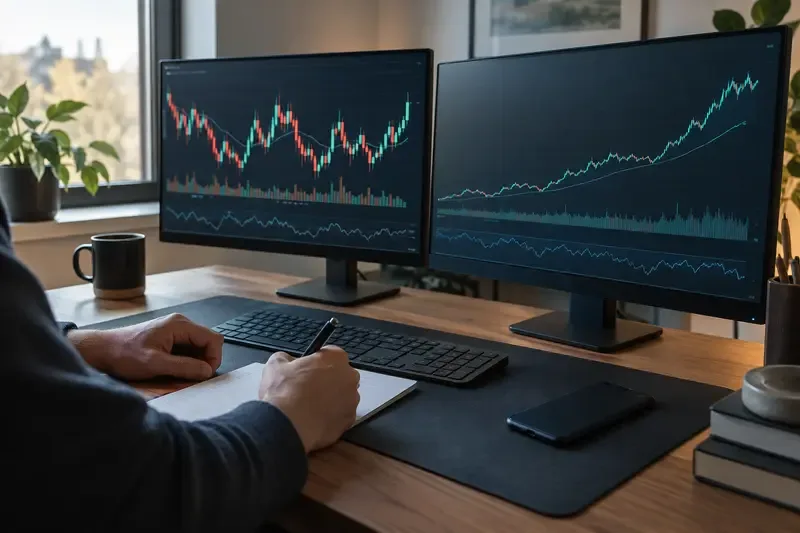
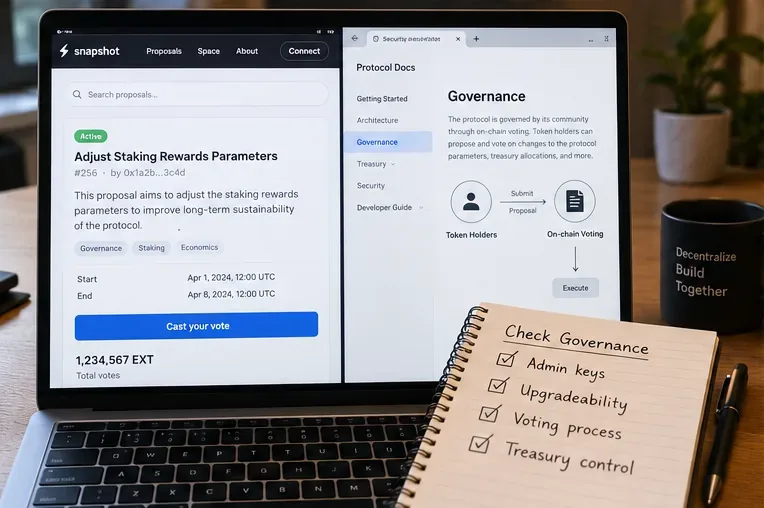
A trader studies short-term price movement on one monitor and a broader trend on the other before choosing a holding period.
Day trading vs. swing trading crypto at a glance
Factor
Day trading
Swing trading
Typical holding time
Minutes to hours; positions are normally closed within the session
Several days to several weeks
Main objective
Capture smaller intraday moves repeatedly
Capture a larger directional move with fewer decisions
Time demand
High; active monitoring and fast execution
Moderate; scheduled analysis and alerts may be enough
Daily or four-hour charts, trend structure, support and resistance, alerts
Best fit
Someone with time, tested execution, and strong process discipline
Someone who prefers patience and cannot monitor markets continuously
What does crypto day trading involve?
A day trader looks for a repeatable intraday setup. Examples include a breakout from a defined range, a pullback during a strong trend, or a failed breakout that returns into the range. The specific pattern matters less than the complete plan: entry condition, invalidation point, position size, exit rule, and maximum daily loss.
The attraction is clear. A trader can finish the day without deliberately carrying a position into a major announcement or a period of low attention. The cost is intensity. A strategy that appears profitable before costs may become unattractive after trading fees, spread, slippage, funding or borrowing charges, and missed fills. Rapid decisions also make it easy to convert one planned trade into a series of impulsive trades.
Day trading should not be confused with simply looking at a one-minute chart. A short timeframe can produce more noise, not more reliable information. The trader still needs a higher-timeframe context, a clearly defined risk point, and evidence from a meaningful sample of historical or simulated trades. FINRA's day-trading risk disclosure for securities describes day trading as extremely risky and says it may not be appropriate for people with limited resources or experience. Crypto markets have additional product, custody, and platform risks, so that warning should not be treated as a promise that a crypto version is safer.
Day-trading strengths
Positions can be planned to avoid intentional overnight exposure.
Many trade opportunities can appear without waiting weeks for a thesis to play out.
Results can be reviewed in a compact, repeatable session.
Small position sizes can be used while a trader tests execution.
Day-trading weaknesses
More decisions create more opportunities for mistakes and overtrading.
Frequent trading makes transaction costs and execution quality central to the result.
It requires uninterrupted attention, reliable connectivity, and emotional control.
A stop order does not guarantee the exact exit price during a fast market or a platform problem.
What does crypto swing trading involve?
A swing trader tries to capture a meaningful leg of a trend or a range movement. The analysis may begin with a daily chart and use a four-hour chart to refine the entry. The trader might define a bullish thesis above a level, a bearish thesis below a level, or a range-bound plan with separate invalidation points. The position remains open while the original idea is still valid, even if the trader is not watching every candle.
Swing trading is less demanding minute by minute, but it is not passive investing. Crypto prices can move sharply while the trader is asleep or away from the screen. A position can also be affected by weekend volatility, exchange outages, a sudden change in liquidity, a token-specific event, or a broader risk-off move. FINRA says crypto assets are often extremely volatile and can be less liquid than traditional financial instruments, which can intensify price swings and make selling more difficult. Those characteristics matter directly to a swing trader because the holding period is longer.
Swing-trading strengths
Fewer decisions can reduce the pressure to react to every small fluctuation.
Scheduled reviews may fit around a job, school, or family responsibilities.
Larger moves can make a strategy less dependent on capturing tiny price differences.
Higher-timeframe analysis can help filter some lower-timeframe noise.
Swing-trading weaknesses
Capital remains exposed for longer and can experience unfavorable moves between reviews.
A stop level may be skipped or filled worse than expected in a fast market.
Leverage and derivatives can add financing, liquidation, counterparty, and product-specific risks.
A correct long-term idea can still lose money if the entry, size, or exit plan is poor.
Which strategy is better for your schedule?
Your schedule is a more useful starting point than your preferred indicator. Choose the approach that matches the attention you can reliably provide, not the attention you hope to provide on an unusually quiet week.
Day trading may fit you if:
You can reserve a specific, uninterrupted trading window.
You are willing to stop after reaching a daily loss limit.
You can follow an entry and exit checklist without improvising after a loss.
You have tested the strategy with realistic fees, spread, and slippage.
You accept that some sessions will offer no valid trade.
Swing trading may fit you if:
You cannot monitor charts continuously but can review positions on a schedule.
You are comfortable waiting for a setup instead of seeking constant action.
You can tolerate temporary drawdowns without moving the stop impulsively.
You understand the risks of holding through news, weekends, and illiquid periods.
You prefer fewer, more thoroughly documented decisions.
If neither checklist describes you, the most responsible answer may be to paper trade, use a market simulator where available, or observe the market without risking money. Crypto assets can be exceptionally risky and volatile. Investor.gov advises that the risk of loss remains significant and that investors should only use money they can afford to lose entirely. That is a risk boundary, not a suggested allocation.
How risk management changes between the two approaches
Risk management is not a separate add-on. It determines whether a strategy can survive a losing streak. A simple position-sizing model is:
Position size = amount willing to lose ÷ distance from entry to stop
For example, if a trader decides that a single trade may lose $20 and the stop is $0.50 away from the entry, the position would be 40 units before accounting for fees, slippage, contract specifications, or any leverage effect. The example illustrates the method; it is not a recommendation for a particular risk amount or asset.
Day traders usually need a daily stop rule in addition to a per-trade limit. Without one, a small edge can be overwhelmed by revenge trading. Swing traders usually need a portfolio-level exposure limit and a plan for what happens if price moves sharply while they are offline. Both should record the reason for entry, the invalidation point, the planned exit, actual execution, fees, and the emotional state at the time.
Leverage deserves special caution. The CFTC explains that funding a futures position with only a fraction of the underlying value creates leverage and that leverage amplifies both gains and losses. Leverage does not turn a weak setup into a stronger one; it makes the consequences of being wrong arrive faster. Beginners should first understand the difference between spot and derivatives, liquidation mechanics, maintenance margin, funding or financing charges, and the platform's rules before considering leveraged products.
A practical decision process
Define your available time. Write down the hours you can actually monitor markets for at least eight weeks.
Pick one holding period. Do not mix a day-trading plan with a swing-trading exit simply because a trade is losing.
Write objective rules. Specify the market, setup, entry trigger, stop, target or trailing rule, and no-trade conditions.
Test with realistic costs. Include fees, spread, slippage, funding or borrowing costs, and missed executions.
Set a loss boundary. Decide the maximum per-trade, per-day, and total account exposure before trading.
Review a sample. Judge the process over a meaningful series of trades, not one winner or one losing day.
Common mistakes to avoid
Choosing day trading because it looks faster: speed increases the number of decisions; it does not guarantee more opportunity.
Calling a losing day trade a swing trade: changing the time horizon after entry is usually an unplanned risk increase.
Using leverage to compensate for a small account: the account size does not remove market, liquidation, or execution risk.
Ignoring liquidity: a chart may look tradable while the available order book cannot support the intended size at the expected price.
Copying a signal without a complete plan: an entry alone does not explain position size, invalidation, custody, or exit risk.
Confusing a backtest with a guarantee: historical behavior can change, especially in a market affected by technology, regulation, liquidity, and participant behavior.
Bottom line: which strategy is best for you?
Day trading is generally a better fit for a trader who has protected time, a tested short-term edge, dependable execution, and the discipline to stop. Swing trading is generally a better fit for someone who wants fewer decisions, can tolerate overnight exposure, and can follow a multi-day plan without constant monitoring.
For many beginners, the most useful first step is not choosing between day and swing trading. It is learning to define risk, track actual costs, and demonstrate consistent execution with very small or simulated positions. Crypto markets can move quickly in both directions, and the CFTC, FINRA, and SEC investor materials all emphasize that volatility, leverage, liquidity, fraud, custody, and platform risks can produce losses beyond what a simple chart suggests.
This article is educational and does not provide personalized investment, tax, or legal advice. Product availability, investor protections, margin rules, and tax treatment vary by country, asset, platform, and account type. Check the current disclosures and rules that apply to you before trading.