Home
» News
»
How to Verify a Surprise Central-Bank Headline Before Trading It: A Five-Source Checklist
How to Verify a Surprise Central-Bank Headline Before Trading It: A Five-Source Checklist
A surprise central-bank headline can move currencies, bonds, equities, gold, and rate-sensitive assets before most traders have time to read the underlying document. The practical goal is not to become the fastest person to react. It is to reach a sufficiently reliable answer about what happened, when it became official, what exactly changed, and whether the headline is missing material context.
This checklist is designed for that decision point. A good verification result should leave you able to state the policy action in one sentence, cite the primary release, identify its publication time, distinguish a scheduled decision from an unscheduled announcement, and explain any operational detail that could change the market interpretation. If you cannot do those things, the headline is not yet fully verified.
What should be verified before a trade?
At minimum, separate five questions that are often compressed into one breaking-news alert:
Authenticity: Did the central bank itself publish the announcement?
Timing: Is the item new, or is an old statement being recirculated?
Policy substance: Did the policy rate, asset-purchase plan, balance-sheet policy, reserve rule, guidance, or another instrument actually change?
Operational detail: When does the change take effect, and are there implementation notes or technical conditions?
Context: Was this a scheduled meeting, an emergency action, a speech, a clarification, or a report that does not itself change policy?
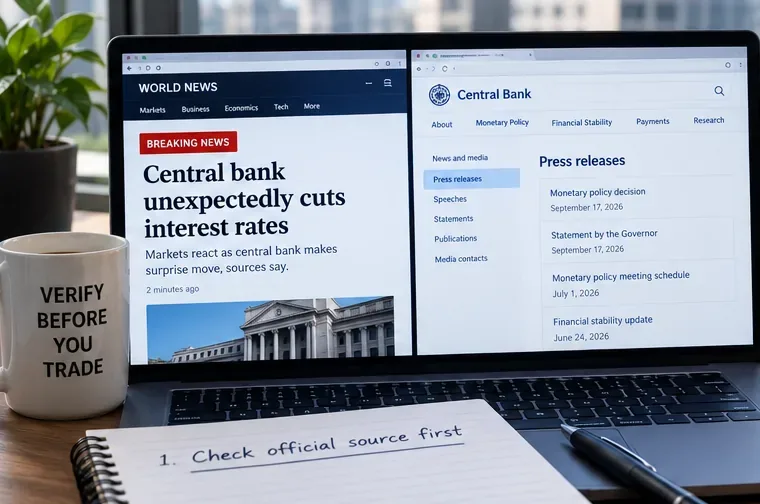
A breaking headline is only the starting point. The first verification step is to find the corresponding release on the central bank’s own website.
The five-source verification checklist
Source
What it answers
What counts as a pass
1. Official decision or press release
Did the policy action actually happen?
The central bank’s own page states the action, date, and policy decision.
2. Official meeting calendar or release schedule
Was the announcement expected?
The event and publication window match the official schedule, or the bank clearly labels an unscheduled release.
3. Supporting official document
What details did the headline omit?
An implementation note, rate table, minutes, statement, transcript, or operational notice confirms the mechanics.
4. Official feed or communications channel
Is the link and timestamp current?
The same release appears through an official RSS/feed or other central-bank-controlled distribution channel.
5. Second authoritative primary record, when relevant
Does another institution have to confirm part of the story?
A counterpart central bank, finance ministry, regulator, debt office, or market operator confirms the portion within its responsibility.
1. Start with the central bank’s own decision page
Search the institution’s official newsroom or monetary-policy section rather than searching the headline wording alone. A legitimate decision page normally provides a publication date, a description of the action, and enough surrounding text to distinguish a rate decision from commentary.
Do not stop at a headline that says “central bank surprises markets” or “officials signal a change.” Those phrases do not tell you whether a formal policy decision occurred. Read the first paragraphs of the primary document and identify the actual instrument: policy rate, target range, asset purchases, reserve remuneration, market operations, forward guidance, or something else.
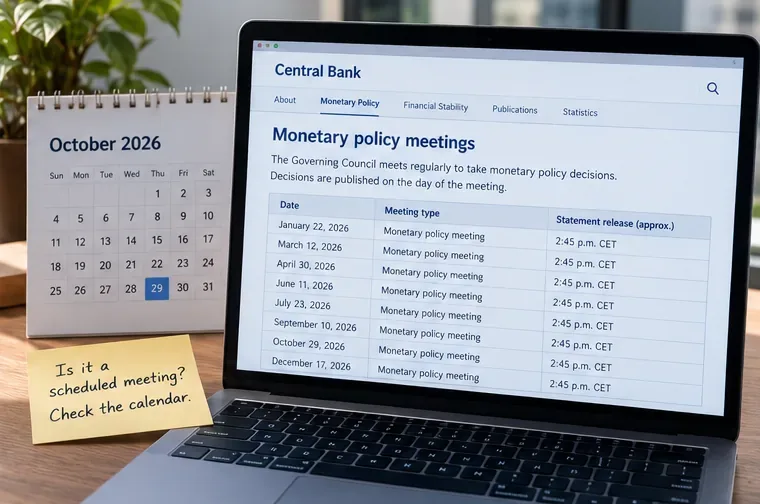
2. Check the calendar before calling it a surprise
A large price move does not prove the announcement itself was unscheduled. Sometimes the meeting was known in advance but the policy outcome was unexpected. Those are different forms of surprise, and they can have different implications for how you interpret the reaction.
Compare the headline time with the official meeting calendar. A surprising decision can still come from a fully scheduled meeting.
The ECB, for example, publishes its Governing Council meeting and press-conference schedule. Its monetary-policy decisions page also states that decisions are normally released at a specified time on meeting days. Similar calendar pages are useful for other central banks.
Convert the official publication time into the timezone used by your trading platform. Around daylight-saving transitions, a familiar local clock time can shift even when the central bank has not changed its release convention. Record both the institution’s local time and UTC if the trade decision depends on seconds or minutes.
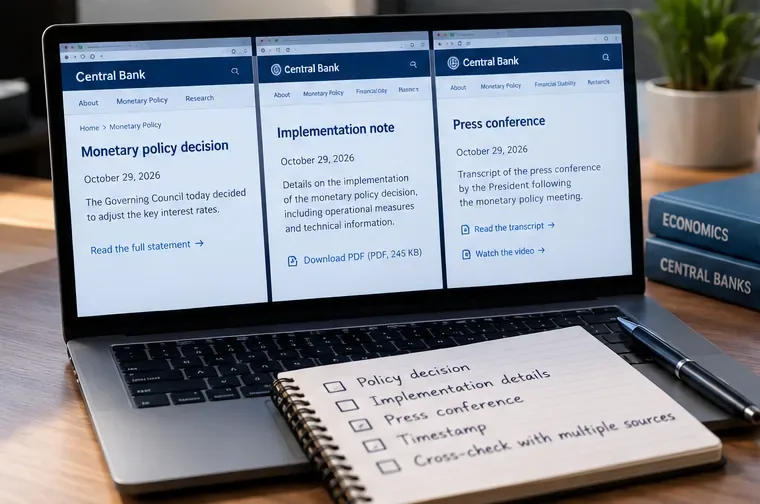
3. Read the supporting document, not just the decision sentence
The market can react to details that do not fit into the first headline. These may include the effective date of a rate change, the voting split, changes to balance-sheet runoff, reinvestment rules, collateral treatment, liquidity operations, or language about future decisions.
The Federal Reserve often publishes an implementation note alongside an FOMC statement. The ECB follows decisions with a monetary-policy statement and press conference; its monetary-policy statements and Q&A archive provides the additional explanation. The Bank of England publishes policy summaries and minutes on its official site, including the vote and rationale. A trader should therefore treat “rate unchanged” as incomplete until the accompanying guidance and mechanics have also been checked.
Supporting documents can change the interpretation of the headline by clarifying implementation, timing, votes, or forward guidance.
4. Use an official feed to check recency and distribution
An official RSS or institutional feed is useful because it helps answer a different question from the webpage itself: when did the institution distribute this item? It can also expose a common failure mode in fast markets—an old article resurfacing with a fresh social-media timestamp.
The Federal Reserve provides official RSS feeds for press releases, monetary policy, speeches, and related categories. The ECB likewise publishes official RSS news feeds covering press releases, speeches, interviews, press-conference transcripts, and other releases.
A matching item in an official feed strengthens confidence that you have the current release and the intended link. It does not replace reading the document. Feeds can be delayed, cached, or consumed at different intervals by different applications.
5. Ask whether another authoritative institution must confirm part of the claim
Some central-bank headlines cross institutional boundaries. In those cases, one central-bank page may not be enough to verify the whole story.
Examples include coordinated swap-line actions involving multiple central banks, foreign-exchange intervention conducted on behalf of a finance ministry, emergency regulatory measures involving a banking supervisor, or trading and settlement changes announced by an exchange or market operator. The correct fifth source is the institution that has formal responsibility for that part of the claim.
This is also where many misleading headlines fail. A policymaker may discuss a possibility without announcing an action; a finance ministry may own the relevant decision; or a market operator may publish different effective dates than a short news alert suggests.
How much agreement is enough?
A useful standard is source convergence, not source count. Five webpages repeating the same unverified sentence are not five independent confirmations. One primary decision page plus an implementation note and the relevant counterpart authority can be stronger evidence than dozens of reposts.
Before acting, you should be able to fill in this short record:
Central bank and policy body
Exact action taken
Publication date and official timestamp
Effective date, if different
Scheduled or unscheduled event
Supporting document checked
Any second authority required
What remains uncertain
The verification process should end with a clear record of what is confirmed and what is still uncertain before an order is considered.
When should you stop and change your approach?
Do not force a conclusion when the primary source is missing. If a headline claims an emergency rate move but the central bank’s current release page, calendar, and official feed show nothing, the appropriate status is unconfirmed, not “probably true.” The same applies when a screenshot circulates without a stable official URL or when the quoted wording cannot be found in the source document.
Switch from fast verification to slower research when:
the policy instrument is unfamiliar or technically complex;
the announcement refers to a facility, collateral rule, or balance-sheet measure you cannot interpret confidently;
different official institutions describe the same event differently;
the effective date is unclear;
the initial statement is followed by a press conference that materially changes the interpretation.
What this checklist cannot tell you
Verification answers whether the headline is authentic and what the official documents say. It does not tell you whether the market has already priced the information, whether the first price move will reverse, or whether a trade offers attractive risk and reward. A true headline can still be a poor trading signal.
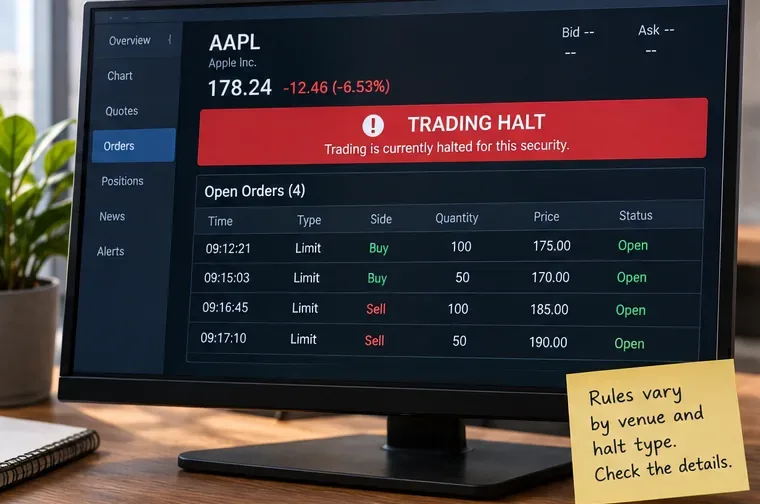
It also cannot eliminate publication latency. Official websites, feeds, video streams, and third-party terminals can update at slightly different times. During extreme volatility, spreads can widen and liquidity can deteriorate before verification is complete. That is a limitation of the market environment, not a reason to lower the evidence standard.
A simple quality test
Your verification is strong enough for decision-making when another person can reproduce it from the same official links and arrive at the same description of the policy action. If your conclusion depends on a cropped screenshot, an anonymous post, an unexplained market move, or wording that cannot be located in the primary release, the result is not yet robust.
The discipline is straightforward: verify the institution, verify the timestamp, read the actual decision, inspect the implementation details, and check any second authority whose mandate is part of the story. That process may cost a few minutes. In a surprise central-bank event, those minutes can be more valuable than acting on a headline you have not yet understood.