Home
» News
»
What Happens to Open Orders During an Exchange Trading Halt? A Current Rules Guide
What Happens to Open Orders During an Exchange Trading Halt? A Current Rules Guide
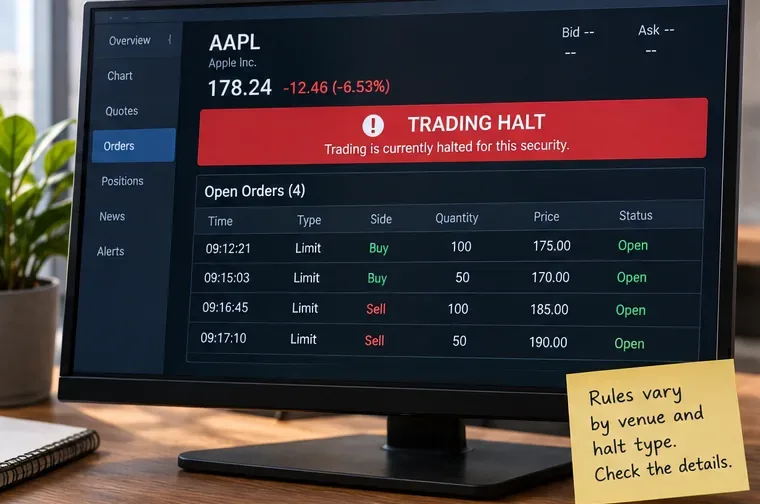
When an exchange halts trading, an open order does not automatically have one universal fate. Depending on the venue, security, halt type, order type, time-in-force, and session configuration, an order may remain on the book, be queued for a reopening process, be canceled, become ineligible, or continue to be cancelable while executions are paused.
This guide reflects official exchange materials available as of September 29, 2026. It focuses on U.S. equities, options, and exchange-traded derivatives because those venues publish detailed halt and reopening procedures. The most important practical rule is simple: do not assume “halted” means “all orders canceled.” Check the venue and the exact halt category.
Quick answer: what can happen to an open order?
Possible outcome
What it means
Why it happens
Remains working or resting
The order stays in the exchange system but cannot execute while trading is halted.
The venue preserves eligible resting orders through the halt.
Queued for reopening
The order is carried into a halt auction or reopening process.
The exchange uses existing and newly entered eligible orders to form a reopening price.
Canceled automatically
The exchange removes the order and sends a cancellation back.
The order type, halt type, member setting, or venue rule requires cancellation.
Cancelable but not executable
You can send a cancel request even though matching is paused.
Many exchanges continue to process cancellation messages during halts.
New order rejected or restricted
New entries may be blocked, limited to certain order types, or accepted only for a reopening process.
Rules differ by venue and by whether the security is listed there.
An order screen can still show open orders while a symbol is halted. Their treatment depends on the exchange, the halt category, and the order instructions.
NYSE: some orders are canceled, others may be maintained
NYSE Rule 7.18 provides a useful example of why blanket statements are dangerous. For a UTP Regulatory Halt in a security listed on another market, the rule says NYSE will cancel certain unexecuted order types, including market orders and specified non-displayed orders, while maintaining other resting orders on the Exchange Book at their last working and display prices. It also continues to accept cancellations. A cancel-and-replace request is processed as a cancellation without replacing the order.
The current NYSE rulebook is available through the NYSE Rules PDF. Traders can also confirm active and historical events on the exchange’s Trading Halts page.
The operational lesson is that “NYSE halt” is not enough information. You need to know whether the security is NYSE-listed or a UTP security, the reason for the halt, and the order type. A market order and a resting displayed limit order may not receive the same treatment.
Nasdaq: listing venue matters
Nasdaq updated its trading-halt framework in 2026. In a July 8, 2026 Equity Trader Alert, Nasdaq said amendments would become operative August 10, 2026 across The Nasdaq Stock Market, Nasdaq Texas, and Nasdaq PSX. The changes were designed to align definitions and procedures for regulatory and operational halts across exchanges. The official notice is available in Nasdaq Equity Trader Alert 2026-38.
For Nasdaq-listed securities, Nasdaq has long allowed orders to be accepted during many halt states and used in the Halt Cross that reopens the security. For non-Nasdaq-listed securities, Nasdaq’s handling can differ: orders may be rejected during the halt unless they use an eligible routing strategy that directs them to the primary market. The practical question is therefore not just “Is Nasdaq open?” but “Where is this security listed, and what does this order’s routing instruction do?”
For market-wide circuit breakers, Nasdaq also publishes a current Market-Wide Circuit Breaker FAQ. Its guidance for Nasdaq options says open orders are kept during a halt and firms retain the ability to cancel them, while standing market-maker quotes are handled separately.
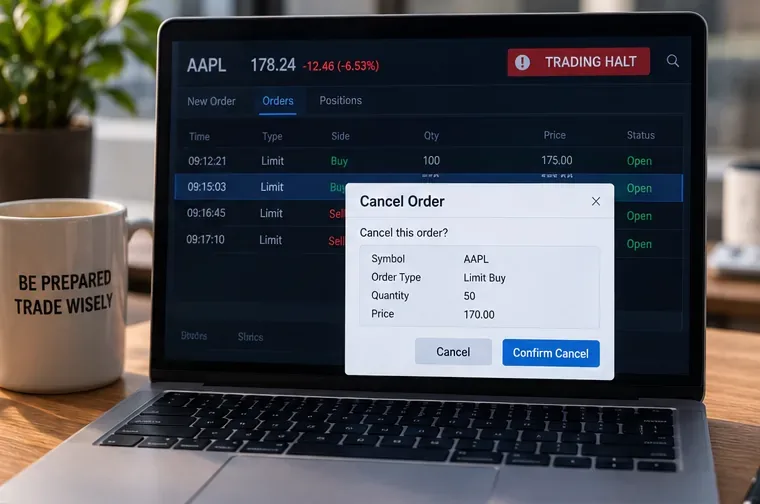
Many halt procedures still allow cancellation messages. A visible cancel control does not guarantee every venue or halt type will accept a replacement order immediately afterward.
Cboe: default queuing can be changed by session settings
Cboe’s current U.S. market-wide circuit-breaker documentation is especially explicit about open orders. For Cboe U.S. Equities exchanges, open orders are generally queued by default into the halt reopening process, except for specified categories such as Post Only orders and orders with a non-zero minimum quantity. Members can opt into session settings that cancel all orders, or just continuous-book orders, when a halt is received.
Cboe also distinguishes between listed and non-listed symbols. Its U.S. Market-Wide Circuit Breaker FAQ says resting orders in non-listed symbols may be canceled or modified after the halt is declared, and new orders may also be entered. For BZX-listed symbols, resting orders may be canceled once the halt is declared, while modifications and new orders are restricted until the quote-only period begins.
Cboe’s Regulatory Halt reopening specification states that eligible open orders are queued and rolled into the reopening process by default, subject to member-configured cancel-on-halt choices.
What happens in a reopening auction?
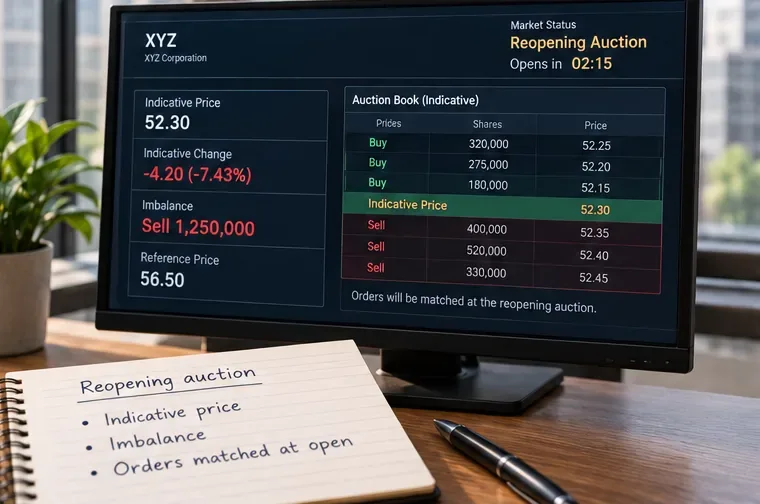
A halt is often followed not by immediate continuous trading, but by a reopening mechanism. Exchanges may collect eligible orders, publish indicative pricing or imbalance information, and then execute a reopening cross or auction at a single price before normal matching resumes.
This creates an important distinction: an order can be “open” during the halt without being immediately executable. It may instead be waiting for the reopening process. If its price is marketable at the reopening price, it may execute in the auction. If it is not fully executed, the remaining quantity may roll into continuous trading if the venue’s rules and the order’s time-in-force permit that.
During a reopening process, eligible orders may be queued while the exchange calculates an indicative price and imbalance before continuous trading resumes.
Cboe options: orders may queue while matching is stopped
Cboe’s current market-wide circuit-breaker FAQ says that during a Level 1 or Level 2 halt, its options exchanges stop options trading but continue accepting new orders and cancels. Orders and quotes enter a queued state while waiting for reopening. Orders entered before the halt may either persist or be canceled depending on the user’s cancel-on-halt session setting.
That illustrates a broader point for options traders: the stock, the option class, and the options venue can each have separate statuses. A halt in the underlying may cause options to pause, while the options exchange still accepts administrative messages or new queued orders. Do not infer options-order behavior solely from what is happening in the stock.
Futures and CME-related markets: separate market halts from connection events
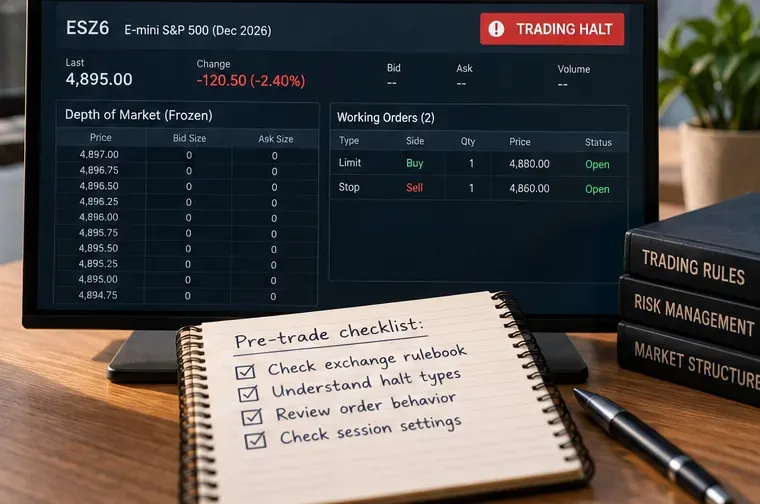
Futures traders should be particularly careful about importing equity rules into derivatives. CME Group product rules can impose temporary halts, price-limit events, or coordinated pauses that vary by contract. The exchange’s Global Command Center publishes operational status and reopening communications, and CME says that during an emergency market halt it will issue periodic messages and announce a reopening time once the issue is resolved.
CME’s Global Command Center guidance also makes an important distinction about connectivity: if CME closes a participant’s iLink ports for disruptive behavior, existing working orders remain active unless Cancel on Disconnect is enabled. Traders without that setting can use other cancellation tools such as Kill Switch, FirmSoft, or the GCC. That is not the same event as a product-wide trading halt, but it shows why “my session is disconnected” and “the market is halted” must not be treated as equivalent.
Some CME-operated venues publish still different rules. For example, current EBS Market terms state that in an emergency halt, Day Orders are canceled, matching stops, and new orders are rejected. This is another reason to check the rule set for the actual venue and product rather than assuming one Globex-wide behavior.
For futures and other derivatives, verify the specific product and venue rules. A halted market, a disconnected session, and a cancel-on-disconnect event are different conditions.
Do stop orders disappear during a halt?
Not necessarily. A stop order may remain stored without triggering because the trades or quotes required to activate it are not occurring. What happens when trading resumes depends on the exchange’s stop-order mechanics, the reopening price, the broker’s handling, and any protection limits attached to the order.
This is a high-risk area for assumptions. A large reopening gap can cause a stop condition to become true immediately after trading resumes. A stop-market order can then behave very differently from a stop-limit order. The exchange halt itself does not guarantee execution near the pre-halt market.
Can you cancel during a halt?
Often yes, but not always under every condition. NYSE’s Rule 7.18 expressly says cancellations continue to be processed for the UTP Regulatory Halt scenario described above. Cboe’s market-wide circuit-breaker procedures likewise allow cancellation of many resting orders during the halt. Nasdaq and its options markets also provide halt-period order-management functionality in many cases.
The practical test is not whether the broker app shows a cancel button. The test is whether the cancellation receives an exchange or broker acknowledgment confirming that the order is no longer working. During market stress, interfaces and acknowledgments can be delayed.
What should you check before assuming an order is safe?
Identify the primary listing exchange or derivatives venue. Order handling often depends on where the instrument is listed.
Identify the halt type. News halt, regulatory halt, operational halt, LULD pause, market-wide circuit breaker, and product price-limit halt are not interchangeable.
Check the order type. Market, limit, stop, auction-only, non-displayed, post-only, and minimum-quantity orders can be treated differently.
Check time-in-force. DAY, GTC, IOC, and session-specific orders may expire or cancel on different schedules.
Check broker and session settings. Cancel-on-halt, cancel-on-disconnect, and port-level settings may override the default behavior available to exchange members.
Confirm cancellation status. A submitted cancel request is not the same as a confirmed canceled order.
Read the reopening procedure. Your order may participate in an auction before continuous trading restarts.
Do not confuse an exchange halt with an SEC trading suspension
An SEC trading suspension is a separate regulatory action. The SEC states that federal securities laws permit it to suspend trading in a stock for up to 10 trading days when the Commission determines that doing so is required in the public interest and for investor protection. Current suspension notices are published on the SEC Trading Suspensions page.
If a security is subject to an SEC suspension, do not rely on the normal intraday reopening assumptions used for a short exchange halt. The duration, resumption conditions, and availability of quotations can be materially different.
A practical order-status checklist during a halt
Verify the halt on the primary exchange or official market-status feed.
Record the halt reason and timestamp.
Check each open order’s type, time-in-force, venue, and current status.
Determine whether the venue retains, cancels, or queues that category of order.
If you want out, submit a cancellation and wait for a confirmed canceled status.
Watch the official reopening or quote-only process rather than guessing a restart time.
Recheck any remaining orders immediately after trading resumes.
Bottom line
The safest working assumption is not that a halt cancels your orders; it is that you do not know their status until the exchange rules and the order acknowledgments tell you. On current U.S. venues, open orders may remain active, be queued, or be canceled depending on the specific rule set. Some venues allow cancellations throughout the halt, some restrict new or modified orders, and reopening auctions can execute orders before ordinary continuous trading returns.
For any live event, use the exchange’s current rulebook and status notices as the source of truth, then verify your broker’s order acknowledgments. Rules and technical specifications change, and member-level settings can alter default behavior. That final verification matters more than any generic rule of thumb.