Home
» News
»
Institutional DeFi Explained: How Wall Street Is Accessing Onchain Liquidity Pools
Institutional DeFi Explained: How Wall Street Is Accessing Onchain Liquidity Pools
Institutional DeFi is no longer just a thought experiment about banks eventually “using crypto.” The more useful question for a newcomer is much narrower: how can a regulated asset manager, bank, hedge fund, corporate treasury, or broker access onchain liquidity without abandoning the controls that traditional finance requires?
The answer is emerging through a layered model. Institutions are generally not sending unrestricted corporate wallets into anonymous yield farms. Instead, they are combining tokenized financial assets, qualified or regulated service providers, allowlists, institutional custody, smart-contract settlement, and carefully selected decentralized finance infrastructure. In some cases the DeFi component looks like an automated market maker, or AMM, where software prices trades against pooled assets. In others it looks more like a request-for-quote, or RFQ, system in which approved market makers compete to provide a price before the transaction settles onchain.
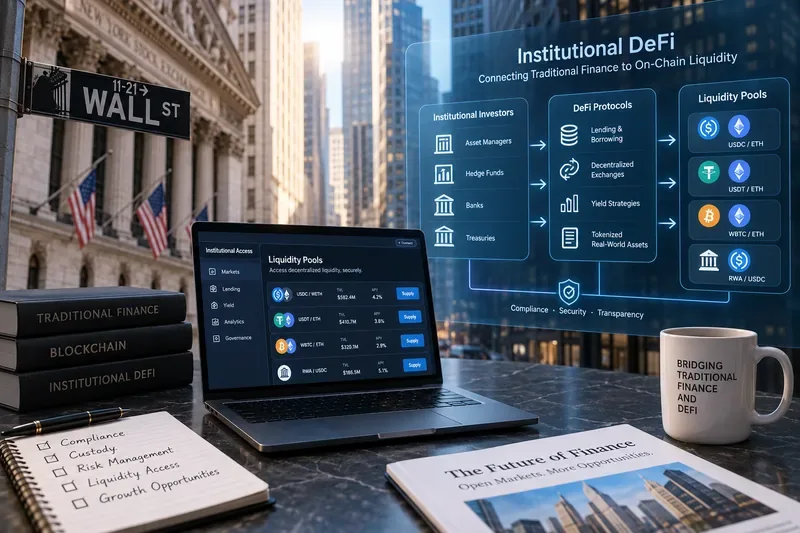
A Wall Street-themed institutional DeFi workspace showing the main bridge from traditional financial institutions through compliant onchain infrastructure to liquidity pools.
First, understand what “institutional DeFi” actually means
Decentralized finance, or DeFi, refers to financial applications that use blockchain networks and smart contracts to perform functions such as trading, lending, borrowing, settlement, collateral management, and asset issuance. A liquidity pool is a smart-contract-controlled reserve of assets that can support trading or lending without relying on a conventional order book for every transaction.
Institutional DeFi adds another layer: the participants, assets, and transaction flows must often satisfy requirements around investor eligibility, anti-money-laundering controls, custody, recordkeeping, sanctions screening, internal risk limits, and legal ownership. The resulting system can therefore be decentralized at the settlement or market-infrastructure layer while still having centralized compliance checkpoints at onboarding, custody, transfer, or redemption.
That distinction matters because the phrase “Wall Street protocols” can be misleading. Many of the protocols themselves are not owned or operated by Wall Street firms. What is changing is that traditional institutions are increasingly connecting regulated products and institutional workflows to public blockchains and DeFi-style execution rails.
What should a newcomer prepare before evaluating institutional DeFi?
Before focusing on headline yields, it helps to separate the stack into five questions. First, what is the underlying asset? Second, who is legally entitled to own or redeem it? Third, where is custody held? Fourth, what smart contracts or trading venues are used? Fifth, what happens if the blockchain, issuer, custodian, market maker, or redemption process fails?
Layer
Question to ask
Why it matters
Asset
Is the token a stablecoin, fund share, Treasury-backed token, deposit token, or another claim?
The token's legal and economic rights depend on its structure.
Eligibility
Is access permissionless, limited to qualified investors, or restricted to approved wallets?
Institutional products frequently use onboarding and wallet allowlists.
Custody
Who controls the private keys or the legally recognized asset account?
Operational risk can differ greatly between self-custody and third-party custody.
Liquidity
Does trading occur in an AMM pool, through RFQ market makers, or via direct mint and redemption?
Each route has different price, depth, and execution characteristics.
Settlement
Does the trade settle atomically onchain, offchain, or through a hybrid process?
Settlement design determines counterparty and timing risk.
How institutions are actually reaching onchain liquidity
1. Tokenize a familiar financial asset
The first step is often not “buy crypto,” but to put a familiar financial instrument into a blockchain-compatible form. Tokenized money-market funds and tokenized U.S. Treasury products are important examples because they give institutions an onchain asset with a recognizable underlying exposure.
In August 2026, BlackRock announced tokenized access to selected Institutional Cash Series money-market fund share classes in Europe using Kinexys by J.P. Morgan's asset-tokenization platform, with digital tokens minted on Ethereum for eligible investors. The official announcement describes these as digital representations of existing regulated money-market fund strategies rather than a replacement for the underlying legal structure. See the BlackRock announcement on tokenized institutional cash funds.
2. Restrict access where regulation or product terms require it
Public blockchains are open to observe, but that does not mean every institutional asset is open to every wallet. A token contract or transfer agent can restrict who may hold or transfer a token. A front end can require identity checks. A market can also limit counterparties to approved institutions.
A clear 2026 example is the integration between Securitize and Uniswap Labs for BlackRock's BUIDL fund. Securitize said participating BUIDL investors are pre-qualified and whitelisted, while trading uses UniswapX's RFQ framework to request competitive quotes from approved subscribers. Settlement can then occur atomically onchain. The primary announcement is available from Securitize's BUIDL and UniswapX integration release.
This is an important model for beginners to recognize: the blockchain transaction may be decentralized and programmable, but access to the asset and counterparties can still be permissioned.
3. Use RFQ systems, pools, or direct mint-and-redeem routes
Institutional liquidity does not have to come from one giant public AMM. There are at least three practical routes.
AMM liquidity pools: assets sit in a smart contract and a pricing function determines swaps. Institutions may use these when the asset is freely transferable and the pool has acceptable depth.
RFQ liquidity: approved market makers submit quotes for a specific trade. This can reduce information leakage and can fit large or compliance-sensitive orders better than simply crossing a public pool.
Primary liquidity through mint and redemption: investors exchange cash or stablecoins for tokenized fund shares, or redeem the token back into the underlying structure. This can anchor secondary-market prices when the process is fast and reliable.
Ondo's Nexus initiative illustrates the third route. Ondo describes Nexus as infrastructure intended to provide instant liquidity for third-party tokenized Treasury products while using OUSG's minting and redemption capabilities and assets from multiple major managers. See Ondo's official introduction to Nexus.
4. Keep custody and collateral workflows compatible with institutional controls
A bank or asset manager usually cannot treat key management as an afterthought. Institutional DeFi therefore often separates trading from custody. The asset may remain with a regulated custodian while a trading venue recognizes it as collateral.
In April 2026, OKX, BlackRock, and Standard Chartered announced a framework in which eligible institutional clients could use BUIDL as collateral while the asset remained in off-exchange custody with Standard Chartered. This is not a liquidity pool in the narrow AMM sense, but it shows the broader institutional pattern: tokenized assets become usable across digital trading workflows without forcing firms to move the asset into an exchange wallet. The details are in the official Securitize release on the collateral framework.
5. Settle onchain and reconcile with traditional records
The attraction of blockchain settlement is that asset transfer and payment can be coordinated in software. Atomic settlement means both legs complete together or neither completes, reducing the window in which one party has delivered while the other has not. But institutions still need accounting, legal ownership records, corporate actions, tax reporting, and internal books to remain synchronized with the blockchain state.
This is why institutional DeFi is best viewed as a bridge rather than a full replacement for traditional market infrastructure. Project Guardian, led by the Monetary Authority of Singapore, has included financial institutions testing tokenized bonds, deposits, funds, foreign exchange, secured borrowing, lending, and secondary-market liquidity. The participant and use-case list can be reviewed in the Monetary Authority of Singapore's Project Guardian participant annex.
What can go wrong?
The first common mistake is assuming a tokenized asset is economically identical to the asset named on the screen. Investors need to verify the legal claim, redemption rights, transfer restrictions, and who maintains the authoritative ownership record.
The second mistake is focusing only on quoted annual percentage yield. Institutional returns can be offset by smart-contract risk, liquidity fragmentation, market-maker spreads, custody fees, bridge risk, redemption delays, or changes in the yield of the underlying Treasury or money-market assets.
The third mistake is treating “onchain” as a synonym for “permissionless.” As the BUIDL example shows, an onchain transaction can involve whitelisted holders and approved market makers. A product can use public blockchain settlement while access remains tightly controlled.
The fourth mistake is confusing secondary liquidity with guaranteed redemption. A token may trade in a pool or through market makers, but those venues can become shallow during stress. Primary redemption rights, their timing, and their conditions still matter.
Finally, do not assume that technology standardizes regulation across jurisdictions. Institutional DeFi products can have different eligibility rules, transfer restrictions, disclosures, and legal treatment depending on the investor and location. Official product documentation should take priority over social-media summaries or dashboard labels.
How to check whether you understand an institutional DeFi structure
A useful self-test is to explain the complete transaction without using vague phrases such as “the blockchain handles it.” You should be able to identify the investor, the token issuer or fund, the custodian, the smart contract, the market maker or liquidity pool, the settlement asset, and the redemption route.
Then ask what happens in four failure cases: the DeFi protocol pauses, the market maker disappears, the custodian becomes unavailable, or redemptions are temporarily limited. If you cannot trace who controls the asset and which legal or technical mechanism applies in each case, you do not yet have enough information to evaluate the structure.
That is the central lesson of institutional DeFi in 2026. Wall Street is not simply pouring money into anonymous liquidity pools. The more durable pattern is a controlled connection between regulated financial products and programmable onchain markets: tokenized assets enter approved wallets, liquidity is sourced through pools or RFQ networks, custody is separated where necessary, and settlement uses blockchain rails while compliance and legal ownership remain explicit.
Information date: September 2026. Product availability, eligible jurisdictions, counterparties, yields, and protocol configurations can change. This article is educational and does not constitute investment, legal, or tax advice.