Home
» News
»
Web3 Gaming Tokens: How to Judge Tokenomics, Inflation, and Player Retention
Web3 Gaming Tokens: How to Judge Tokenomics, Inflation, and Player Retention
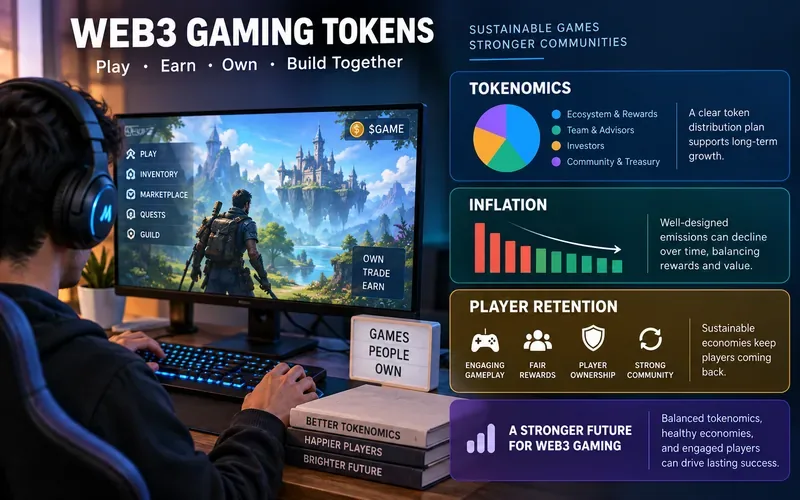
Web3 gaming tokenomics are easiest to misunderstand when token price, player rewards, and player retention are treated as the same problem. They are not. A token can become less inflationary while the game loses users. A game can retain players while its reward token weakens. And a growing player base can still be economically fragile if most demand comes from new entrants rather than from gameplay people genuinely value.
The useful goal is therefore not to find a token model that looks “deflationary” on a slide. It is to judge whether the game economy can keep functioning when rewards fall, token prices fluctuate, and growth slows. As of September 16, 2026, first-party documentation from established Web3 gaming ecosystems continues to show the same basic lesson: emissions, sinks, utility, and player motivation have to be managed together, and economic policy often changes as developers learn from live data.
A healthy Web3 game economy has to balance token issuance and token sinks without making rewards the only reason players return.
What should a good Web3 gaming token model actually achieve?
A strong model should make the game more useful or expressive without requiring perpetual token-price appreciation. That sounds simple, but it changes what you measure. Instead of asking only whether supply is capped, ask whether players have recurring reasons to spend, hold, use, or sacrifice the token inside the game.
For a reward token, the central equation is straightforward: new issuance enters the economy, while spending, burning, locking, crafting, entry fees, upgrades, or other sinks remove tokens from liquid circulation or create demand for them. If issuance routinely overwhelms meaningful usage, inflation can pressure the economy even when the nominal maximum supply looks attractive.
Axie Infinity offers a useful historical case because its developers publicly documented both the problem and their response. In a 2022 economic-balancing journal, Sky Mavis said SLP creation had consistently outpaced usage and called the inflation unsustainable. The team subsequently reduced some reward emissions and expanded sinks. In January 2024, it announced a 44 billion SLP supply cap, a buyback and stability mechanism, and a long-term target of 2% deflation. The policy was explicitly described as something that could evolve with experience. See the official Axie SLP monetary-policy update and the earlier Axie economic-balancing journal.
What to look for: a project should disclose where tokens come from, where they go, what creates recurring demand, and which parameters developers or governance can change. If the only visible sink is speculation or onboarding new players, the economy deserves more scrutiny.
How do you measure inflation without being fooled by a fixed maximum supply?
Maximum supply is only one number. For players and investors, near-term circulating-supply growth can matter more. A token with a fixed cap can still experience heavy effective inflation when ecosystem rewards, team allocations, investor vesting, treasury distributions, or staking rewards unlock faster than organic demand grows.
A practical review should separate at least four flows:
Flow
What to measure
Why it matters
Gameplay emissions
Tokens distributed for quests, wins, rankings, nodes, or participation
High issuance can become persistent sell pressure if rewards exceed useful spending opportunities.
Scheduled unlocks
Team, investor, ecosystem, and treasury vesting
Unlocks increase transferable supply even if no new gameplay tokens are minted.
Sinks reveal whether the token has recurring in-game demand.
Net supply change
Issuance minus burns and other permanent removals
This gives a cleaner view of monetary expansion than maximum supply alone.
Gala provides another example of why mechanics need to be read carefully. Its support documentation says that, following an August 2024 change, daily GALA emissions became dynamic: 0.25% of the difference between total supply and the 50 billion maximum supply. The same documentation states that GALA used as gas on GalaChain is burned and that some ecosystem purchases can also result in burns. These are specific policy mechanics, not proof that supply will always shrink. The balance depends on both issuance and actual usage. See Gala's $GALA tokenomics documentation.
What good looks like: net issuance is understandable, observable, and responsive to real economic activity. When to reassess: circulating supply accelerates while active spending, token sinks, or player activity stagnate.
Are token burns automatically bullish or sustainable?
No. A burn is an accounting event; its economic quality depends on what caused it. A token burned because players willingly pay for an attractive upgrade is different from a token burned only because designers impose a costly mandatory fee that makes the game less enjoyable.
The more useful metric is productive sink demand: how much token consumption comes from actions players would still want to perform even if token prices were flat. Examples can include crafting desirable items, tournament entry, upgrades, customization, or access to optional content. Good sinks create utility. Bad sinks can become taxes on participation.
Axie illustrates how sink design can be connected to gameplay. Its Origins model introduced SLP requirements for crafting NFT runes and charms, while Classic later introduced an SLP entry fee for Premium Cursed Coliseum, with a documented portion burned. These mechanisms matter because they tie token consumption to game activities rather than to an abstract promise of scarcity. See the official Origins Phase 3 economy explanation and Classic SLP Coliseum update.
Quality test: ask whether removing the token reward tomorrow would leave players with reasons to perform the activity that consumes the token. If the answer is no, the sink may be economically circular.
What does player retention tell you that token price cannot?
Retention answers whether people choose to return. Price does not. A rising token can temporarily make weak gameplay look healthy because rewards attract users who optimize for earnings. When rewards normalize, that cohort can disappear quickly.
Traditional game metrics remain useful in Web3:
D1 retention: the share of new players returning the next day.
D7 and D30 retention: whether the experience develops into a habit rather than a one-session experiment.
Cohort retention: whether users acquired in different periods behave similarly.
Session frequency and playtime: whether engagement persists when financial incentives change.
Payer conversion and repeat spending: whether players willingly purchase useful or enjoyable content.
Reward-adjusted retention: whether retention survives after token rewards per player decline.
That last measure is especially important. If a game cuts emissions by 30% and retention barely changes, the game may have genuine non-financial pull. If participation collapses immediately, rewards were probably doing more of the retention work than the underlying product.
Current Immutable materials emphasize many of the same conventional game-growth signals—identified players, engagement, conversion, purchase behavior, and re-engagement—rather than treating blockchain ownership as a replacement for game design. Its platform also promotes gas-free player interactions and reduced blockchain friction. See Immutable's current game growth platform and gaming infrastructure overview.
What to aim for: retention that remains healthy across changes in token rewards, market prices, and promotional campaigns. If user activity tracks the token price almost one-for-one, treat retention as incentive-sensitive rather than durable.
Single-token or dual-token economy: which is better?
Neither is automatically better. The question is whether each token has a clear job.
A single-token design is easier to understand, but governance, rewards, payments, speculation, and progression can all compete for the same asset. A dual-token design can separate a scarcer governance or value-accrual asset from a more elastic gameplay currency, but it also creates more balancing work and more ways for value to leak between markets.
Axie's public framework explicitly distinguishes what it calls a reward currency from a value-accrual token. SLP is treated as the reward currency, while AXS serves broader ecosystem and governance roles. That separation can make policy more targeted, but it does not remove the need to balance SLP issuance against usage. The model is useful as a design example, not as a universal template.
Decision rule: prefer conceptual clarity over token count. Every token should have a reason to exist that could not be handled more simply with an off-chain resource, NFT, account-bound point, or existing currency.
How should rewards be designed if retention is the goal?
Rewards work best when they reinforce behavior that is already valuable to the game. Competitive achievements, social contribution, content creation, guild activity, tournaments, or skilled progression can support the ecosystem. Paying indiscriminately for repetitive actions can invite farming, bots, and low-intent users.
Axie's earlier economic-balancing work explicitly discussed reducing emissions from activities vulnerable to automation and shifting rewards toward skilled activity. Gala's game-specific reward documentation also shows that different games use different reward triggers, including competition rankings, victory points, listening activity, and node participation. The point is not that any one mechanism is superior; it is that reward criteria shape player behavior. See Gala's first-party guide to reward tokens on GalaChain.
A useful experiment is to classify every emission as one of three types: acquisition, retention, or ecosystem contribution. Then measure whether the rewarded behavior actually improves the intended outcome. If an “acquisition” reward brings wallets that disappear as soon as rewards end, its headline user count can be misleading.
When should a project change its tokenomics?
Tokenomics should not be immutable just for the sake of predictability. Live games change, player populations change, exploits appear, and new content creates new demand. However, frequent ad hoc changes can also destroy trust.
Change is justified when measurable evidence shows the economy is drifting from its goals. Warning signs include:
persistent net issuance far above token consumption;
reward farming growing faster than genuine game activity;
retention falling immediately after rewards are reduced;
large unlocks arriving without corresponding utility or demand growth;
mandatory sinks making progression feel punitive;
token rewards becoming a larger share of the game's appeal than gameplay itself;
governance repeatedly changing economics without clear data or advance communication.
The healthier process is transparent: define a target, publish the relevant metrics, change one major variable when possible, observe the result, and explain what would trigger the next adjustment. Axie's SLP documentation is notable precisely because it frames the policy as iterative and publishes the economic objective rather than presenting the first design as permanent.
A practical scorecard for evaluating a Web3 game economy
Before treating a gaming token as evidence of a sustainable ecosystem, check the following categories. You do not need perfect numbers; you need enough transparency to understand the direction of travel.
Question
Healthy signal
Reason to investigate
Where do tokens come from?
Emission rules and unlock schedules are public
Supply growth is difficult to reconstruct
Why are tokens spent?
Useful, optional gameplay demand
Sinks exist mainly to support token price
Who receives rewards?
Rewards favor skill, contribution, or meaningful participation
Simple repetitive farming dominates
What happens if rewards fall?
Players continue playing and spending
Activity collapses with incentives
Does the economy need new entrants?
Existing players create recurring internal demand
New buyer growth is needed to fund existing rewards
Can policy change?
Rules, authority, and change process are transparent
Key parameters can change without clear accountability
The limit of tokenomics analysis
No spreadsheet can prove that a game will retain players. Tokenomics analysis can identify structural pressure—excess emissions, weak sinks, concentrated unlocks, circular incentives—but it cannot measure fun, community quality, creative direction, competitive balance, or whether future content will succeed.
It also has a timing problem. Published token schedules can be precise while player demand is uncertain. Teams may change emission rates, add sinks, remove rewards, or redesign progression. That is normal for live games, but it means any tokenomics review is a snapshot. The project documentation cited here includes policies announced in prior years that remain useful examples; readers should verify the latest first-party documentation before relying on a specific parameter.
The strongest conclusion is therefore modest: a durable Web3 gaming economy is not one with the lowest possible inflation. It is one where token supply, utility, and reward policy support a game that people still want to play when the financial incentive becomes ordinary. Measure the economy, but judge the product too.