Home
» News
»
October 2026 Bank of Japan Calendar: BOJ Meeting, Tokyo CPI and Yen Volatility Checkpoints
October 2026 Bank of Japan Calendar: BOJ Meeting, Tokyo CPI and Yen Volatility Checkpoints
The practical problem with an October Bank of Japan calendar is not simply finding the policy meeting date. It is knowing which releases can change expectations before that meeting, which ones arrive close enough together to amplify yen volatility, and which dates are merely background information. October 2026 is especially important because the BOJ's two-day Monetary Policy Meeting ends on the same day that the Statistics Bureau is scheduled to publish preliminary October CPI for the Tokyo wards.
The easiest way to use the month is to separate it into three layers: early-month expectation setting, mid-month communication and data checks, and the late-month policy decision cluster. The dates below are based on official Bank of Japan and Statistics Bureau schedules available as of late September 2026. Both agencies note that release schedules can change, so traders and analysts should re-check the source calendars shortly before each event.
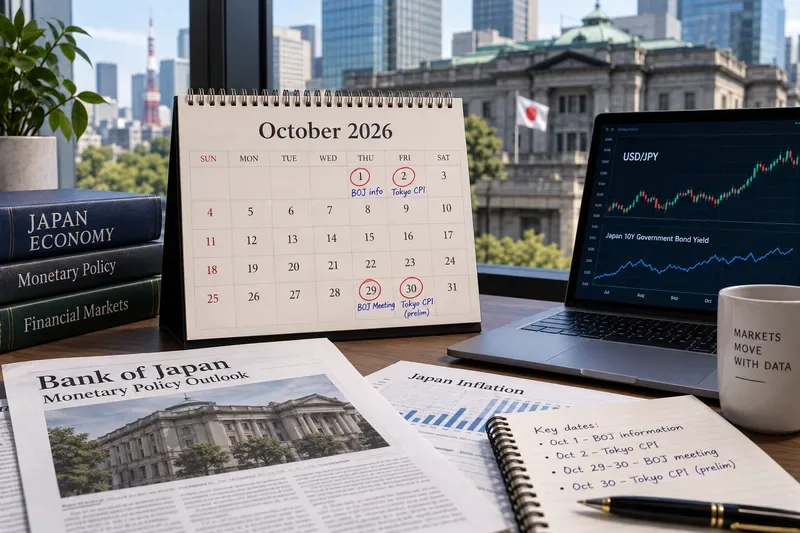
An October 2026 market calendar highlights the early-month BOJ and Tokyo CPI releases and the Oct. 29–30 policy meeting cluster.
The October 2026 dates that deserve the most attention
Date
Official event
Why it can matter for the yen
What to verify
Oct. 1
BOJ Summary of Opinions from the Sept. 17–18 MPM, 8:50 a.m. JST; Tankan September survey summary and outline, 8:50 a.m. JST
Shows how Policy Board members framed inflation, growth and policy risks; Tankan can shift expectations about business conditions, pricing and investment.
Compare the wording with the Sept. 18 policy statement rather than reading a single quote in isolation.
Oct. 2
Preliminary September CPI for the Ku-area of Tokyo, 8:30 a.m. JST; Tankan comprehensive data set, 8:50 a.m. JST
Tokyo CPI is an early read on current-month price pressure and can affect expectations for national inflation and BOJ policy.
Check headline, less-fresh-food and underlying measures, and confirm the 2025-base series.
Oct. 8
BOJ Regional Economic Report, release time listed as undecided
Regional assessments can help investors judge whether wage, demand and pricing trends are broadening beyond Tokyo and major exporters.
Watch for changes in regional assessments rather than treating the report as a direct policy signal.
Oct. 15
Speech by Policy Board Member Junko Koeda at a meeting with local leaders in Kumamoto, 10:30 a.m. JST
A policy-board speech can refine how markets interpret the BOJ's reaction function before the late-October meeting.
Use the official text and distinguish personal assessment from an agreed BOJ decision.
Oct. 23
September national CPI for Japan, 8:30 a.m. JST
National CPI is broader than Tokyo CPI and arrives less than a week before the BOJ meeting.
Check whether the national result confirms or contradicts the Tokyo signal from earlier in the month.
Oct. 29–30
BOJ Monetary Policy Meeting
This is the month's principal policy event. The Policy Board can alter its policy guidance, market-operations framework or assessment of the economy and prices.
Do not assume the decision time in advance; the BOJ says decisions are released immediately after the MPM concludes.
Oct. 30
Preliminary October Tokyo CPI, 8:30 a.m. JST; BOJ Outlook Report and policy decision after the meeting; Governor's press conference scheduled for 3:30 p.m. JST
Inflation data, the policy decision, updated forecasts and the press conference can create several separate yen repricing windows in one session.
Track the sequence: CPI first, policy decision later, then the governor's explanations.
The official BOJ calendar currently lists the October releases and the Oct. 29–30 meeting dates on its Release Schedule. The BOJ's formal annual schedule also shows that the October MPM is held on Oct. 29 and 30, with the Outlook Report scheduled for Oct. 30, the Summary of Opinions for Nov. 10 and the meeting minutes for Dec. 23 in the Scheduled Dates of Monetary Policy Meetings in 2026.
Why Oct. 1 matters before the CPI headlines arrive
The first trading day of the month brings two different kinds of information at the same scheduled time. The Summary of Opinions condenses views expressed at the Sept. 17–18 BOJ meeting, while the Tankan reports business conditions from the September survey. They answer different questions.
The Summary of Opinions is useful if your concern is policy interpretation. It can show whether board members are emphasizing persistent inflation, downside growth risk, wage dynamics or uncertainty around financial conditions. The Tankan is more useful if your concern is whether the real economy is evolving in a way that could eventually justify a policy adjustment. The BOJ says Tankan results are released at 8:50 a.m. JST and publishes them on a preannounced schedule; see the BOJ's Tankan FAQ.
Action: If you only have time for one document, choose based on your question. Read the Summary of Opinions for policy language; use the Tankan for business sentiment, investment and price-setting evidence. If both surprise in the same direction, the yen reaction can be more durable than a move caused by one isolated headline.
How to use the two Tokyo CPI dates without double-counting the signal
The Statistics Bureau's official schedule places preliminary September Tokyo CPI on Oct. 2 and preliminary October Tokyo CPI on Oct. 30. The same calendar puts September national CPI on Oct. 23. Tokyo CPI is therefore useful as an early inflation checkpoint, but it is not simply a duplicate of the national release.
The Statistics Bureau states that national CPI for the preceding month and preliminary CPI for the current month in the Ku-area of Tokyo are normally released at 8:30 a.m. Japan time. The October dates can be checked on the official CPI release schedule and the methodology is summarized in the CPI Q&A.
There is also a technical point worth verifying in 2026: the Statistics Bureau began publishing the 2025-base CPI in August 2026. The agency says the 2020-base series continues to be calculated and released through December 2026, but the main monthly reporting now uses the 2025 base. Anyone comparing current figures with old spreadsheets should therefore confirm that the series are aligned. The change is described on the 2025-base CPI revision page.
Action: On Oct. 2, ask whether Tokyo inflation is strengthening or weakening relative to the previous trend. On Oct. 23, check whether national CPI confirms that message. On Oct. 30, treat the new Tokyo print as fresh information arriving before the BOJ decision, not as a replacement for the broader national data.
The Oct. 29–30 BOJ meeting is a sequence, not a single timestamp
A common calendar mistake is to assign one fixed release time to a BOJ rate decision. The Bank states that Monetary Policy Meeting decisions are announced immediately after the meeting concludes, rather than at a pre-set clock time. The BOJ also explains that it holds eight regular MPMs each year, generally over two days, and releases an Outlook Report at the January, April, July and October meetings. That framework is described in the Bank's official explanation of Monetary Policy Meetings.
For Oct. 30, the BOJ's current Japanese release calendar schedules the governor's regular press conference for 3:30 p.m. JST. That creates a second policy-communication window after the written decision. A market can initially react to the policy statement and Outlook Report, then move again if the governor's explanation changes how investors interpret the decision.
Action: Do not label the entire day simply “BOJ rate decision.” Break it into at least three checkpoints: 8:30 a.m. Tokyo CPI, the policy decision and Outlook Report after the meeting concludes, and the 3:30 p.m. governor press conference.
Which checkpoint should you prioritize?
If your focus is short-term USD/JPY volatility
Prioritize Oct. 30, then Oct. 23 and Oct. 2. Oct. 30 combines fresh Tokyo inflation with the MPM, updated BOJ forecasts and the governor's press conference. That concentration of information creates multiple opportunities for expectations to be repriced within the same Japanese trading day.
If your focus is the BOJ's policy path over several months
Give more weight to Oct. 1, Oct. 23 and Oct. 30. The Summary of Opinions helps reveal the range of views inside the Policy Board, national CPI provides a broader inflation reading, and the October Outlook Report updates the Bank's own macroeconomic projections.
If your focus is whether domestic demand can sustain inflation
Use the Tankan and Regional Economic Report as context around the CPI releases. They are less likely than a policy decision to generate an immediate one-directional yen move, but they help test whether business confidence, investment, wages and regional activity support a broader inflation narrative.
Why the yen may move differently from the headline
A stronger inflation print does not mechanically mean a stronger yen, and a BOJ hold does not mechanically mean a weaker yen. Exchange rates react to the gap between the actual information and what markets had already priced in. They also respond to U.S. rates, global risk sentiment and the expected interest-rate differential between Japan and other economies.
BOJ research on historical policy episodes found that large yen reactions were particularly associated with major policy surprises, while other easing announcements did not always produce statistically large exchange-rate moves. The paper is available from the Bank of Japan as Japan's Unconventional Monetary Policy and the Exchange Rate Dynamics. That historical result is not a forecast for October 2026, but it reinforces a useful principle: surprise matters more than the calendar label alone.
Action: Before each major event, record the market consensus or your own baseline scenario. After the event, compare the result with that baseline before attributing a yen move to the raw headline.
What is confirmed, what can still change, and what is not known yet
Confirmed on official schedules: Oct. 1 Summary of Opinions and Tankan releases; Oct. 2 preliminary September Tokyo CPI; Oct. 15 Board Member Koeda speech; Oct. 23 national September CPI; the Oct. 29–30 MPM; Oct. 30 preliminary October Tokyo CPI; and the Oct. 30 Outlook Report date.
Subject to change: the BOJ states that issue dates on its release calendar can change, while its statistics schedule also warns that releases can be postponed by operational disruptions. The Statistics Bureau publishes a dated CPI schedule, but it is still prudent to check the source page before the event.
Not knowable from the calendar alone: the exact time at which the Oct. 30 MPM decision will be released, whether policy will change, the content of the governor's answers, the CPI outcomes, or the direction and size of the yen's reaction.
A quick self-check before you rely on the calendar
Confirm that your event times are in Japan Standard Time, especially if your trading platform displays UTC, New York or London time.
Verify Oct. 29–30 on the BOJ MPM page rather than relying on a third-party economic calendar.
Check the BOJ Release Schedule again during the week of the meeting for newly added speeches or timing changes.
For CPI, confirm that you are reading the 2025-base series and distinguish Tokyo preliminary data from national CPI.
Do not assign a fixed time to the BOJ policy decision unless the Bank itself publishes one.
On Oct. 30, keep the 8:30 a.m. Tokyo CPI, the later MPM decision and the 3:30 p.m. press conference as separate volatility windows.
If those checks are satisfied, your October 2026 BOJ calendar is doing more than listing dates: it is sequencing the information that can change expectations for Japanese rates and the yen, while leaving room for the events whose outcomes cannot be known in advance.