Home
» News
»
October 2026 Federal Reserve Calendar: Speeches, Minutes and Blackout Dates to Verify
October 2026 Federal Reserve Calendar: Speeches, Minutes and Blackout Dates to Verify
October 2026 has several Federal Reserve dates worth separating carefully because they do not all carry the same information value. Some are fixed releases with known times, such as the September FOMC minutes. Some are scheduled public remarks that can be added or changed. And one period—the FOMC communications blackout—matters precisely because it limits monetary-policy commentary from Committee participants.
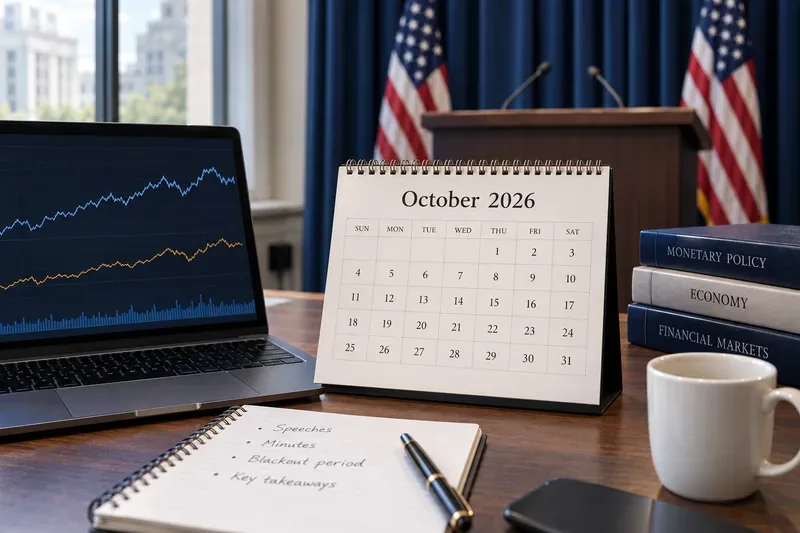
An October 2026 calendar beside market charts and a central-bank briefing setup, illustrating the mix of scheduled releases, speeches and the FOMC blackout period investors may want to track.
This article reflects official Federal Reserve information checked on September 29, 2026. The most important practical distinction is between dates the Fed has already formally scheduled and events that can still be added to public calendars. For traders, analysts and business planners, that distinction is more useful than treating every entry as equally certain or equally market-moving.
October 2026 at a glance
Date
Officially scheduled item
What is verified
What to do with it
October 1
Four Board-member public appearances
The Board calendar lists events involving Governor Christopher J. Waller at 10:00 a.m. ET, Vice Chair Philip N. Jefferson at 1:30 p.m., Vice Chair for Supervision Michelle W. Bowman at 3:00 p.m., and Governor Lisa D. Cook at 3:30 p.m.
Check the topic before assuming policy relevance. Some remarks may focus on data, regulation or central banking rather than the near-term rate path.
October 7
FOMC minutes
Minutes of the September 15–16 meeting are scheduled for 2:00 p.m. ET.
Use the minutes to assess the range of views behind the September decision and projections, not as a fresh policy decision.
October 14
Beige Book
The Federal Reserve calendar schedules the Beige Book for 2:00 p.m. ET.
Useful for regional business conditions and anecdotal evidence, especially before the October meeting.
October 17–29
FOMC blackout period
The official 2025–2027 blackout calendar marks October 17 through October 29 as blackout dates for the October meeting cycle.
Do not expect normal discretionary monetary-policy commentary from covered FOMC participants during this window.
October 27–28
FOMC meeting
The two-day meeting is on the official 2026 FOMC calendar.
Treat October 28 as the key decision day.
October 28
Policy statement and press conference
The FOMC’s standard schedule calls for the policy statement at 2:00 p.m. ET and the Chair’s news conference at 2:30 p.m. ET on the second day.
For immediate market risk, this is normally more important than the earlier October speeches because it contains the actual policy decision and live communication.
Choice 1: Track fixed FOMC releases or chase every speech?
If your goal is to reduce calendar noise, fixed FOMC releases deserve priority. The official FOMC meeting calendar confirms the October 27–28 meeting and states that minutes of regularly scheduled meetings are released three weeks after the policy decision. The Federal Reserve Board’s October 2026 calendar specifies that the September 15–16 minutes are due October 7 at 2:00 p.m. ET.
The tradeoff is that speeches can still matter between meetings, especially when a speaker discusses the economic outlook, inflation, labor markets or monetary policy. But speeches are less standardized. A scheduled appearance may be focused on financial regulation, data infrastructure or another topic with limited direct implications for the federal funds rate.
For investors who want a lean watchlist, prioritize October 7 and October 28, then monitor policy-relevant speeches as they are confirmed. For journalists or macro desks that need broader coverage, checking the speech calendar daily is more appropriate.
What is actually on the October 1 speech calendar?
As checked on September 29, the Board calendar lists four public appearances on Thursday, October 1. Governor Christopher J. Waller is scheduled at 10:00 a.m. ET for an event titled “Federal Reserve Economic Data.” Vice Chair Philip N. Jefferson is scheduled at 1:30 p.m. ET for “U.S. Economy and Monetary Policy.” Vice Chair for Supervision Michelle W. Bowman is scheduled at 3:00 p.m. ET for “Modernizing Financial Regulation: Initial Observations from eSLR.” Governor Lisa D. Cook is scheduled at 3:30 p.m. ET for a discussion on “Global Central Banking.”
These titles are a reminder that “Fed speech” is not one category of signal. Jefferson’s scheduled topic explicitly includes monetary policy, while Bowman’s focuses on financial regulation and Waller’s on economic data. The likely market sensitivity can therefore differ even when several officials speak on the same day.
There is also a calendar-management tradeoff: the Board’s central calendar is authoritative for Board events, but it should not be treated as a permanent, exhaustive list of every future Federal Reserve System appearance. Regional Reserve Bank presidents and their Banks publish events through their own official channels, and events can be announced closer to the date. If a strategy depends on knowing every FOMC participant appearance, recheck official calendars rather than freezing a September 29 snapshot for the whole month.
Choice 2: How much weight should you put on the October 7 minutes?
The October 7 release contains minutes from the September 15–16 FOMC meeting, not from a new October policy meeting. That timing matters. Minutes can clarify how broad or narrow a consensus was, what risks participants emphasized, and how members discussed the outlook. But they describe deliberations that occurred three weeks earlier.
The practical tradeoff is timeliness versus detail. The September policy statement, press conference and Summary of Economic Projections were available on September 16. The minutes provide more texture, but by October 7 markets may also have absorbed newer economic data and public comments.
For event-driven traders, the 2:00 p.m. ET release time is the key operational detail. For longer-horizon investors, focus less on the first price move and more on whether the minutes reveal disagreement, conditionality or risks that were not obvious from the September statement and projections.
The blackout period is October 17 through October 29
The governing FOMC policy on external communications of Committee participants says the monetary-policy communications blackout begins at 12:00 a.m. Eastern Time on the second Saturday before a regularly scheduled meeting and ends at 11:59 p.m. Eastern Time the day after the meeting. For a Tuesday–Wednesday meeting, the policy gives the familiar example of a blackout beginning ten days before the Tuesday start and ending Thursday night.
What the blackout does—and does not—mean
The blackout does not mean the Federal Reserve goes silent. The communications policy restricts covered participants from expressing views about current or prospective monetary policy during the period, but regular Federal Reserve data releases, surveys, operational communications and other permitted activities can continue. That is why the October calendar still contains statistical releases inside the blackout window.
For market monitoring, the useful implication is narrower: the flow of discretionary policy commentary from FOMC participants should drop sharply from October 17 until the blackout ends on October 29. If you normally use speeches to update your read of the Committee, you will have less new public commentary to work with during that period.
Choice 3: Should October 14’s Beige Book be on the same watchlist?
Yes, if your purpose is to understand the information set going into the October meeting. The Board calendar schedules the Beige Book for October 14 at 2:00 p.m. ET. It is not an FOMC policy decision and it does not provide a rate forecast. Instead, it compiles qualitative information about economic conditions across Federal Reserve districts.
The tradeoff is breadth versus precision. The Beige Book can highlight regional changes in hiring, prices, demand and credit conditions, but it is anecdotal rather than a single high-frequency statistical measure. A macro analyst may find it useful as context before the meeting, while a short-term rates trader may put greater weight on inflation, employment and the October 28 policy communication.
October 27–28: the meeting itself is the anchor event
The FOMC calendar lists October 27–28 as the seventh regularly scheduled meeting of 2026. Unlike the September and December meetings, October is not marked with an asterisk, meaning it is not one of the scheduled meetings associated with a Summary of Economic Projections.
The Fed’s published meeting schedule states that the Committee releases its policy statement at 2:00 p.m. ET on the second day of a regularly scheduled meeting and the Chair holds a press conference at 2:30 p.m. ET. For October, that puts the statement and press conference on Wednesday, October 28.
For anyone managing market exposure, the absence of a scheduled new SEP changes the information mix. The statement, implementation note and press conference become especially important for interpreting the decision and the Committee’s reaction function. That does not make the meeting “less important”; it simply means there is no scheduled quarterly projection package to analyze alongside it.
What remains uncertain as September 29
The FOMC meeting dates, October 7 minutes release, October 14 Beige Book, and October 17–29 blackout window are supported by current official Federal Reserve sources. The October 1 Board appearances are also listed on the Board calendar.
What should not be treated as final is the complete speech roster for the rest of October. Public appearances can be added, updated or canceled. A calendar showing no speech on a future date today is not proof that no Federal Reserve official will speak on that date later. This matters most before October 17, because the blackout sharply limits policy commentary after that point.
A practical verification routine for different needs
For active rates or FX traders: recheck the official Board calendar at least daily before the blackout, and set hard alerts for October 7 at 2:00 p.m. ET and October 28 at 2:00 p.m. and 2:30 p.m. ET.
For equity or credit investors: add October 14’s Beige Book and focus on labor, demand, pricing and credit anecdotes that may shape the meeting narrative.
For macro researchers: compare the September minutes with the September statement, press conference and projections rather than reading the minutes in isolation.
For event-calendar publishers: label speeches as subject to change, but treat the FOMC meeting and blackout dates as officially scheduled unless the Federal Reserve updates them.
For anyone using third-party calendars: verify key times against the Federal Reserve source before acting, because aggregators can lag changes or mix Eastern Time with local time.
Bottom line
October 2026 has three different kinds of Federal Reserve calendar risk. The first is scheduled public commentary, with four Board-member appearances currently listed for October 1 and the possibility of later additions. The second is fixed information releases, led by the September FOMC minutes on October 7 and the Beige Book on October 14. The third is the meeting cycle itself: an official communications blackout from October 17 through October 29 around the October 27–28 FOMC meeting, with the policy statement due October 28 at 2:00 p.m. ET and the Chair’s press conference at 2:30 p.m.
The most reliable approach depends on what you need. Use fixed FOMC dates for core risk planning, speeches for incremental signal, and the blackout calendar to know when the normal flow of policymaker commentary is intentionally constrained. Rechecking the Federal Reserve Board calendar remains important because speech schedules can change as October approaches.