Home
» Ecosystem
»
Polygon 2.0 in 2026: What Really Happened to the ZK-Rollup Migration?
Polygon 2.0 in 2026: What Really Happened to the ZK-Rollup Migration?
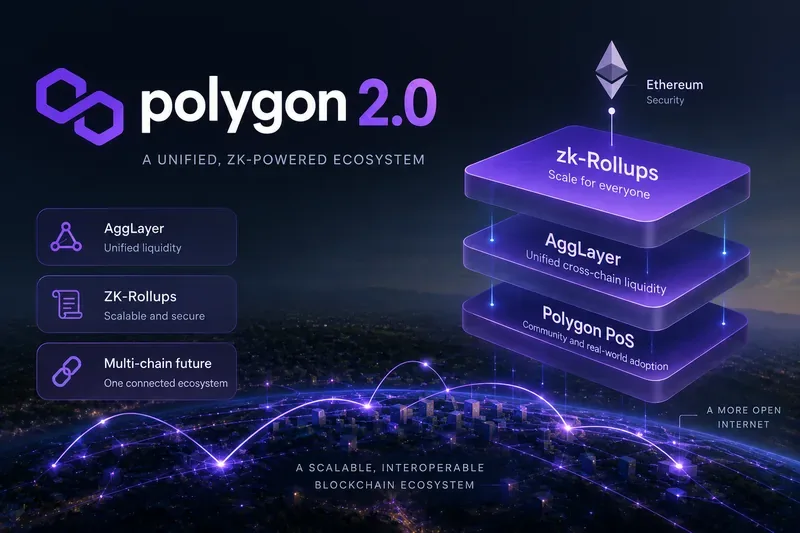
Polygon 2.0 was originally presented as a major architectural shift toward a network of ZK-powered chains with shared liquidity, stronger Ethereum alignment, and a redesigned token economy. In 2026, however, the project looks different from the simple “Polygon PoS becomes a ZK-rollup” narrative that circulated when Polygon 2.0 was first proposed.
The most important update is concrete: Polygon zkEVM Mainnet Beta was sunset on July 3, 2026. Its sequencer stopped producing blocks, and the network is no longer active. Polygon now provides a separate claims interface for users who still had eligible self-custodied assets on the retired chain. Polygon’s official status page explains the shutdown and recovery path at Polygon zkEVM Mainnet Beta: Sunset Complete.
At the same time, Polygon PoS did not simply disappear into a new ZK-rollup. Polygon’s current developer documentation still describes Polygon PoS as a proof-of-stake network built around the Heimdall-v2 consensus layer and Bor execution layer. The docs separately describe a future evolution toward a ZK-based validium. That distinction matters because a validium and a rollup use different data-availability models.
Polygon’s current architecture is better understood as a multi-chain strategy around Polygon PoS, AggLayer, POL, and optional ZK-based chain designs rather than a single completed migration to one ZK-rollup.
The biggest 2026 update: Polygon zkEVM was shut down
For anyone analyzing “the ZK-rollup migration,” the July 2026 shutdown of Polygon zkEVM is the first fact to absorb. Polygon zkEVM was the ecosystem’s general-purpose, Ethereum-compatible ZK-rollup product. Polygon later acknowledged that the product was not adapting quickly enough to market needs and chose to wind it down while focusing resources elsewhere.
The official Polygon support documentation states that the Polygon zkEVM sequencer stopped on July 3, 2026. The AggLayer Bridge and Polygon Portal no longer process normal withdrawals from that network. Instead, a dedicated claims interface exists for fund recovery.
This does not mean Polygon abandoned zero-knowledge technology. It means the original product packaging changed. ZK proofs remain important inside Polygon’s broader interoperability and chain-development strategy, but the standalone Polygon zkEVM Mainnet Beta is no longer the flagship expression of that strategy.
Polygon PoS is still a PoS chain today
Polygon’s current architecture documentation describes Polygon PoS as a network with three major layers: Ethereum smart contracts, Heimdall-v2, and Bor. Validators stake POL on Ethereum, Heimdall-v2 manages validator-related consensus functions and checkpoints, and Bor produces blocks.
The official Polygon PoS architecture overview still documents this live structure. It does not describe the production network as a completed Ethereum ZK-rollup.
Heimdall-v2 also materially changed the performance profile of the chain. Polygon’s documentation says the milestone mechanism can provide deterministic finality in roughly two to five seconds. In June 2026, Polygon also announced an upgrade that raised the gas limit and described Polygon Chain as supporting up to 5,000 payments per second under its benchmark assumptions. The official announcement is available at Polygon Chain Now Supports 5000 Payments per Second.
For readers evaluating Polygon today, that means the live PoS chain should be analyzed on its actual architecture and operating metrics, not as if a proposed ZK conversion had already been completed.
Was Polygon PoS supposed to become a ZK-rollup?
Not exactly. The more precise proposal was to evolve Polygon PoS into a zkEVM validium, which is not the same thing as a full ZK-rollup.
Both models can use validity proofs to verify state transitions. The key difference is data availability. A ZK-rollup posts transaction data, or sufficient rollup data, to Ethereum so that Ethereum acts as the data-availability layer. A validium keeps transaction data off Ethereum while using validity proofs for state correctness. That can reduce costs and increase throughput, but it creates a different security and availability model.
Polygon’s current PoS overview still lists a planned evolution toward a ZK-based validium using a zkEVM execution environment and a dedicated data-availability layer. See the official Polygon PoS overview. Because the documentation continues to frame this as an upcoming evolution rather than a completed production migration, it would be inaccurate to tell readers in September 2026 that Polygon PoS has already become a ZK-rollup.
What Polygon 2.0 became: aggregation instead of one-chain migration
The durable part of the Polygon 2.0 thesis is aggregation. Rather than requiring every application to live on one execution environment, Polygon increasingly treats multiple chains as separate domains that can communicate through a common interoperability layer.
That layer is AggLayer. Polygon describes AggLayer as infrastructure for connecting chains and coordinating cross-chain state and liquidity. The architecture has also broadened beyond the original assumption that every connected network would be a ZK-rollup built with the same stack.
By 2026, Polygon’s AggLayer documentation lists several chain modes, including ZK-secured validiums, zkEVM-style rollups, chains secured through a pessimistic-proof model, and other connection modes. Polygon also announced in May 2026 that AggLayer had demonstrated testnet interoperability with Miden, a non-EVM architecture. The official update is Agglayer Is Chain Agnostic: Miden Joins Agglayer on Testnet.
This is a meaningful strategic change. The project is no longer best analyzed as “convert everything into Polygon ZK-rollups.” The more current thesis is “connect heterogeneous chains while using cryptographic mechanisms to reduce cross-chain trust assumptions.”
Why pessimistic proofs matter to the new architecture
AggLayer’s expansion also helps explain why Polygon’s ZK strategy now looks broader than pure rollup proving. Polygon uses what it calls a pessimistic proof to check accounting constraints for cross-chain settlement. Conceptually, the system assumes a connected chain could behave incorrectly and verifies that cross-chain withdrawals do not exceed what the chain can legitimately account for.
This matters because interoperability becomes less dependent on every chain sharing identical execution logic. A chain can preserve more sovereignty over its own execution while still connecting to a common settlement and liquidity environment.
POL replaced MATIC as the center of the token design
Another part of Polygon 2.0 that did ship is the token migration from MATIC to POL. Polygon PoS automatically converted native MATIC balances to POL on a 1:1 basis, while users holding MATIC on Ethereum can migrate through Polygon’s official tooling.
Polygon reported in September 2025 that the migration was approximately 99% complete and that POL had already become the native gas token on Polygon PoS. The current developer instructions remain available in Migrate to POL.
POL is not merely a ticker change. The design positions it as the staking and utility token around Polygon PoS and, subject to governance and implementation details, the broader AggLayer ecosystem. That gives Polygon a token layer intended to align multiple components of an aggregated network rather than only one execution chain.
What investors should separate when analyzing Polygon
A useful Polygon analysis in 2026 should avoid combining several different technical systems into one label. At minimum, separate these components:
Component
Status in 2026
Why it matters
Polygon PoS / Polygon Chain
Active PoS network using Heimdall-v2 and Bor
Handles current application, payments, and asset activity
Polygon zkEVM Mainnet Beta
Sunset July 3, 2026
No longer an active production rollup; legacy assets may require claims flow
AggLayer
Active interoperability strategy under continued development
Attempts to connect liquidity and state across multiple chain architectures
POL
Native gas and staking token for Polygon PoS
Core token for network security and broader Polygon token economics
PoS-to-ZK evolution
Still described in official docs as a planned ZK-validium evolution
Should not be modeled as a completed rollup migration
The migration thesis changed, but the ZK thesis did not disappear
The original Polygon 2.0 story put zero-knowledge proving at the center of scaling. In 2026, ZK remains important, but the role is more modular.
ZK can secure state transitions for validiums and rollups. It can support privacy-oriented applications. It can contribute to cross-chain security. It can also exist inside specialized chains without forcing Polygon PoS itself to immediately become a conventional rollup.
This is a healthier way to evaluate the project technically: ask where proofs are being used, what they prove, where data is available, who sequences transactions, how exits work, and which security assumptions remain. “Uses ZK” is not a complete security model.
Polygon’s strategic focus has shifted toward payments
Another significant change since the early Polygon 2.0 narrative is product focus. Polygon spent much of 2026 positioning Polygon Chain and AggLayer as infrastructure for payments, stablecoins, and real-world assets.
In March 2026, Polygon introduced its Open Money Stack as an integrated set of payment infrastructure. In May, it described AggLayer as the cross-chain layer underneath that stack. In June, it emphasized Polygon Chain’s higher throughput. By September 2026, Polygon’s official blog was heavily centered on institutional payment infrastructure and stablecoin movement.
The project’s technical architecture and commercial positioning are therefore converging around a different question than the one Polygon 2.0 originally raised. Instead of asking only, “How does Polygon scale Ethereum with ZK-rollups?” the current strategy asks, “How can Polygon move money across multiple chains while hiding most chain complexity from users and businesses?”
For developers, the most important signals are implementation milestones rather than branding. Several questions remain worth monitoring:
Whether and when Polygon PoS actually transitions to the ZK-validium architecture described in current documentation.
How AggLayer’s security model behaves as more heterogeneous chains connect.
How quickly cross-chain liquidity becomes usable without fragmented bridging workflows.
Which POL utilities become economically meaningful beyond Polygon PoS gas and staking.
Whether the Open Money Stack attracts production payment volume that depends directly on AggLayer interoperability.
How Polygon balances low fees and throughput with data availability, validator decentralization, and operational resilience.
These are measurable engineering and adoption questions. They are more useful than assuming that the success or failure of Polygon depends on a single ZK-rollup migration event.
Key risks in the current Polygon architecture
1. Roadmap execution risk
The PoS-to-ZK-validium evolution remains a future-facing item in official documentation. Any investment or technical thesis that depends on its completion should treat timing and final architecture as uncertain until the relevant upgrades are deployed and documented.
2. Interoperability complexity
AggLayer aims to simplify cross-chain activity for users, but the infrastructure underneath that experience is complex. Connected chains can have different consensus mechanisms, execution environments, data-availability assumptions, and failure modes. The broader AggLayer becomes, the more important formal security boundaries and operational monitoring become.
3. Product-transition risk
The shutdown of Polygon zkEVM is evidence that Polygon is willing to discontinue a major product when adoption or strategic fit does not justify continued investment. That can be positive capital allocation, but it also means developers should assess the longevity and migration paths of the specific Polygon product they choose.
4. Token-value capture is not automatic
POL has a broader intended role than MATIC, but network adoption does not automatically translate one-for-one into token value. Investors need to examine staking demand, emissions, fee flows, treasury policy, validator economics, and any AggLayer-related mechanisms actually deployed through governance.
Bottom line: Polygon 2.0 is now an aggregation story, not a completed ZK-rollup migration
The most accurate September 2026 interpretation of Polygon 2.0 is not that Polygon successfully migrated its flagship PoS chain into a ZK-rollup. That migration has not happened in that form.
Instead, several pieces evolved separately. MATIC became POL. Polygon PoS continued operating and received major performance and consensus upgrades. Polygon zkEVM Mainnet Beta was retired. AggLayer expanded from a ZK-centric interoperability concept toward a chain-agnostic aggregation layer. Polygon’s commercial strategy increasingly focused on payments and stablecoin infrastructure.
The ZK component remains important, especially for validity proofs, privacy, validium designs, and secure interoperability. But the project’s center of gravity has shifted from “one ZK migration” to “many chains connected through an aggregated system.”
For anyone evaluating Polygon now, the practical takeaway is simple: analyze the live Polygon PoS network, the actual AggLayer security model, the deployed utility of POL, and the adoption of Polygon’s payment infrastructure separately. Treat the future ZK-validium conversion as a roadmap item until Polygon documents that it has reached production.