Home
» Knowledge
»
Binance Dual Investment Explained: Risks and Rewards
Binance Dual Investment Explained: Risks and Rewards
Binance Dual Investment can look like a high-yield savings option, but that description leaves out the decision that matters most: your crypto may be settled in a different asset at a target price on a fixed date. You earn a quoted reward, yet you also accept a trade-off between yield, price exposure, and access to your funds. The product is easier to evaluate when you treat it as a conditional buy-or-sell strategy with a reward, not as guaranteed interest.
Information checked on September 16, 2026. Binance may change available assets, product terms, interface labels, fees, eligibility, and settlement schedules. Review the live product page and applicable service terms before subscribing. This article is educational information, not personalized investment advice.
What is Binance Dual Investment?
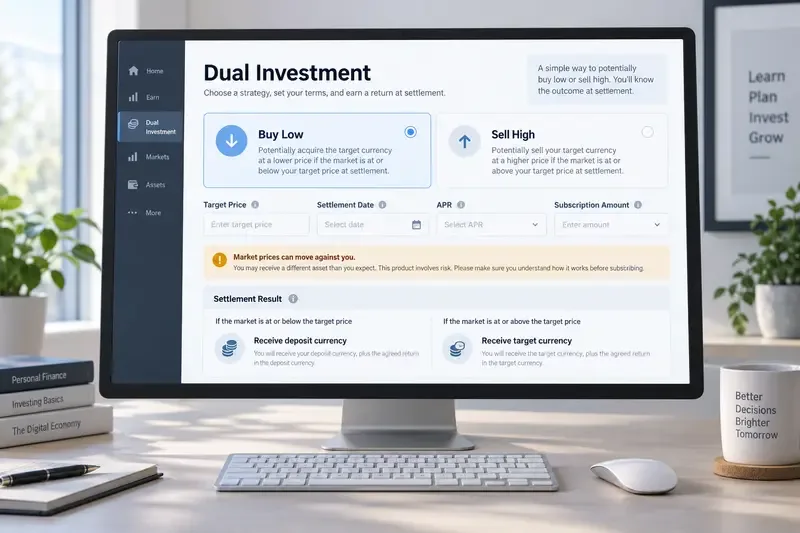
Binance describes Dual Investment as a structured financial product with two basic directions: Buy Low and Sell High. You choose a subscription amount, a target price, and a settlement date from the products available to your account. You also see an annualized reward rate, usually displayed as APR in the regular product documentation. At settlement, Binance compares the relevant market price with your target price and pays the result according to the product terms.
The important distinction is that the reward does not guarantee that you will receive the asset you deposited. In a Buy Low product, you generally deposit a quote currency such as a stablecoin and may receive the target crypto if the settlement condition is met. In a Sell High product, you generally deposit the target crypto and may receive the quote currency if the condition is met. If the target condition is not met, the product can settle in the deposit currency plus the reward, depending on the selected product and terms.
Read Binance’s official Dual Investment FAQ for the definitions of subscription amount, target price, settlement date, deposit currency, target currency, subscription period, and fixing price.
Conceptual interface showing the main Dual Investment choices and the two possible settlement outcomes; it is not a live Binance screenshot.
Buy Low vs. Sell High: what changes?
Product direction
What you are trying to do
Possible settlement trade-off
Buy Low
Use a quote currency to potentially acquire crypto at your chosen target price.
You may end up holding the target crypto when its market price has moved lower, so the market value can fall after settlement.
Sell High
Use crypto to potentially sell at a target price while earning the quoted reward.
You may receive the quote currency while the crypto market continues rising, limiting your upside compared with simply holding the crypto.
This is why a high APR alone is not enough to choose a product. Buy Low is more coherent when you would genuinely be comfortable owning the target asset at the target price. Sell High is more coherent when you would genuinely be comfortable reducing that asset position at the target price. If either outcome would surprise you, the product may not match your plan.
How does the settlement calculation work?
Binance’s FAQ gives a general reward formula: subscription amount multiplied by the APR, multiplied by the subscription period in days, divided by 365. The displayed APR is annualized, so a large percentage over a short period does not equal that percentage as a cash return. The exact calculation can also include rounding rules and product-specific terms.
The settlement price is not simply the price you see at the moment you subscribe. Binance describes a fixing price based on an averaging window before 08:00 UTC on the settlement date in the regular Dual Investment FAQ. Because product documentation and available instruments can change, check the exact fixing and settlement rules shown for the product you are reviewing.
Once a subscription is completed, Binance states that the target price, settlement date, and APR are fixed and cannot be revised. That makes the pre-subscription review important: the product is not a limit order that you can freely edit after placing it.
What are the main rewards?
1. A defined reward for waiting
The most visible benefit is the quoted reward paid at settlement according to the product terms. It can create a return in the deposited or target asset even when the market does not move in the direction you expected. However, the reward is denominated in crypto, so the result measured in dollars or another fiat currency can still be negative.
2. A rules-based entry or exit price
Dual Investment can give a disciplined investor a preselected target instead of an emotional market decision. For example, a person who already wants to buy BTC below a chosen level may prefer to place a conditional Buy Low position rather than chase a rally. Someone who already plans to sell part of a crypto holding near a chosen level may consider Sell High. The reward is secondary to whether the target price is acceptable.
3. A straightforward scenario comparison
Before subscribing, you can write down both outcomes: “What will I receive if the target is reached?” and “What will I receive if it is not reached?” This forces you to evaluate the actual asset exposure instead of focusing only on APR.
What are the main risks?
Conversion risk and opportunity cost
If a Buy Low position settles into crypto and that crypto falls sharply, the reward may be small compared with the price decline. If a Sell High position settles into a quote currency and the crypto then rallies, you may miss part of the upside. The product can therefore be economically worse than simply holding the original asset, even though a reward was paid.
Locked-funds risk
Binance’s FAQ says that you cannot edit, cancel, or redeem a regular Dual Investment subscription before settlement. Do not commit emergency funds, money needed for a scheduled payment, or collateral that may be required elsewhere. The inability to exit is not a minor interface limitation; it changes the liquidity risk of the position.
APR misunderstanding
APR is an annualized rate, not a promise that your account value will increase by that percentage. It also does not describe the future fiat value of the asset you receive. Compare the reward in units of crypto and in your preferred currency under several price scenarios. Binance’s general Earn risk warning says virtual-asset prices can move up or down and that users may not get back the amount invested.
Platform, counterparty, and product-availability risk
Dual Investment is a centralized exchange product. You depend on the platform to operate the product, credit the settlement, and maintain access under its terms. Asset availability, geographic eligibility, and account restrictions can change. The fact that a product appears in an app does not remove these risks.
Auto-Compound risk
Binance documents an Auto-Compound feature that can automatically re-subscribe the investment and rewards into a new product when enabled and when a matching product is available. This can extend your exposure beyond the original settlement date. Check whether Auto-Compound is enabled, understand its criteria, and disable it if you want the position to end at settlement. The FAQ states that the setting can be changed up to 30 minutes before the settlement date, but the live product rules should take precedence.
Worked example: why the target price matters more than APR
The following is a hypothetical illustration, not a real trade, test, or performance result. Suppose you hold 1,000 USDT and consider a two-day BTC Buy Low product with a target price of 60,000 USDT per BTC. The displayed APR may look attractive, but you should ask what happens in two different scenarios.
Target condition is not met: the position may settle in USDT plus the stated reward, according to the product terms. You do not acquire BTC, so you may miss a later rally.
Target condition is met: the investment and reward may be converted into BTC at the target price. If BTC is trading well below 60,000 soon after settlement, the crypto you receive may be worth less in USDT than the amount you committed.
The same logic works in reverse for Sell High. If you would regret receiving USDT after a strong BTC rally, the target price is not truly acceptable, regardless of the APR. The useful decision is not “Is the rate high?” but “Would I willingly accept either settlement asset at the stated target price and date?”
Practical checklist before subscribing
Confirm the direction. Choose Buy Low only if you are comfortable potentially receiving the target crypto. Choose Sell High only if you are comfortable potentially selling that crypto at the target price.
Read the settlement condition. Check whether the product compares the fixing price with the target price and which asset is delivered in each case.
Check the settlement date and UTC timing. Ask whether you can leave the funds locked for the entire period and whether the fixing window creates a timing risk for your plan.
Calculate the reward in units, not just percent. Estimate the reward using the displayed term, then model the value of the asset you may receive.
Review the exact subscription terms. Confirm the asset, amount, target price, APR, settlement date, and any displayed warnings before confirming.
Inspect Auto-Compound. Leave it disabled unless you intentionally want an automatic new subscription.
Check access and eligibility. Product availability can differ by account, region, and asset. Do not rely on an old screenshot or a rate seen in a third-party post.
Keep a liquidity buffer. Use only funds that can remain unavailable until settlement and that you could afford to hold in either possible asset.
How should you compare Dual Investment with simpler choices?
Choice
Strength
What you give up or risk
Hold the asset in Spot
Direct exposure and generally simpler access.
No Dual Investment reward; the asset price can still fall.
Use a limit order
Clear buy or sell target without the same structured reward calculation.
The order may never fill, and the unfilled funds may earn nothing.
Dual Investment
Potential reward plus a conditional conversion at settlement.
Locked funds, possible settlement into another asset, opportunity cost, and platform/product risk.
This comparison is not a universal ranking. It is a way to match the tool to the objective. If your priority is immediate liquidity, a locked product may be unsuitable. If your priority is a specific entry or exit price and you accept both outcomes, Dual Investment may deserve further analysis.
Say the decision out loud in one sentence: “If the target condition is reached, I will receive this asset at this target price on this date; if it is not reached, I will receive that asset plus the stated reward.” If you cannot complete that sentence from the product terms, do not subscribe yet.
Then confirm that the amount is affordable to lock, the target price is acceptable in both directions, the APR is being read as annualized crypto rewards, and Auto-Compound is set as intended. Finally, save the subscription details and settlement date so you can verify the result after settlement. Binance Dual Investment can be useful as a rules-based conditional strategy, but its reward does not remove market risk, liquidity risk, or the possibility of receiving an asset you would rather not hold.