Home
» Knowledge
»
Understanding Ethereum Gas Fees: How to Save Money on Transactions
Understanding Ethereum Gas Fees: How to Save Money on Transactions
Short answer: Ethereum gas fees are the cost of the computation required by a transaction. You can often reduce what you pay by choosing the right network, waiting when demand is lower, accepting a reasonable priority fee, and reviewing the wallet’s estimated total before signing. The safest savings usually come from using a suitable Layer 2 for supported activity, not from blindly changing advanced fee fields.
Gas is not the same thing as the price of ETH. Gas measures computational work, while the gas price is the amount of ETH paid per unit of that work. The final fee depends on both the amount of gas the transaction uses and the price per unit. A simple ETH transfer generally uses less gas than a swap, NFT mint, liquidity operation, or other smart-contract interaction.
This article separates verified facts from circumstance-dependent guidance and from points that cannot be known in advance. Ethereum’s fee market and Layer 2 ecosystem can change, so the current wallet estimate and the network’s own documentation should always take priority over an old screenshot or a fixed fee table. The technical references were checked on September 16, 2026.
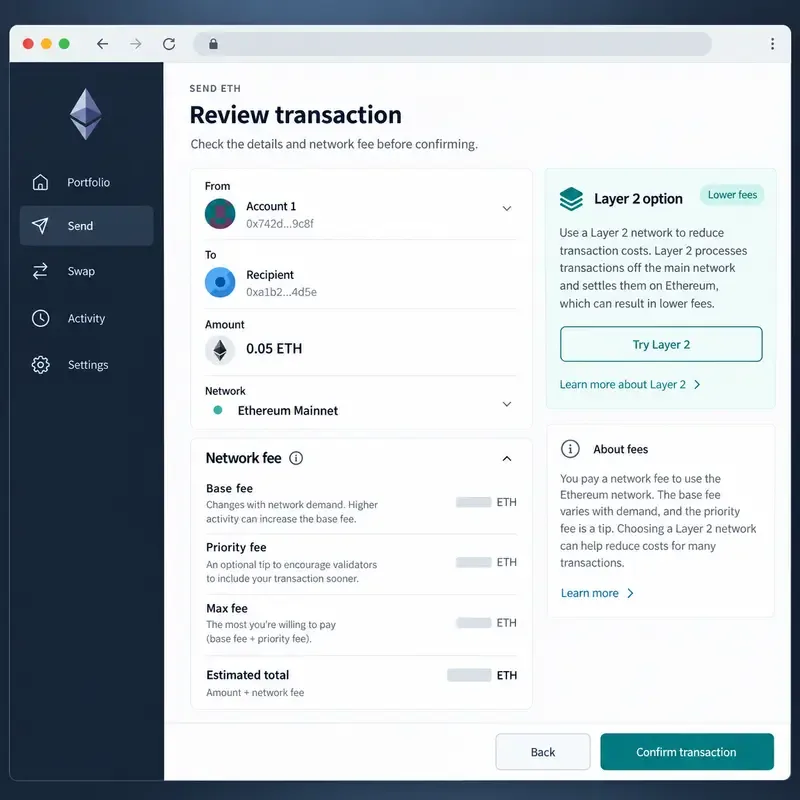
A generic wallet review screen separates the base fee, priority fee, maximum fee, estimated total, and a Layer 2 option; it is an illustrative interface, not a live fee quote or a real wallet screenshot.
What is an Ethereum gas fee?
Every Ethereum transaction asks the network to perform work. That work may be as simple as updating an account balance or as complex as executing several smart-contract operations. Gas is the unit used to measure the computational effort. The fee is calculated from the gas used multiplied by the effective price per gas.
Gas prices are normally displayed in gwei. One gwei is one-billionth of an ETH, or 0.000000001 ETH. Using gwei makes small fee amounts easier to read, but the wallet ultimately deducts ETH from the sender’s account.
Verified fact: Ethereum.org states that the fee is paid for the work of a transaction even when the transaction fails. There is an important technical distinction: a transaction rejected during validation because its gas limit is too low may consume no gas, while a smart-contract call that starts execution and then reverts can still consume gas for the work already performed.
Useful action: before signing, confirm that the destination, contract action, token amount, and network are correct. Do not treat a failed transaction as a harmless test, especially when interacting with an unfamiliar contract.
How the fee is calculated after EIP-1559
For the modern fee market, the most useful simplified formula is:
Transaction fee = gas used × (base fee + effective priority fee)
The base fee is set by the protocol according to recent block demand. It is not paid to the validator; it is burned. The priority fee, also called the tip, is an additional amount intended to make the transaction more attractive for inclusion. The max fee per gas is the most the sender authorizes paying per unit of gas. It is a ceiling, not automatically the amount that will be charged.
The Ethereum gas and fees documentation explains that the base fee can rise when blocks are used above their target and fall when demand is lower. The EIP-1559 specification describes the same mechanism and confirms that the base fee is burned while the priority fee is retained by the block proposer.
Common misconception: setting a high max fee does not necessarily mean paying that entire amount. The sender pays the applicable base fee plus the effective priority fee, within the authorized maximum, and the difference is not charged. Unused gas is also returned under the normal transaction accounting rules.
Useful action: read the wallet’s “estimated fee” and “maximum fee” separately. Treat the maximum as a protection limit, but check that the estimated total is acceptable before confirming.
Which fee settings actually affect cost?
Base fee: the part you usually cannot negotiate away
The base fee reflects demand for Ethereum block space. When many users compete for limited capacity, it can rise. A lower priority fee cannot eliminate the base fee. If the activity is not urgent, waiting for a less congested period may reduce the price per gas, but this is not guaranteed because demand can change suddenly.
Situation-dependent: there is no universal “cheapest hour” that works every day. Network demand is influenced by market moves, popular mints, liquidations, application launches, and other events. A quiet period can become expensive before a pending transaction is included.
Useful action: compare the wallet’s current estimate with a reputable live network view immediately before signing, then decide whether the transaction is urgent enough to send now. Do not rely on a fixed gas price copied from a previous day.
Priority fee: speed versus cost
The priority fee is a tip that signals urgency. A higher tip may improve the chance of prompt inclusion when transactions compete for space, but it does not always produce a meaningful speed improvement. If the base fee is the main source of cost, increasing the tip can add expense without solving the real problem.
Common misconception: the highest possible priority fee is not automatically the best choice. Ethereum.org notes that the appropriate tip depends on current network usage. A transaction that is not time-sensitive may not need an aggressive tip.
Useful action: use the wallet’s normal or standard recommendation for routine transfers. Consider a faster setting only when timing matters, and avoid manually entering an unusually large tip unless you understand why it is needed.
Gas limit: a safety ceiling, not a discount slider
The gas limit is the maximum amount of gas the transaction is allowed to consume. A simple ETH transfer has a commonly cited 21,000-unit limit, while smart-contract calls can require much more. If the limit is higher than the actual gas used, the unused portion is not normally charged. If it is too low for the operation, the transaction can fail.
Common misconception: lowering the gas limit does not reliably make a successful transaction cheaper. The actual cost is based on gas used, and an artificially low limit can cause failure. A smart contract that runs out of gas may revert while still consuming gas for the attempted execution.
Useful action: keep the wallet’s estimated gas limit unless you have contract-specific technical knowledge and a clear reason to change it. If the estimate suddenly looks abnormal, stop and investigate the contract call instead of forcing it through.
Practical ways to save money on Ethereum transactions
1. Choose the correct network before you sign
Ethereum Mainnet is designed for high-security settlement, but it is not always the most economical place for routine activity. Many applications also support Ethereum Layer 2 networks, which process activity away from the Mainnet execution environment and settle or publish data in relation to Ethereum.
The official Ethereum Layer 2 overview describes rollups as networks that store data on Ethereum’s Mainnet and explains that Layer 2 networks can offer lower transaction costs. Lower cost does not mean identical risk, liquidity, application support, or withdrawal experience for every network.
Situation-dependent: a Layer 2 is useful only if the wallet, application, asset, and recipient all support that network. Moving funds between Mainnet and a Layer 2 can require a bridge transaction, which itself costs money and introduces additional smart-contract and operational considerations.
Useful action: before switching networks, verify three things: the dapp supports the selected chain, the recipient can receive funds there, and you have the network’s required gas token. Send a small test amount when the route or bridge is unfamiliar.
2. Avoid unnecessary repeated transactions
Many workflows contain several separate actions: approving a token, swapping it, depositing it, or claiming a reward. Some applications support permit signatures, batching, or a single transaction that combines operations, while others do not. A single combined transaction can reduce repeated overhead, but it may also make the action harder to understand and can carry more contract permissions.
What cannot be known in advance: the cheapest workflow depends on the specific contract, calldata, application design, and current network. It is not safe to assume that a button labeled “batch” is cheaper or safer without reviewing what it authorizes.
Useful action: compare the full estimated cost and the requested permissions for each route. If a batch operation requests an unlimited token approval or an unfamiliar permission, stop and investigate before accepting the possible fee saving.
3. Time non-urgent activity carefully
Waiting can help when the base fee falls, particularly for routine transfers or non-time-sensitive contract interactions. However, a pending transaction is not a guaranteed discount strategy. A market event can raise demand, and a transaction that waits too long may need to be replaced or repriced, depending on the wallet and network conditions.
Useful action: set a personal fee ceiling before you start. If the current estimate is above that ceiling and the activity is not urgent, postpone it and recheck later rather than signing impulsively.
4. Compare the total cost, not just the gwei number
Two transactions can show similar gas prices but have very different gas usage. A token swap can consume far more gas than a simple transfer. Conversely, a higher gwei estimate for a simple transfer may still result in a lower total ETH fee than a complex contract call at a lower gwei value.
Useful action: compare the wallet’s estimated total in ETH, not only the base fee or gwei label. If possible, also check the transaction type and the contract action so that you know what work the network is being asked to perform.
What should you do when the fee looks unusually high?
Confirm that the wallet is connected to the intended network.
Read the contract action, token amount, recipient, and requested approvals.
Compare the estimated total with the maximum authorized fee.
Check whether the application supports a suitable Layer 2.
If the action is not urgent, wait and reassess the live estimate.
If the estimate remains abnormal, cancel the flow and check the application’s official documentation.
Verified fact: a high fee can result from network demand, a high priority fee, or a complex smart-contract operation. The presence of a high estimate does not by itself prove that the wallet, exchange, or dapp is overcharging you.
Useful action: inspect the fee breakdown and the transaction simulation, if your wallet provides one, before signing. Never approve a transaction merely because a pop-up says it is urgent.
A simple decision rule for everyday users
Your situation
Reasonable approach
Main trade-off
Urgent Mainnet transfer
Use the wallet’s normal or faster recommendation and review the maximum fee.
You may pay more for faster inclusion.
Routine transfer
Compare the current estimate and consider waiting if the fee exceeds your ceiling.
Waiting can delay the transaction and may not lower the fee.
Frequent dapp activity
Check whether the dapp supports a suitable Layer 2.
Network support, liquidity, bridging, and security differ.
Complex contract call
Keep the estimated gas limit and inspect permissions carefully.
A lower limit can cause failure; a batch route may add permission risk.
Bottom line
The most reliable way to save on Ethereum gas fees is to understand what the wallet is showing before you sign. The base fee reflects network demand, the priority fee reflects urgency, the max fee limits authorization, and the gas limit describes the maximum computation allowed. A larger max fee is not automatically the amount paid, while a lower gas limit is not automatically a cheaper transaction.
For many routine actions, the best combination is a supported Layer 2, a normal wallet fee recommendation, and a willingness to wait when the live estimate exceeds your personal limit. For every transaction, verify the network and contract details first. Fee savings are useful only when they do not introduce a larger risk of sending funds to the wrong chain, approving the wrong contract, or paying for a failed transaction.
Educational information only, not financial or investment advice. Gas prices, wallet interfaces, Layer 2 support, and transaction costs change over time. Check the live transaction preview and the relevant network’s current documentation before signing.