Home
» Knowledge
»
Dollar-Cost Averaging in Crypto Bear Markets: A Safer Timing Strategy, Not a Safety Guarantee
Dollar-Cost Averaging in Crypto Bear Markets: A Safer Timing Strategy, Not a Safety Guarantee
Dollar-cost averaging, or DCA, is often promoted as the “safest” way to keep buying crypto during a bear market. That wording needs a correction. DCA can reduce timing risk—the risk of putting all your money in just before another sharp decline—but it cannot make Bitcoin, Ether, or any other crypto asset safe. Crypto prices can remain highly volatile, an individual token can fail, and a platform or custodian can create risks that have nothing to do with your purchase schedule.
That distinction matters even more after recent investor guidance. In May 2026, FINRA refreshed its explanation of dollar-cost averaging, emphasizing both sides of the trade-off: regular fixed investments can reduce the impact of short-term market swings, but keeping money in cash and entering gradually can also mean missing gains if markets rise. Separately, the SEC's Office of Investor Education and Assistance published updated crypto custody guidance in December 2025, reminding retail investors that how and where crypto is held introduces additional risks beyond price movement. Those updates do not change what DCA is; they reinforce why a bear-market plan should address both buying discipline and asset/custody risk.
A fixed-dollar purchase schedule can make bear-market investing more systematic, but the schedule itself does not protect against crypto price, platform, custody, or asset-specific risks.
What dollar-cost averaging actually means
The U.S. Securities and Exchange Commission's investor education site defines dollar-cost averaging as investing equal portions of money at regular intervals regardless of market ups and downs. With the same dollar amount each time, you naturally buy more units when the price is low and fewer when the price is high. See the Investor.gov definition of dollar-cost averaging.
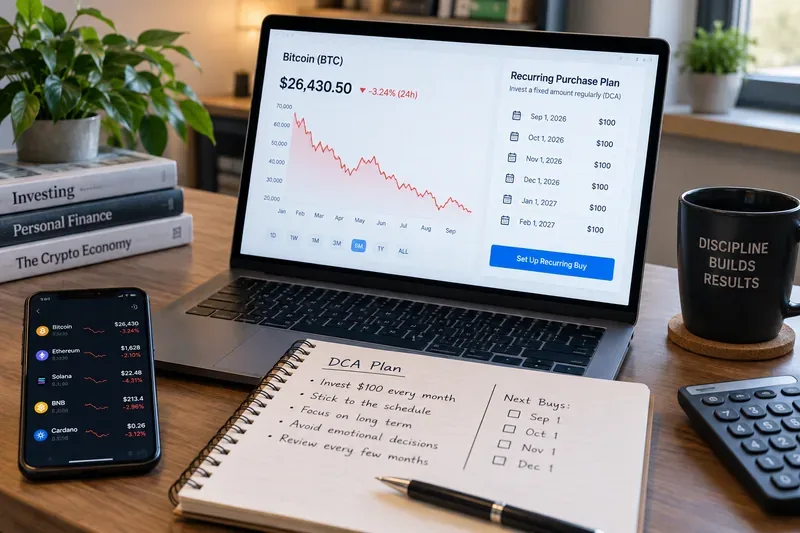
For crypto, a simple plan might look like this: invest $100 in Bitcoin on the first day of every month for a year, without increasing the purchase because prices are surging or skipping it because prices are falling. The defining feature is the rule-based schedule, not the asset itself.
DCA is different from “buying the dip” whenever you feel prices look cheap. Buying the dip is still a form of market timing because you decide when a decline is attractive enough. DCA instead removes much of that timing decision from each purchase.
Why DCA can feel especially useful in a bear market
A bear market generally refers to a prolonged period of falling prices and pessimistic sentiment. Crypto bear markets can include very large drawdowns, repeated rallies that fail, and long stretches when nobody knows where the bottom is.
That uncertainty is exactly where DCA has a practical advantage: you do not need to identify the bottom. Suppose you invest $100 four times at Bitcoin prices of $50,000, $40,000, $25,000, and $20,000. You would invest $400 total and acquire about 0.0135 BTC, for an average acquisition cost of roughly $29,630 per BTC. This example is purely illustrative and ignores fees, spreads, taxes, and price movement between quoted and executed prices.
The benefit is not that DCA “beats” the market. It is that a declining market causes each fixed dollar contribution to buy progressively more units. If the asset later recovers, those lower-price purchases can reduce your overall average cost relative to having invested the full amount at the first, higher price.
What risk DCA can reduce—and what it cannot
Risk
Can DCA help?
Why
Bad entry timing
Yes, partially
Your capital enters over multiple dates instead of one.
Emotional buying and selling
Potentially
A fixed schedule reduces the number of discretionary timing decisions.
Short-term volatility
Partially
Only part of your planned capital is exposed at the beginning.
Permanent failure of a token
No
Repeated purchases can compound losses if the asset ultimately loses most or all value.
Exchange or custodian failure
No
Your purchase schedule does not change counterparty or custody risk.
Hacking, phishing, lost keys
No
Security practices and custody choices determine these risks.
Regulatory or liquidity risk
No
DCA cannot guarantee that an asset remains tradable or liquid.
The CFTC warns that virtual currencies can be more volatile than traditional fiat currencies and identifies risks including platform safeguards, market manipulation, hacking, phishing, and flash crashes. Its virtual currency risk advisory is a useful reminder that DCA addresses only one narrow part of the overall risk picture.
Why “safest way to hold crypto” is the wrong mental model
DCA is a purchase method. Holding is a portfolio and custody decision. Those are related, but not identical.
If you DCA into a highly speculative token with weak liquidity, poor security, or no durable use case, buying it gradually does not fix those weaknesses. Likewise, if you leave a growing balance with a third party that later fails, your careful entry schedule may have done nothing to protect the assets you accumulated.
The SEC's December 2025 retail investor bulletin defines crypto custody as how and where you store and access crypto assets. It recommends researching third-party custodians carefully, never sharing private keys or seed phrases, watching for phishing, and using strong passwords and multi-factor authentication. Review the SEC investor bulletin on crypto asset custody.
A more accurate statement is: DCA may be a lower-timing-risk way to build a crypto position gradually, but the safety of the overall strategy still depends on what you buy, how much you allocate, and how you hold it.
DCA versus investing a lump sum
The central trade-off is straightforward. With a lump-sum approach, all available capital is invested immediately. With DCA, part of the money remains uninvested while you wait for future scheduled purchases.
Consideration
DCA
Lump sum
Exposure on day one
Partial
Full
Risk of buying just before another drop
Reduced, not eliminated
Higher for the full amount
Benefit if price rises immediately
Lower because some cash is still waiting
Higher because all capital participates
Emotional discipline
Rule-based schedule may help
Requires comfort with one large entry
Number of purchases
More
Usually one
Potential fees/spreads
May accumulate across multiple trades
Fewer transactions
FINRA's 2026 discussion of DCA notes that gradual investing may lower the impact of short-term market swings, but it can also reduce potential returns if prices rise while part of your money remains in cash. It also points out that repeated transactions can create additional fees. See FINRA's discussion of the benefits and limitations of dollar-cost averaging.
If you are investing money only as you earn it—for example, a fixed amount from each paycheck—the trade-off is somewhat different. You are not necessarily choosing to keep an already-available lump sum in cash; you are investing new savings on a recurring basis.
When DCA may fit a bear-market plan
DCA can be useful when your biggest problem is uncertainty about timing. It may suit someone who has a long horizon, accepts that crypto can decline substantially, wants a predetermined contribution amount, and does not want every purchase to depend on sentiment or headlines.
It is less compelling if you have not decided what percentage of your portfolio you are willing to lose, if the money may be needed soon, or if you are using DCA as a reason to avoid reevaluating a deteriorating asset. A schedule should impose discipline, not suspend judgment.
A sensible DCA rule has three limits
1. A dollar limit. Decide how much you can invest without jeopardizing emergency savings, debt payments, rent, taxes, or near-term goals. U.S. investor warnings on speculative crypto assets consistently emphasize that losses can be significant; money needed for essential obligations should not depend on a crypto recovery.
2. An allocation limit. Decide how much of your total investable portfolio can be exposed to crypto. DCA controls when money enters; allocation controls how large the eventual position becomes.
3. A review rule. A fixed purchase schedule does not mean “never reassess.” Periodically ask whether the reasons for owning the asset still hold, whether custody arrangements remain appropriate, and whether the position has grown beyond your risk budget.
Do not confuse lower average cost with lower risk
One of the most common DCA mistakes is celebrating a falling average purchase price while ignoring why the asset is falling. If a token drops from $10 to $5, then to $1, repeated purchases will reduce the average entry price—but the position may still be suffering a severe fundamental decline.
Average cost is an accounting measure. It does not tell you whether an asset is healthy, liquid, secure, fairly valued, or likely to recover. This is particularly important in crypto, where some assets lose relevance, suffer exploits, lose liquidity, or disappear from major trading venues.
The CFTC advises buyers of digital coins and tokens to conduct extensive research and warns against promises or guarantees of future value. Its customer advisory on buying digital coins and tokens is especially relevant before setting an automated purchase that could continue long after the original investment thesis has weakened.
Fees, spreads, taxes, and automation still matter
Small recurring buys can be convenient, but convenience has costs. Compare the platform's trading fee, spread, withdrawal fee, and any recurring-purchase surcharge. A $5 fee on a $50 weekly purchase is economically very different from a $5 fee on a $1,000 monthly purchase.
Taxes also depend on jurisdiction and can be affected by each acquisition lot and later disposal. DCA creates more purchase records, which can make cost-basis tracking more detailed. This article does not provide tax advice; use the rules and official tax guidance that apply where you live.
Automation can help with consistency, but it should not become “set and forget forever.” Review the destination asset, purchase amount, exchange or broker, custody setup, and transaction records on a regular schedule.
A bear-market DCA checklist
Define the maximum total amount you are willing to allocate to crypto.
Choose a fixed contribution amount and a fixed interval you can sustain.
Understand the asset before automating repeated purchases.
Compare trading fees, spreads, and withdrawal costs.
Keep emergency savings separate from your DCA budget.
Decide where accumulated crypto will be held and understand the custody trade-offs.
Use strong account security, including multi-factor authentication where available.
Track each purchase for portfolio and tax records.
Review the investment thesis periodically rather than buying indefinitely by habit.
Have a rule for stopping or reducing purchases if your financial situation changes.
The bottom line
DCA is useful because it turns an uncertain timing decision into a repeatable process. In a bear market, that can reduce the damage from committing all your planned capital immediately before another decline, and it can reduce the temptation to make every purchase based on fear or excitement.
But calling DCA the “safest” way to hold crypto goes too far. It does not prevent permanent losses, eliminate volatility, select good assets, secure your wallet, protect a custodian from failure, or guarantee that a market recovers. It also carries an opportunity cost when prices rise while part of your capital remains uninvested.
The durable lesson is narrower and more useful: DCA can be a disciplined way to manage entry timing in a volatile market, provided it sits inside a broader plan for asset quality, position size, liquidity needs, custody, security, fees, and periodic review. That is a more realistic way to use the strategy during a crypto bear market without mistaking consistency for safety.