How to Analyze Trading Volume to Confirm a Crypto Pump
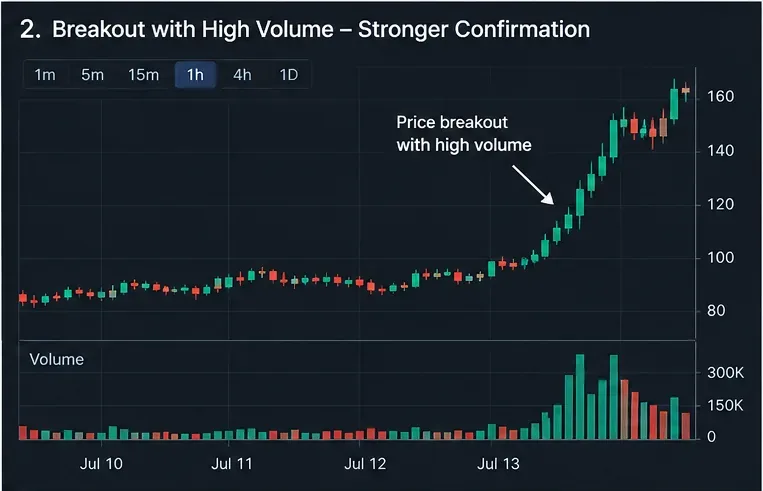
Learn how to compare crypto volume with its baseline, confirm price breakouts, spot fading momentum, and avoid mistaking a manipulated spike for strength.
A seed phrase is not merely a password. For many self-custody wallets, it is the backup from which wallet keys can be recovered. Anyone who obtains it may be able to recreate the wallet elsewhere, while an owner who loses every usable backup can lose the ability to recover funds after a device failure. That makes seed-phrase security a two-sided problem: you must prevent theft without creating a setup so fragile that one fire, flood, move, or forgotten hiding place causes permanent loss.
The practical rule is simple: keep the seed phrase offline, keep it private, protect it from physical damage, and maintain only the amount of redundancy you can secure responsibly. The BIP39 specification describes mnemonic phrases as a human-readable way to represent wallet seed material, while wallet manufacturers such as Trezor explicitly advise users to keep wallet backups offline and never make digital copies. See the BIP39 specification and Trezor's wallet-backup guidance.
| Goal | Recommended practice | Avoid |
|---|---|---|
| Prevent remote theft | Write the phrase down offline and keep it off internet-connected devices | Cloud notes, email, screenshots, password-manager attachments, chat messages |
| Prevent physical loss | Use durable storage in a secure location; consider a second protected backup | One loose sheet in an obvious drawer |
| Prevent environmental damage | Use a fire/water-resistant safe or a durable metal backup where appropriate | Assuming ordinary paper will survive every disaster |
| Prevent phishing | Enter the phrase only in a legitimate wallet recovery flow you intentionally started | Typing it into websites, forms, support chats, or links sent by strangers |
| Improve recovery confidence | Verify the backup using the wallet maker's supported backup-check procedure | Waiting until an emergency to discover a transcription error |
When a wallet presents a recovery phrase, copy the words carefully and in the exact order shown. BIP39 phrases encode both entropy and a checksum, so word order matters. Do not invent your own phrase, rearrange words, or “improve” the wording. The standard was designed to convert computer-generated randomness into a human-readable mnemonic, not to turn a memorable sentence into secure wallet entropy.
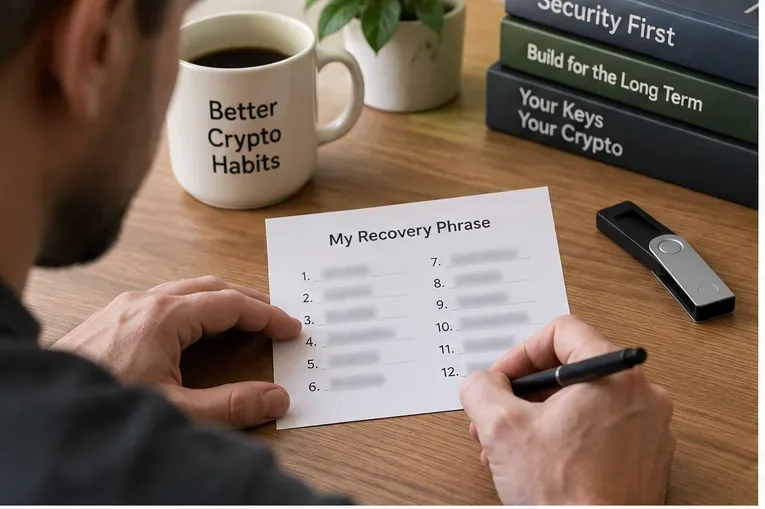
Writing the phrase on paper is still a valid baseline because it keeps the secret out of cloud services, synced photo libraries, browser history, clipboard managers, and malware-accessible files. Trezor's official guidance specifically says not to keep digital copies such as screenshots, photographs, emails, or cloud files. The same principle applies regardless of wallet brand: once the phrase becomes a normal digital file, it can be copied silently and indefinitely.
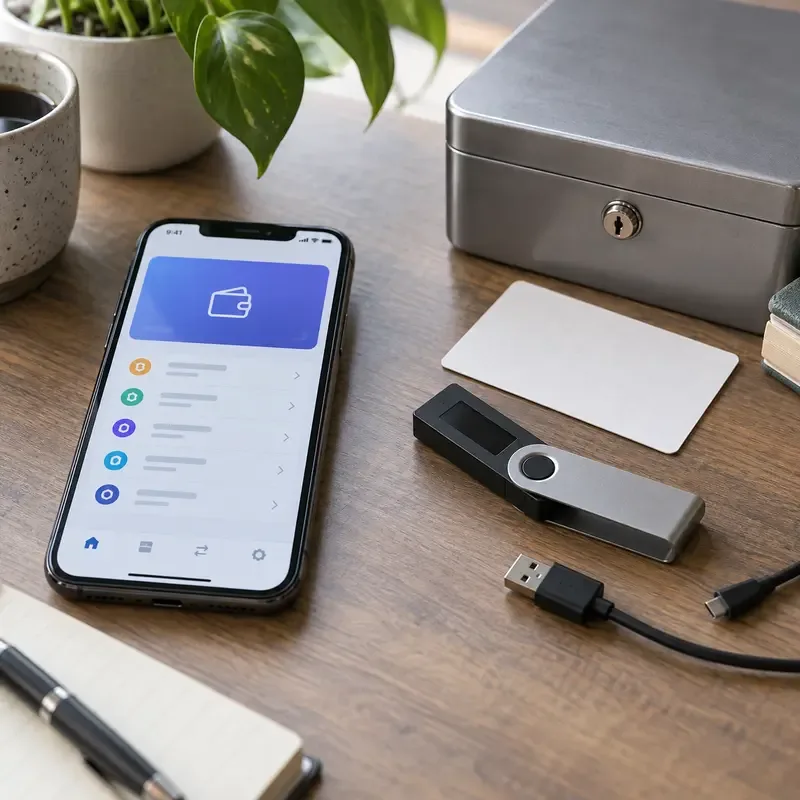
Offline storage solves remote exposure, but not burglary, snooping, or accidental discovery. Treat the phrase like a bearer instrument: possession may be enough to control the wallet. A home safe can be reasonable if it is securely installed and not easily removed. A bank safe-deposit box may reduce some household risks, but access rules, jurisdiction, inheritance procedures, and availability differ, so it is not automatically the right choice for everyone.
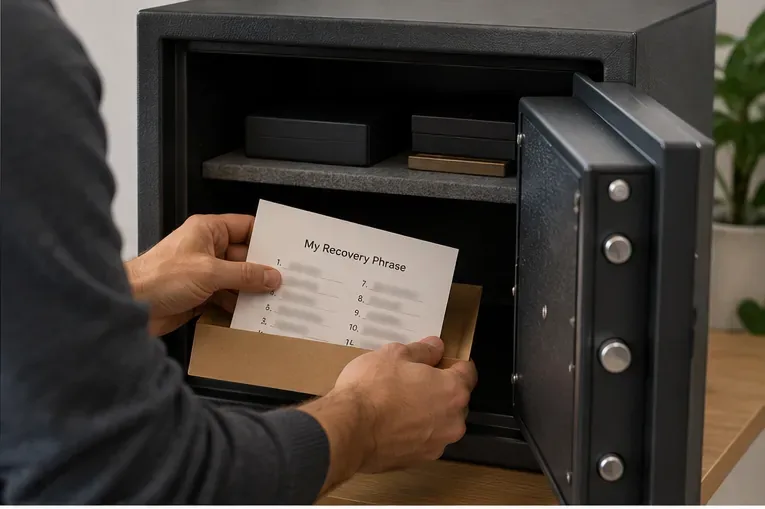
The right location depends on your threat model. A renter in a shared apartment faces different risks from a homeowner in a flood zone, and someone with a large balance may need stronger controls than someone experimenting with a small wallet. Trezor's backup-storage guidance explicitly frames storage choices around environmental, physical, and remote threats rather than a single universal hiding place.
Paper can last for years in good conditions, but it is vulnerable to fire, water, mold, tearing, ink degradation, and accidental disposal. For long-term or high-value storage, a metal backup can add resilience against some environmental hazards. The important point is the material and storage method, not a particular brand: the backup must remain readable after the types of damage you are realistically planning for.
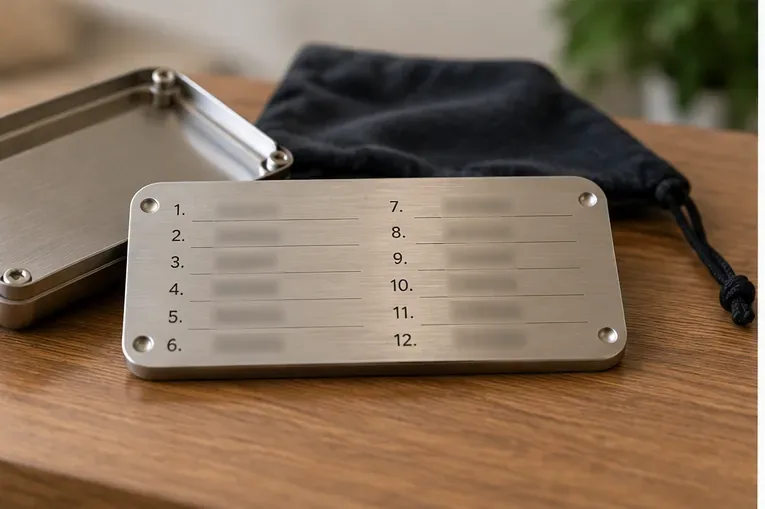
Do not assume “metal” automatically means indestructible. Different products vary in heat tolerance, corrosion resistance, fastening method, and how clearly data remains readable after deformation. If you buy a backup product, use the manufacturer's documented procedure and test the assembly with non-secret sample data before committing your real phrase.
A single copy creates a single point of failure. Two copies in the same desk drawer create almost the same single point of failure. A more resilient setup may use two physically separated backups, but each additional complete copy also creates another place an attacker could find.
A reasonable personal setup might be one primary backup in a secured home safe and one secondary backup in another controlled location. The second location should not be so remote or complicated that you forget where it is, lose access, or create inheritance confusion.
Avoid homemade “split the 12 words into two piles” schemes. They are easy to misunderstand and can produce weak or unrecoverable arrangements. If you want threshold recovery, use a wallet-supported standard designed for that purpose. Trezor, for example, documents SLIP39 multi-share backups, where a defined threshold of shares can reconstruct the wallet. The key distinction is that this is a formal recovery scheme, not an improvised division of words.
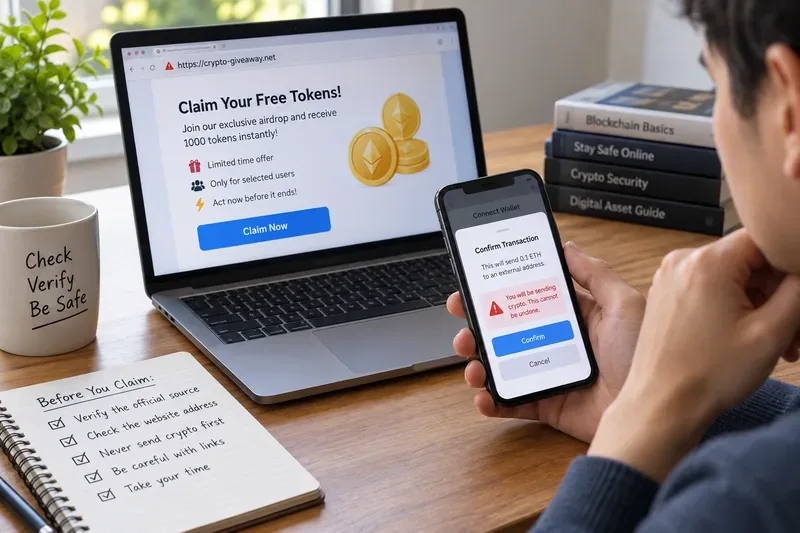
Phishing remains one of the most dangerous seed-phrase threats because an attacker does not need to break wallet cryptography if they can persuade the owner to hand over the backup. A fake support representative, fraudulent website, malicious browser extension, fake wallet update, or social-media direct message may ask you to “verify” or “synchronize” your wallet by entering the phrase.
Legitimate support should not need your seed phrase. Trezor's phishing guidance explicitly warns users never to share a wallet backup. Treat any unsolicited request for the phrase as a security incident.
A backup that contains a misspelled, missing, or misordered word may fail when you need it most. Many hardware-wallet ecosystems provide a “check backup” or dry-run recovery feature that validates the backup without requiring you to destroy the existing wallet first. Use the wallet maker's documented method, preferably on the hardware device itself when supported.
Do not perform a recovery test by typing the phrase into a random website or generic online BIP39 tool. Online tools can expose the phrase to browser extensions, compromised scripts, telemetry, clipboard software, or malware. For real funds, keep recovery operations within a trusted, documented wallet workflow.
BIP39 allows an optional passphrase in addition to the mnemonic. This can provide another layer of protection because the same seed phrase combined with different passphrases produces different wallets. It can also create a serious new failure mode: if you forget the passphrase, the seed phrase alone does not recreate that passphrase-protected wallet.
This is not the same as a simple account password that a company can reset. Use a passphrase only if you understand the recovery model and have a secure way to preserve it separately. The BIP39 specification describes how the mnemonic and passphrase are combined, and Trezor's documentation likewise warns that passphrase-protected wallets depend on the exact passphrase.
If you have typed the seed phrase into an untrusted website, sent it to someone, stored it in a compromised cloud account, or otherwise believe another person may possess it, do not assume changing a wallet PIN fixes the problem. The seed phrase can be used to reconstruct the wallet independently of the original device.
The safer response is to treat the phrase as compromised and move funds to a newly generated wallet with a new backup. Trezor's official compromised-backup guidance recommends moving funds promptly when a wallet backup may have been exposed. Exact steps depend on your wallet, assets, and available hardware, so follow the recovery procedure documented by the wallet you use.
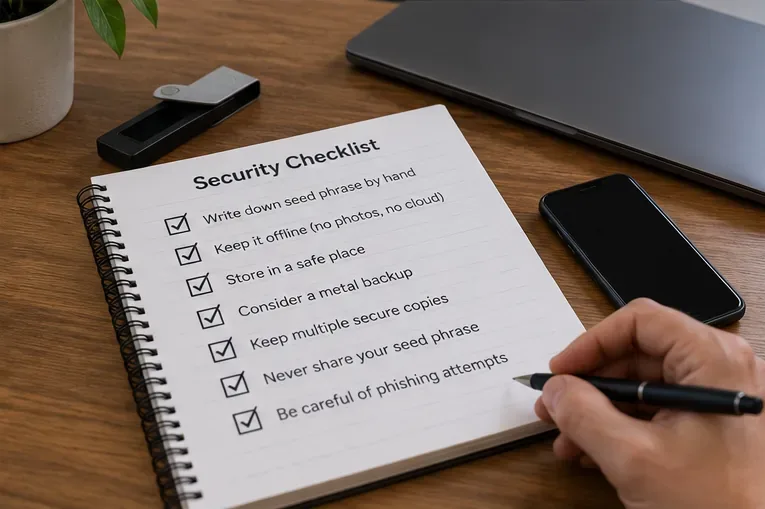
The best seed-phrase security is not the most complicated arrangement. It is the one that survives both major failure modes: unauthorized access and permanent loss. Keep the phrase offline, use physically durable and private storage, add carefully controlled redundancy, resist every request to reveal the phrase, and verify your backup before an emergency. Advanced options such as passphrases and threshold backups can improve resilience, but only when you fully understand their recovery requirements.
Learn how to compare crypto volume with its baseline, confirm price breakouts, spot fading momentum, and avoid mistaking a manipulated spike for strength.
Learn how to spot fake crypto airdrops and giveaway scams, verify claims safely, understand wallet approval risks, and respond quickly if you already interacted.
Protect your crypto seed phrase with an offline backup, secure physical storage, redundancy, phishing defenses, and a clear recovery plan.
Compare hot and cold crypto wallets by convenience, online exposure, recovery risk, and real-world use. Learn which setup fits trading, spending, and long-term storage.
Fix crypto trading bot API key connection errors with a practical checklist for permissions, IP allowlists, signatures, timestamps, endpoints, rate limits, and secure re-testing on Binance and OKX.
Learn a practical breakout workflow using crypto screeners, liquidity and on-chain scanners, chart confirmation, and risk checks, with a clearly fictional example.
Learn how spot grid bots work, then set up and manage one on Binance or OKX with beginner-friendly parameters, risk checks, and exit steps.
Compare five free crypto token scanners for honeypots, scam signals, smart-contract vulnerabilities, holder risks, and token security before you trade.
Learn how to spot crypto rug-pull warning signs before buying: hype, team transparency, holder concentration, admin powers, liquidity, sell restrictions, and wallet approvals.
Learn how X (Twitter) and Telegram can amplify meme coin momentum, which social signals matter, how to spot coordinated hype, and how to avoid pump-and-dump traps.