Home
» Knowledge
»
How to Spot a Crypto Rug Pull Before It Happens: An 8-Step Pre-Trade Check
How to Spot a Crypto Rug Pull Before It Happens: An 8-Step Pre-Trade Check
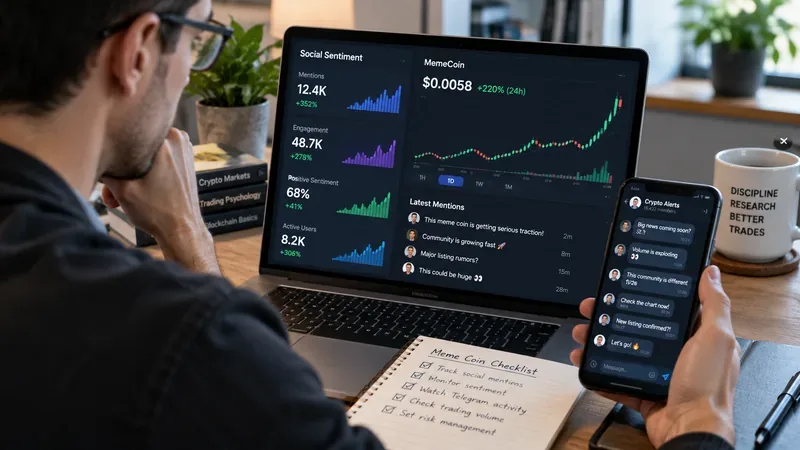
You find a new token in a social feed. The chart is moving fast, the community is shouting that the presale is almost over, and the website claims early buyers could make extraordinary returns. The temptation is to decide in minutes. That is exactly when a rug pull is hardest to spot: before the exit, the project can look busy, liquid, and legitimate.
A rug pull generally describes a crypto scheme in which insiders or promoters suddenly extract value from a project—such as by draining liquidity, dumping a concentrated token position, abusing privileged contract controls, or making the asset effectively unsellable. Not every failed or badly designed token is a rug pull, and no single warning sign proves fraud. The goal of this guide is to combine several independent checks before you put money or wallet permissions at risk.
The process below moves from the fastest checks to deeper on-chain review. If a project fails an early check badly, you do not need to keep digging just to justify walking away.
Step 1: Strip away the hype before you inspect the token
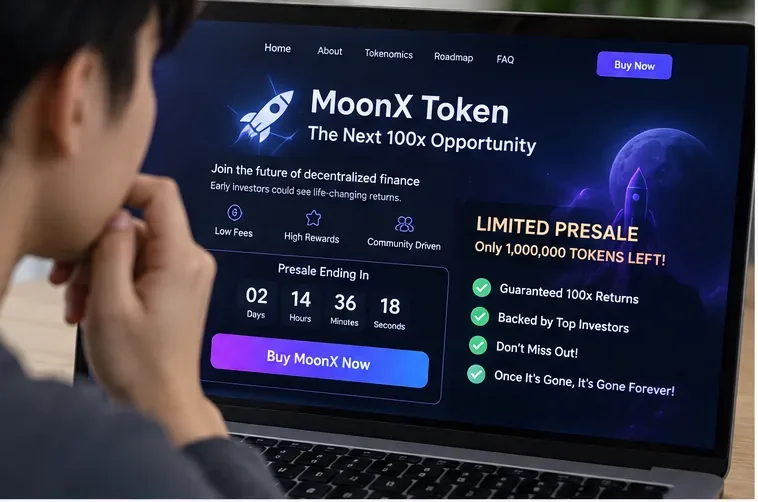
Guaranteed returns, countdown pressure, and “last chance” language are reasons to slow down, not reasons to buy faster.
Start with the sales pitch. The U.S. Securities and Exchange Commission's investor education staff repeatedly warns that promises of high or guaranteed returns, low or no risk, unsolicited offers, and pressure to act immediately are classic fraud red flags. The Federal Trade Commission likewise warns that nobody can guarantee crypto profits.
Before looking at code, ask three simple questions:
Is the pitch promising guaranteed, fixed, or near-certain profits?
Is there a countdown, “whitelist closing,” “last allocation,” or other artificial urgency?
Is most of the evidence social proof—screenshots, influencers, testimonials, or follower counts—rather than verifiable facts?
Step 2: Verify that the project exists beyond its own marketing
A polished website is not the same as verifiable development history, documentation, or accountable operators.
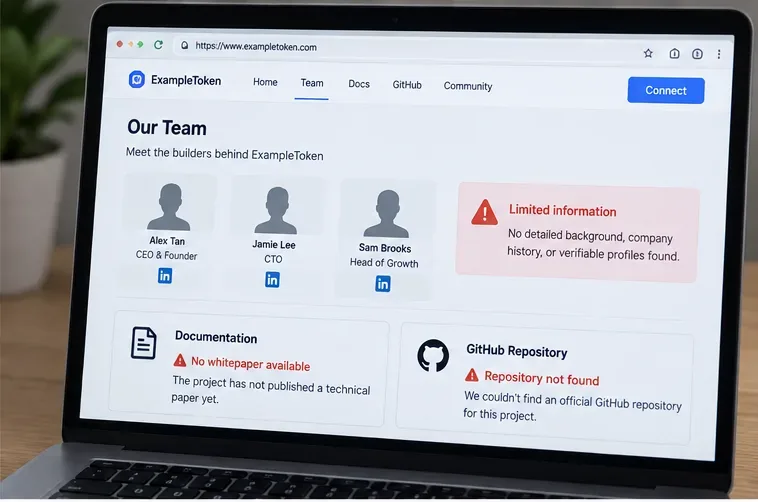
Next, check whether the people, product, and code can be independently verified. Look for a technical description that explains what the token does, a consistent contract address published across official channels, a development history, and team information that can be checked outside the project's own site.
An anonymous team is not automatically fraudulent—some legitimate crypto projects use pseudonymous contributors—but it changes the risk profile. If the operators are unknown, the code is closed, the documentation is vague, and the project has no meaningful history outside promotional channels, you have fewer ways to evaluate who controls the system or what happens when something goes wrong.
Search the project name, token symbol, contract address, and key team names independently. The FTC specifically recommends searching for the name of the company or person and the cryptocurrency along with terms such as “scam” or “complaint.” Do not rely only on links handed to you by promoters.
Step 3: Check holder concentration and connected wallets
Heavy supply concentration can give a few wallets enough inventory to crash the market if they sell, especially when liquidity is shallow.
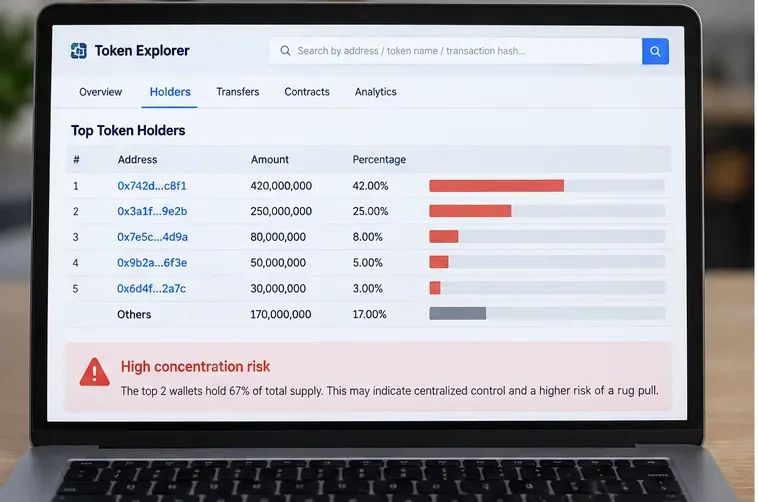
Open a reputable block explorer for the chain and inspect the token's largest holders. A concentrated supply does not prove a rug pull: exchange wallets, vesting contracts, bridges, treasury contracts, staking vaults, and liquidity pools can legitimately hold large balances. The question is who controls those addresses and what they can do.
Look for patterns such as:
one externally owned wallet holding an unusually large share of supply;
several top wallets funded by the same deployer or interacting in a coordinated way;
large unlocked team allocations with no credible vesting mechanism;
rapid transfers from deployer-linked addresses into fresh wallets before a marketing push.
The SEC has cautioned that crypto offerings can have highly concentrated and opaque ownership and control structures. Concentration becomes more dangerous when paired with thin liquidity or privileged contract controls.
Step 4: Read the contract's admin powers, not just the tokenomics page
Owner or admin functions are not automatically malicious, but they tell you what trusted parties can change after you buy.
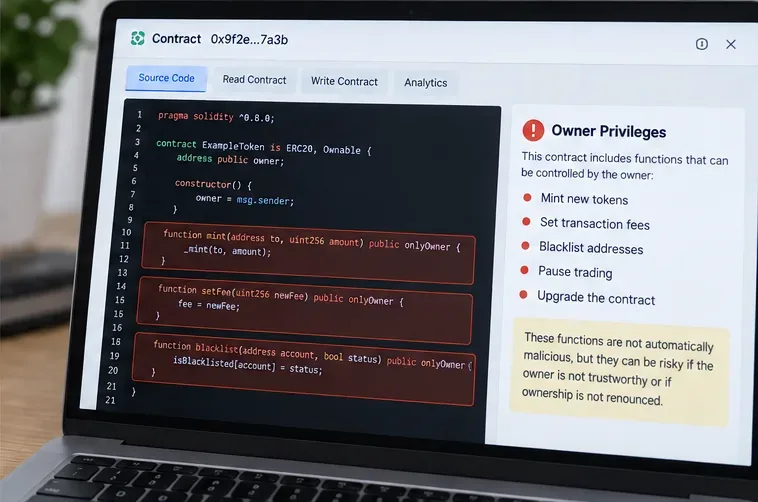
Marketing material may say “fixed supply” or “community owned,” but the smart contract is the more important source of truth. If source code is verified, inspect the functions and access-control roles. If the contract is upgradeable, inspect the proxy administrator and upgrade authority as well.
Pay particular attention to whether an owner or admin can:
mint additional tokens;
change transfer fees or taxes;
blacklist or whitelist addresses;
pause transfers or trading;
change trading limits;
upgrade or replace implementation logic;
move treasury or protocol funds.
These functions can be legitimate. Emergency pause controls, for example, may be useful during a critical bug. The risk is not the mere existence of an admin function; it is whether a single party can use powerful functions without a timelock, multisignature control, transparent governance, or other constraints.
OpenZeppelin's current access-control documentation explains why roles governing minting, freezing, upgrades, and other privileged actions matter. Ethereum's smart-contract security documentation similarly emphasizes proper access control for sensitive functions.
Step 5: Inspect liquidity depth and who can remove it
Price and market capitalization can look impressive even when the actual pool is too small—or too centrally controlled—to support normal exits.
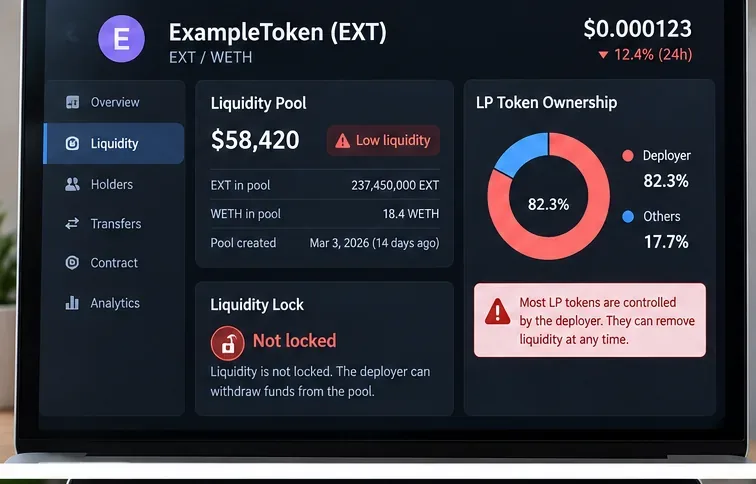
A token can display a large nominal market capitalization while having very little liquidity available for buyers and sellers. Check the actual pool: how much of the base asset is there, how deep is the market, and who controls the liquidity position?
If the deployer or a closely related wallet controls most of the withdrawable liquidity, the project may be able to remove that liquidity abruptly. A lock or vesting mechanism can reduce that specific risk, but “liquidity locked” is not a universal safety certificate. You still need to verify the lock contract, duration, beneficiary, unlock date, and whether other pools exist.
Also separate liquidity risk from token ownership risk. Even permanently locked liquidity cannot stop insiders from dumping a huge unlocked token allocation into the pool.
Step 6: Confirm that ordinary holders can actually sell
Extreme sell taxes, transfer restrictions, or address-specific rules can turn a tradable-looking token into a practical honeypot.
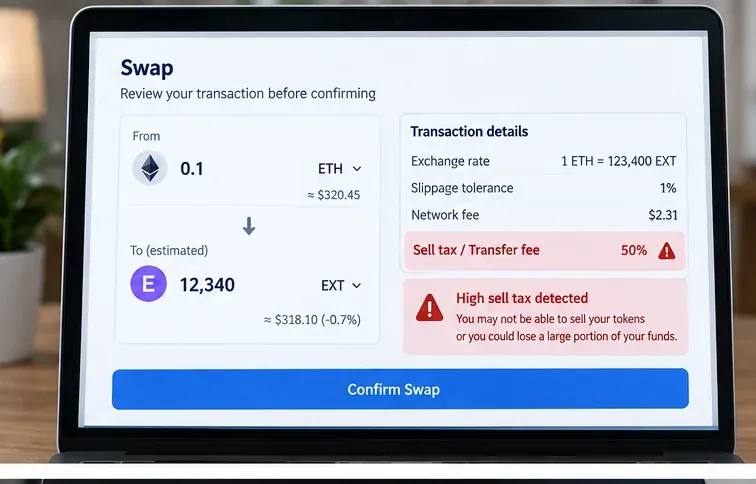
Some malicious tokens are designed so buying is easy while selling is blocked, heavily taxed, or permitted only for selected addresses. Before risking meaningful money, inspect the transfer logic and use reputable transaction simulation or explorer tools when available.
Look for:
sell fees that can be changed to extreme levels;
different rules for buys and sells;
blacklists or trading permissions controlled by the owner;
maximum-transaction or maximum-wallet rules that can be changed arbitrarily;
logic that treats router, pair, or specific addresses differently.
Do not assume a successful buy proves a successful exit. If you choose to test market mechanics, keep the amount trivial and understand that even a successful small sell does not prove future sells will remain enabled; an administrator may be able to change parameters afterward.
Step 7: Treat wallet approvals as a separate security decision
Buying a token and granting a contract permission to spend your existing assets are two different risks. Review approvals separately.
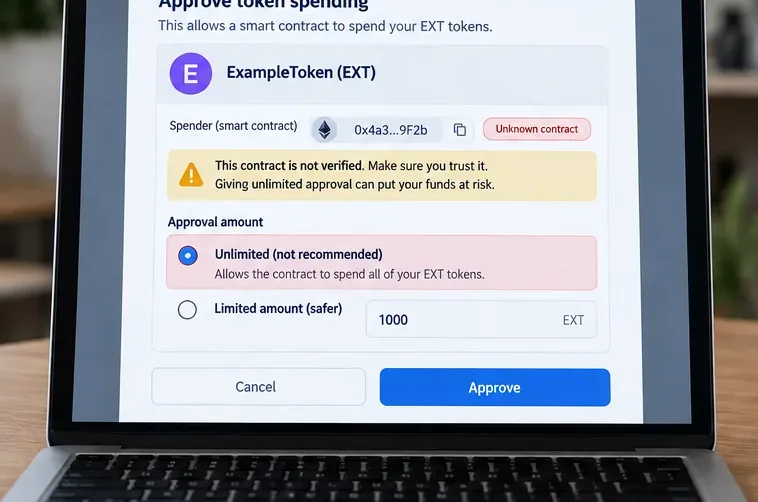
A rug-pull check should include what the website asks your wallet to sign. A malicious or compromised dapp may request an unlimited token approval that allows its contract to spend tokens already in your wallet. That risk can remain even after you leave the website.
Ethereum.org warns that malicious contracts can abuse unlimited approvals and recommends approving only what you need and revoking unnecessary permissions. If a new project asks for broad approval unrelated to the action you are performing, stop and understand exactly which token, spender address, and amount you are authorizing.
Use the official Ethereum guidance on reviewing and revoking token access. If you have already interacted with a suspicious project, Ethereum.org also recommends securing remaining assets and revoking suspicious approvals in its scam support guidance.
Step 8: Combine the evidence and make a stop/go decision
The safest conclusion comes from combining independent signals instead of trusting one badge, audit, influencer, or automated score.
At this point, do not reduce the project to a single automated “rug score.” A project can pass one check and still fail another. Audited code does not guarantee honest operators. Locked liquidity does not eliminate insider token dumps. Doxxed founders do not remove dangerous contract privileges. A successful test sell does not prove that sell rules cannot be changed later.
A practical decision rule is to classify what you found into three buckets:
Finding
What it means
Suggested response
Explained and independently verifiable
The risk exists but the project documents and constrains it.
Keep evaluating.
Unclear or unverifiable
You cannot determine who controls an important function or asset.
Do not assume the benign explanation; investigate further.
Directly dangerous
Examples include extreme mutable sell taxes, hidden mint authority, removable liquidity controlled by insiders, or deceptive guaranteed-return claims.
Do not proceed unless the issue is resolved and independently verified.
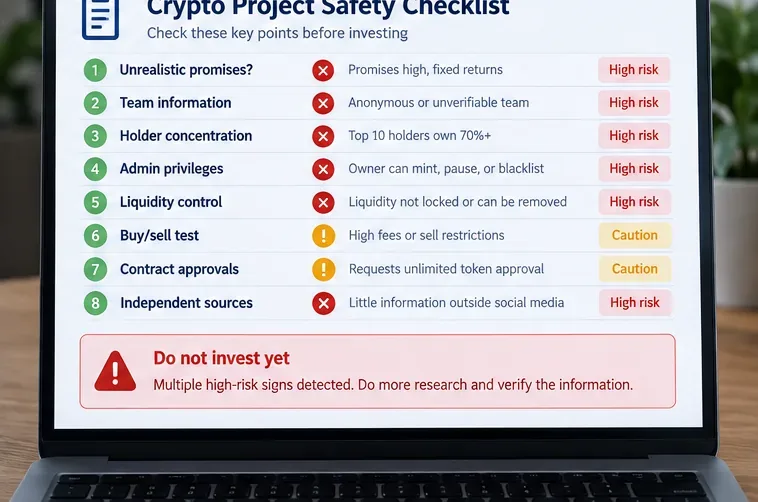
A 10-minute rug-pull screening checklist
If you need a compact version before considering a small speculative position, run this list in order:
Ignore urgency and promises; write down exactly what the project claims.
Verify the official contract address from more than one trustworthy source.
Check whether the team, documentation, and development history can be independently verified.
Inspect the largest token holders and identify contracts, exchanges, treasury wallets, and deployer-linked addresses.
Read verified contract code and identify owner, admin, minter, pauser, fee, blacklist, and upgrade powers.
Inspect the real liquidity pool depth and who can withdraw the liquidity position.
Review buy/sell restrictions and mutable fees; use transaction simulation where available.
Read every wallet signature and token approval before confirming it.
Search independently for complaints, security reports, and contradictory information.
If multiple critical facts remain unverifiable, walk away rather than filling the gaps with assumptions.
How to self-check your conclusion
Before buying, close the project's website and social channels. Then try to reproduce your conclusion using only independent data: the blockchain explorer, verified source code, liquidity positions, official registry or regulator tools where relevant, and documentation hosted outside promotional posts.
Ask yourself:
Can I explain who can mint, pause, blacklist, change fees, or upgrade the contract?
Can I explain who owns the largest token positions?
Can I explain who controls the main liquidity and when that control can change?
Can ordinary holders sell under the current contract rules?
Did I verify the contract address rather than trust a social-media link?
Did I avoid granting unnecessary unlimited approvals?
Would I still consider the project if the price chart and influencer posts were hidden?
If you cannot answer the first six questions with evidence, you do not yet understand the risk well enough to rely on the seventh.
What to do if you already interacted with a suspicious token
If you believe your wallet may have interacted with a scam contract, focus first on protecting what remains. Review and revoke suspicious token approvals, move unaffected assets to a secure wallet if compromise is plausible, and preserve transaction hashes, addresses, screenshots, and communications. Do not pay strangers who claim they can recover stolen crypto for an upfront fee; regulators warn that recovery scams frequently target people who have already lost money.
Possible U.S. securities fraud can be reported through the SEC resources linked from Investor.gov's victim resources, while consumer scams can be reported through the FTC. Recovery of crypto sent to fraudsters can be difficult, which is why pre-trade verification matters more than any promise of getting funds back later.
Bottom line
Most rug pulls are easier to avoid when you stop treating the token price as the main source of information. Marketing tells you what promoters want you to believe; holder data tells you who owns the supply; smart-contract code tells you what privileged accounts can change; liquidity data tells you how exits are funded; and wallet approvals tell you what access you are granting before anything goes wrong.
The best protection is not finding one magic indicator. It is refusing to invest when several critical parts of the system cannot be independently verified. In crypto, “I don't know who controls this” is not a neutral fact—it is a risk that should be priced accordingly.