Home
» Knowledge
»
On-Chain Analysis for Beginners: How to Track Whale Wallets and Smart Money
On-Chain Analysis for Beginners: How to Track Whale Wallets and Smart Money
A large wallet buys a token, a dashboard calls it “smart money,” and social media immediately treats the transaction as a trading signal. That sequence looks simple, but several different kinds of information have been mixed together. The blockchain may verify that an address moved tokens. It usually does not verify why the transfer happened, who ultimately controls the address, or whether copying the trade will be profitable.
That distinction is the foundation of useful on-chain analysis. The goal is not to turn every large transaction into a prediction. It is to separate what is directly recorded on-chain, what an analytics provider has inferred, and what remains unknown. Once you do that, whale tracking becomes a research tool rather than a source of false certainty.
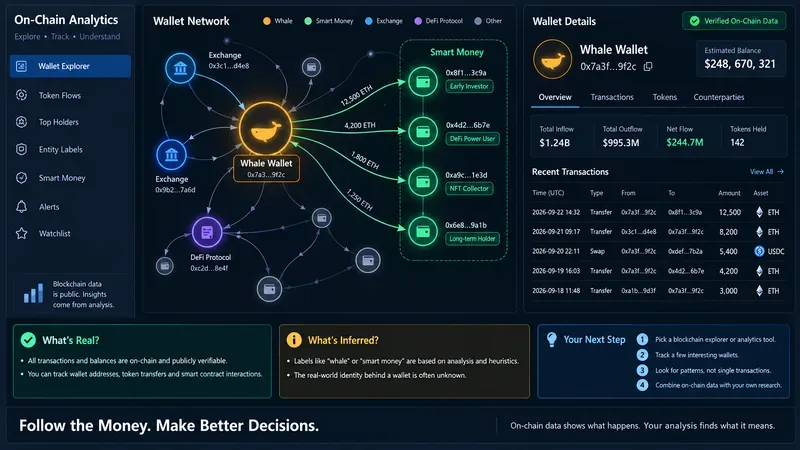
A practical on-chain workflow starts with verifiable transactions and balances, then adds labels and behavioral interpretation. The dashboard shown is a generic teaching example rather than a screenshot from a specific analytics service.
What on-chain analysis can actually tell you
On-chain data is information recorded on a blockchain ledger. On Ethereum, for example, block explorers can expose transaction hashes, timestamps, sender and recipient addresses, token transfers, account balances, transaction history, contract interactions, and other execution data. Ethereum’s official documentation describes block explorers as interfaces to real-time blockchain data and notes that Ethereum is transparent by design. See Ethereum.org’s block explorer documentation.
Verified: if a finalized transaction shows that address A transferred 5,000 tokens to address B, that event can be checked independently against the chain.
Context-dependent: whether that transfer is a purchase, sale preparation, internal treasury movement, bridge operation, collateral transfer, market-maker inventory shift, or something else depends on the counterparties and smart-contract calls involved.
Unknown from the transfer alone: the owner’s motive and future action.
Action: when you see a dramatic wallet alert, open the transaction itself before reading commentary about it. Record the chain, transaction hash, token, amount, timestamp, sender, recipient, and contract interaction first.
Whale wallet does not mean smart money
A whale is generally a wallet or entity holding or moving a large amount of crypto relative to the asset or market being studied. There is no single universal balance threshold that makes an address a whale across every token and chain. A $10 million position may be enormous in one small-cap asset and routine for an exchange wallet in a large market.
Smart money is a different concept. Analytics services may use the term for traders or institutions that meet a provider’s performance or classification methodology. Nansen’s current API documentation, checked in September 2026, separates whale filtering from smart-money filtering and lists smart-money categories such as “Fund,” “Smart Trader,” and performance-window labels such as “30D Smart Trader.” Its documentation describes smart money as sophisticated participants that include institutional funds and historically profitable traders. See Nansen’s Smart Money documentation and Nansen’s core concepts.
Verified: a wallet’s balance, transfers, and contract interactions can be measured on-chain.
Provider-defined: whether a wallet qualifies as “smart money” depends on a particular labeling methodology, performance window, and dataset.
Not established: a large wallet is not automatically a skilled trader, and a historically profitable trader is not guaranteed to be profitable on the next trade.
Action: keep separate watchlists for “large holders” and “performance-labeled traders.” Do not merge them into one category unless you have evidence that a wallet meets both criteria.
A wallet address is not necessarily one person
One of the most common beginner mistakes is treating an address as if it were a named human brokerage account. On Ethereum, an account can be an externally owned account or a smart-contract account, and a wallet application is merely an interface for interacting with accounts. See Ethereum.org’s account documentation.
Real entities can also control many addresses. Exchanges may use deposit addresses, hot wallets, cold wallets, treasury wallets, and operational wallets. Funds and protocols may similarly spread activity across multiple accounts. This is why analytics platforms build entities: clusters of addresses believed to belong to the same organization or actor.
Arkham’s current API guide explicitly describes its model as entity-first and says attribution is confidence-scored rather than a binary claim. Its documentation also says labels evolve as new signals appear. See Arkham’s API guide.
Verified: each address has its own on-chain history.
Inferred: grouping multiple addresses into one real-world entity requires attribution research or heuristics.
Action: before drawing conclusions about a “whale,” check whether the address belongs to a known exchange, protocol, bridge, market maker, fund, custodian, or multisignature treasury. Entity context can completely change the meaning of a transfer.
Wallet labels are useful, but they are not blockchain facts
Human-readable labels make blockchain data far easier to interpret, but they sit on top of the raw ledger. Nansen states that it assigns labels using research and heuristics, while Arkham uses structured entities, address labels, tags, and confidence-scored attribution. Arkham also distinguishes provider attribution from user-created private labels. See Arkham’s tagging-system explanation.
This matters because an unlabeled address is not necessarily unimportant, and a labeled address is not necessarily identified with absolute certainty. Some services distinguish high-confidence attributions from predictions or user-generated labels. Arkham has previously documented lower-confidence entity predictions separately from verified entities and notes that custom labels may be created by users. See Arkham’s entity-prediction explanation.
Verified: the address and its transactions exist on-chain.
Inferred: the real-world identity attached to that address may depend on evidence outside the blockchain.
Action: when identity matters to your thesis, check the label source, confidence status, and whether another reputable dataset independently reaches the same attribution.
Start with behavior, not reputation
Suppose a wallet is known to have been profitable in the past. The next useful question is not “Should I copy it?” but “What behavior produced that record?”
Review:
which assets the wallet trades
average position size
holding period
whether profits are realized or only unrealized
frequency of trades
DEXs and protocols used
stablecoin inflows and outflows
transfers to or from centralized exchanges
whether several addresses may belong to the same entity
whether activity occurs before or after major price moves.
Nansen’s current smart-money API exposes categories such as holdings, DEX trades, net flows, historical holdings, and other wallet activity. Its methodology notes that historical holdings use historical daily prices rather than recalculating old balances using today’s prices, which is important when evaluating past behavior. See Nansen’s data methodology.
Action: inspect several months of history before treating a wallet as informative. One spectacular trade is a weak sample; repeated behavior across different market conditions is more meaningful.
Do not assume a transfer to an exchange means “sell”
Exchange inflows are often interpreted as bearish because a holder may be preparing to sell. That is a plausible hypothesis, but it is not the only explanation. Funds can be sent to an exchange for collateral, derivatives margin, internal rebalancing, custody, market making, OTC settlement, or operational reasons.
Nansen’s own flow documentation uses exchange inflows as a possible sell-pressure indicator and outflows as a possible accumulation signal, while explicitly framing them as patterns to correlate with other information. See Nansen’s flows documentation.
Verified: tokens entered a known exchange-controlled address if the destination attribution is correct.
Context-dependent: that may increase the ability to sell, but it does not prove a sale occurred.
Action: follow the next step. Look for subsequent exchange activity, token balance changes, DEX trades, derivatives positions where visible, and price behavior instead of stopping at the deposit.
Internal transfers can look like market activity
A large transfer may simply move assets between wallets controlled by the same entity. Exchanges routinely rebalance hot and cold storage. Funds may move assets between custody arrangements. Protocol treasuries may reorganize wallets. A raw transfer counter can therefore exaggerate economic activity.
Entity aggregation helps reduce this problem. Nansen’s holder tools can aggregate related addresses by entity, and Arkham describes entities as groups of addresses associated with the same organization or individual.
Action: when two large addresses interact, check whether both are attributed to the same entity. If they are, classify the event as an internal transfer unless further evidence shows a change in beneficial ownership.
Token balances can hide DeFi exposure
Looking only at ERC-20 balances can miss what a sophisticated wallet is actually doing. Assets may be deposited in lending protocols, supplied to liquidity pools, staked, bridged, wrapped, placed in vaults, or represented by receipt tokens. Smart-contract interactions often matter as much as simple transfers.
Ethereum’s transaction model includes an input-data field that lets transactions call contract logic, and explorers can expose contract interactions alongside token transfers. See Ethereum.org’s transaction documentation.
Action: when a token leaves a wallet, identify the destination contract before calling it a sale. A deposit into a lending protocol is economically different from sending tokens to an exchange.
How to build a beginner whale-tracking workflow
1. Pick one chain and one asset first
Trying to follow every whale on every chain creates noise. Begin with a market you already understand, such as ETH activity on Ethereum or a specific token ecosystem.
Action: create a small research universe: one chain, one token, and perhaps 10–20 addresses or entities.
2. Use a block explorer as the source of record
Analytics dashboards make interpretation faster, but the underlying transaction should still be verifiable through a blockchain explorer. Ethereum’s official documentation lists block explorers as tools for examining accounts, transactions, contracts, blocks, and tokens.
Action: save the address and transaction-hash links for every event you consider important.
3. Add labels and entity context second
Once the raw event is confirmed, use reputable analytics datasets to ask who might control the address and what behavioral history is associated with it.
Action: note the provider, label, confidence level if available, and date checked. Treat labels as research metadata, not immutable facts.
4. Compare behavior across time
A single transaction is a point; a wallet history is a pattern. Look for recurring accumulation, distribution, exchange usage, DEX behavior, protocol interactions, and realized outcomes.
Action: maintain a simple journal with columns for date, wallet/entity, transaction, asset, amount, counterparties, interpretation, confidence, and subsequent outcome.
5. Look for clusters, not isolated alerts
A stronger signal may appear when several independently successful wallets move into the same asset over a similar period. Even then, common exposure can reflect the same narrative, incentive program, market-making strategy, or token unlock rather than independent conviction.
Action: compare at least several wallets and check whether their transactions are genuinely independent.
6. Validate with non-wallet context
On-chain data tells you what happened on-chain. It may not reveal token unlocks, governance decisions, vesting schedules, OTC agreements, market-maker mandates, legal restrictions, or off-chain hedges.
Action: read the project’s official documentation, governance proposals, token-distribution information, and other primary sources before converting wallet activity into a market thesis.
A simple evidence framework
Observation
Status
What you can reasonably say
What you should not assume
Address buys tokens on a DEX
Directly verifiable
The address executed a swap under the recorded terms
The owner expects the price to rise
Address holds a very large balance
Directly verifiable
It is a major holder by your chosen threshold
It is a skilled investor
Analytics provider labels it “Smart Trader”
Provider-defined
It meets that provider’s methodology
Future trades will outperform
Tokens move to a labeled exchange wallet
Transfer verified; label may be attributed
Funds moved to an address attributed to an exchange
A sale definitely happened
Several addresses are grouped as one fund
Attribution-based
The provider believes the addresses share control or ownership
The grouping is mathematically certain
Wallet transfers tokens to an unknown contract
Transfer verified
The contract interaction can be decoded
The tokens were sold until the contract behavior is identified
What “smart money” cannot tell you
Even a well-constructed smart-money label has unavoidable limitations. Historical profitability can be strategy-specific. A wallet may hedge off-chain or on another venue. Its risk tolerance may be completely different from yours. A fund may have access to liquidity, financing, information, or execution tools that a retail trader does not. A visible wallet can also represent only one piece of a larger portfolio.
There is also survivorship risk: focusing only on wallets that became famous after making profitable trades can overstate how predictable such performance was in advance.
Action: use smart-money activity as a hypothesis generator. Ask what the wallet sees, what alternative explanation fits the data, and what evidence would prove your interpretation wrong.
Red flags when following whale-wallet posts
No transaction hash: the claim cannot be independently checked.
No chain specified: the same-looking address or asset ticker may exist on multiple networks.
No distinction between wallet and entity: internal transfers may be misrepresented as buys or sells.
“Whale” used as a synonym for “smart money”: size and skill are different attributes.
Exchange deposit described as a confirmed sale: intent is being inferred from a transfer.
Old label presented as permanent identity: attribution databases can change.
Profit screenshots without full history: realized losses, transferred positions, or other wallets may be omitted.
Action: if a post triggers urgency, slow the process down. Reconstruct the claim from the transaction outward instead of accepting the headline inward.
A beginner checklist before acting on an on-chain signal
Can I verify the transaction on the correct blockchain?
Do I know whether the address is an individual wallet, contract, exchange wallet, or part of a larger entity?
Is the identity label verified, confidence-scored, predicted, or user-created?
Am I looking at a real buy or sell, or merely a transfer?
Could the movement be internal to the same entity?
Have I checked smart-contract interactions rather than just token balances?
Does the wallet have a repeatable history, not merely one successful trade?
Is the “smart money” designation based on a documented methodology?
Have I checked project-specific events such as unlocks, treasury activity, or governance changes?
What evidence would make my interpretation wrong?
Bottom line
On-chain analysis is powerful because blockchains expose a verifiable record of transactions, balances, and contract interactions. The difficult part begins after the raw data: deciding who controls an address, whether several wallets belong to the same entity, what a transfer means, and whether past wallet performance says anything useful about the future.
For beginners, the most durable habit is simple: verify first, label second, interpret third. Track whale wallets to understand flows and market structure. Track performance-labeled wallets to study repeatable behavior. But never treat wallet size, a provider label, or one large transfer as a complete trading thesis.
Risk note: Crypto markets are volatile, on-chain attribution can be incomplete or wrong, and historical wallet performance does not guarantee future results. This article is educational and does not provide individualized investment advice.