Home
» Knowledge
»
What Is Impermanent Loss in DeFi Liquidity Pools and How Can You Reduce It?
What Is Impermanent Loss in DeFi Liquidity Pools and How Can You Reduce It?
You add two tokens to a DeFi liquidity pool, trading volume looks healthy, and the pool keeps paying fees. Then one token rallies sharply. When you check your position, you discover that it is worth less than if you had simply held the same two tokens in your wallet. That gap is impermanent loss.
Impermanent loss is not a mysterious fee charged by a protocol. It is an opportunity cost created by the way an automated market maker (AMM) rebalances a liquidity provider’s assets as relative prices move. Fees can offset it, but they do not guarantee a profit. The practical goal is therefore not to pretend the risk can always be eliminated, but to understand when it becomes large, choose pools that fit your risk tolerance, and compare fee income with the value you would have had by simply holding.
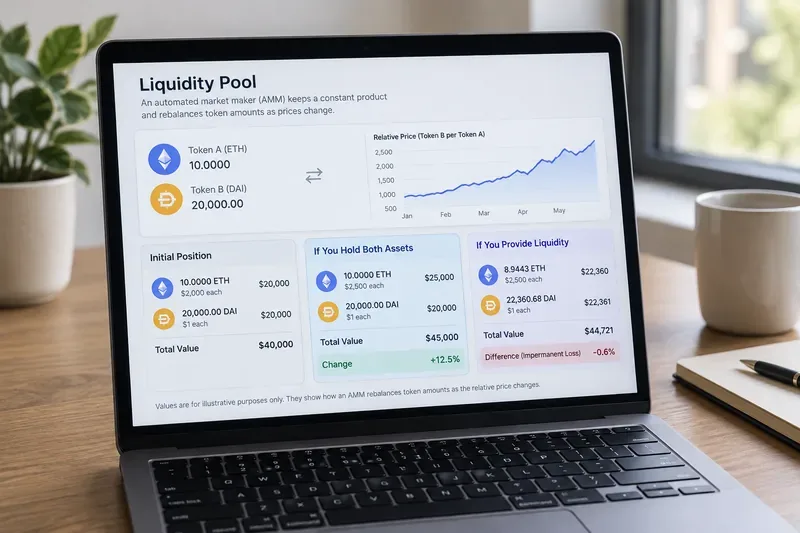
An example of the core trade-off: when the relative price changes, an AMM rebalances the token amounts, so the liquidity-provider position can lag a simple hold strategy even while both positions gain in dollar value.
What is impermanent loss?
Impermanent loss, often shortened to IL, is the difference between the value of assets supplied to a liquidity pool and the value those same assets would have had if they had simply been held outside the pool. Uniswap’s current glossary describes it as the opportunity cost experienced by liquidity providers when token prices change relative to holding the tokens. See the Uniswap Protocol Glossary.
The word “impermanent” comes from the fact that the gap can shrink or disappear if the relative price returns to the level at which liquidity was added. But the label can be misleading. If you withdraw while a gap exists, the difference is effectively realized. And even if you do not withdraw, there is no guarantee the price relationship will ever return to its starting point.
Why does impermanent loss happen?
For a classic constant-product AMM such as Uniswap v2, pool reserves follow the relationship x × y = k. Here, x and y are the reserve balances of the two tokens and k is the invariant. As traders swap against the pool, the reserve ratio changes. Arbitrage traders then tend to trade against price differences between the pool and outside markets, pushing the pool toward the broader market price. Uniswap explains this mechanism in its How Uniswap Works documentation and in the Uniswap v2 whitepaper.
The important consequence for an LP is that the pool automatically changes how much of each token the LP effectively owns. If Token A rises relative to Token B, arbitrage activity tends to leave the pool with less of the appreciating token and more of the other token. If Token A falls, the pool tends to accumulate more of the falling token. Compared with a passive holder, the LP has therefore sold some of the outperformer or bought more of the underperformer along the way.
A simple impermanent-loss example
Suppose you provide equal dollar values of ETH and a dollar-pegged token to a 50/50 constant-product pool when ETH is $2,000. You contribute 10 ETH and 20,000 units of the stablecoin, so the starting value is $40,000.
If ETH later rises to $2,500 while the stablecoin remains at $1, simply holding would leave you with 10 ETH worth $25,000 plus $20,000 of the stablecoin, for a total of $45,000. A constant-product pool, after arbitrage rebalances it to the new relative price, would leave the equivalent position with roughly 8.94 ETH and about 22,361 stablecoins, worth roughly $44,721 before considering fees. The difference is about $279, or roughly 0.6% of the hold value.
This does not mean the LP lost money in dollar terms; the position rose from $40,000 to about $44,721 before fees. Impermanent loss is a comparison with the alternative of holding, not necessarily an absolute portfolio loss.
The standard formula for a 50/50 constant-product pool
If the relative price changes by a factor of r, the return of the LP position relative to holding can be expressed as:
2√r ÷ (1 + r) − 1
The result is negative when the price moves away from the starting ratio. For example, a 2× relative price move produces about a 5.7% shortfall versus holding, while a 4× move produces about a 20% shortfall. The direction does not matter mathematically: a doubling and a halving create the same percentage gap for a symmetric 50/50 constant-product pool.
Does fee income cancel impermanent loss?
Sometimes, but not automatically. Traders pay swap fees, and those fees compensate LPs for supplying capital. Uniswap’s fee documentation explains that fee mechanics vary by protocol version; in v2, the 0.30% swap fee is added to reserves, while v3 and v4 account for fees separately for positions. See Uniswap Fees.
Your real outcome is better thought of as LP value + fees and incentives − costs, compared with the value of simply holding the original assets. Costs can include gas, rebalancing expenses, hedging costs, taxes where applicable, and losses from other risks. A pool with high headline APR can still underperform holding if price divergence is large or if the quoted yield is temporary.
How to reduce or avoid impermanent loss, from simplest to more advanced
1. If you cannot tolerate the comparison risk, do not LP volatile pairs
The only straightforward way to avoid AMM impermanent loss is not to provide liquidity to a pool structure that exposes you to it. Holding the assets separately avoids this specific rebalancing effect, although it still leaves you exposed to ordinary market-price risk. This is the clearest choice when your main goal is to preserve upside exposure to a token you strongly expect to outperform its pair.
2. Favor assets that are expected to move together
Impermanent loss grows as the relative price between the two pooled assets moves farther from the entry ratio. That is why pairs with closely related prices can have lower divergence risk than a volatile token paired with a stablecoin. Uniswap’s v2 whitepaper explicitly notes that correlated assets, such as two USD stablecoins, would generally create less impermanent loss than pairing either one with ETH.
But “stable” does not mean “risk-free.” A stablecoin can depeg, a wrapped asset can lose its peg to the underlying token, and a liquid-staking token can trade at a discount. In those events, a pool designed for correlated assets may experience a large imbalance precisely when liquidity providers are most vulnerable.
3. Look at the pool’s invariant, not just the token names
Different AMMs can use different pricing curves. Curve’s StableSwap design combines characteristics of constant-sum and constant-product invariants to keep prices flatter near equilibrium for assets intended to trade near the same value. The original StableSwap whitepaper explains that this design targets much lower slippage around the balanced point than a plain constant-product curve.
That can reduce rebalancing losses for truly correlated assets, but it does not remove depeg or smart-contract risk. Always understand what assumptions the pool makes about the relationship between its assets.
4. Compare expected fees with realistic price divergence
Before depositing, run more than one scenario. Ask what happens if the relative price moves 10%, 25%, 50%, 2×, or more. Then compare the resulting hold-versus-LP gap with the fee yield you could reasonably earn over the same period. Use recent volume and liquidity only as context, not as a promise that future fees will match the past.
A useful decision question is: How much trading-fee income would this position need to earn to compensate me for the amount of divergence I consider plausible? If the required fee return looks unrealistic, the pool is a poor fit even if its current APR looks attractive.
5. Treat concentrated liquidity as a different risk profile
In concentrated-liquidity AMMs such as Uniswap v3 and v4, an LP can choose a specific price range instead of spreading liquidity across all possible prices. This can make capital more efficient and can increase fee generation per dollar while the position is active. However, tighter ranges generally create stronger exposure to price movement and require more active management. Uniswap notes that concentrated positions can increase the chance of impermanent loss, and positions that move out of range stop earning swap fees. See Uniswap’s impermanent-loss explanation and its liquidity-risk overview.
For a beginner, a wider range is usually easier to reason about than a narrow range, but it still does not guarantee better returns. The appropriate range depends on the assets, volatility, fee tier, market depth, and how often you are willing to monitor or rebalance.
6. Advanced users can hedge, but hedging creates new costs and risks
Professional LPs may use futures, options, borrowing, or dynamic rebalancing to reduce directional exposure. These approaches can change the shape of the risk, but they do not make it disappear. Hedging can introduce funding costs, liquidation risk, basis risk, collateral requirements, execution costs, and additional smart-contract or counterparty exposure.
If a strategy requires constant rebalancing or leverage just to make the headline yield attractive, evaluate the full system rather than the LP position in isolation.
Common mistakes that make impermanent loss worse
Chasing the highest APR: incentive emissions can fall quickly, while token-price divergence can persist.
Ignoring the hold benchmark: a positive dollar return can still be worse than simply holding the assets.
Assuming fees are guaranteed: fee income depends on future trading activity and your active share of liquidity.
Using narrow ranges without a management plan: concentrated liquidity can go out of range and stop earning fees.
Calling stablecoins “safe” without checking peg risk: correlated-asset pools can suffer badly when a peg breaks.
Looking only at IL: smart-contract vulnerabilities, token quality, oracle design, bridge risk, governance changes, and transaction costs can matter just as much.
How to check whether your liquidity position is actually working
Use a consistent benchmark from the moment you deposit. Record the number of each token you supplied, their entry prices, the dollar value of the deposit, and all fees or rewards earned. Then periodically compare two values at the same market prices:
Hold value: what the original token amounts would be worth today if you had never deposited them.
LP value: what you can withdraw from the pool today, plus claimable fees and incentives, minus relevant costs.
If the LP value is higher after costs, the liquidity strategy has outperformed the hold benchmark for that measurement period. If it is lower, the combination of impermanent loss and costs has exceeded the fees and incentives you earned.
Finally, check whether the result came from a repeatable source of return. A one-week period with unusually high volume may not represent normal conditions. Likewise, a period with almost no price movement may understate the risk of a volatile pair.
The bottom line
Impermanent loss is the price of allowing an AMM to rebalance your assets while you earn trading fees. The larger the relative price move, the larger the potential shortfall versus holding in a standard 50/50 constant-product pool. You can reduce the risk by choosing assets that are likely to remain correlated, using pool designs suited to those assets, avoiding unnecessarily tight concentrated-liquidity ranges, and demanding enough realistic fee income to justify the divergence risk.
You cannot reliably “avoid” impermanent loss while keeping all the benefits of liquidity provision in volatile markets. The safer decision process is to model the hold benchmark first, estimate plausible divergence, add expected fees conservatively, and only then decide whether the LP position offers a risk-return trade-off you are comfortable with.