Home
» News
»
Cross-Chain DeFi Bridges: Security Risks, Fees, and Safer Transfer Practices
Cross-Chain DeFi Bridges: Security Risks, Fees, and Safer Transfer Practices
Cross-chain DeFi bridges solve a real interoperability problem: blockchains do not naturally share state, so a user cannot simply move a token from one independent chain to another as if both chains used the same ledger. A bridge coordinates a transfer using mechanisms such as locking and minting, burning and minting, message verification, or liquidity supplied on the destination chain.
The important security lesson is that “bridged” does not describe one architecture. Different bridges can rely on native chain verification, external validator sets, oracle or messaging networks, optimistic verification, liquidity providers, or combinations of these mechanisms. As of September 15, 2026, Ethereum’s official bridge documentation still emphasizes that there is no perfect bridge design—only different trade-offs among security, convenience, connectivity, functionality, and cost. Action: before transferring meaningful value, identify the bridge’s verification model rather than choosing only by brand name or quoted speed.
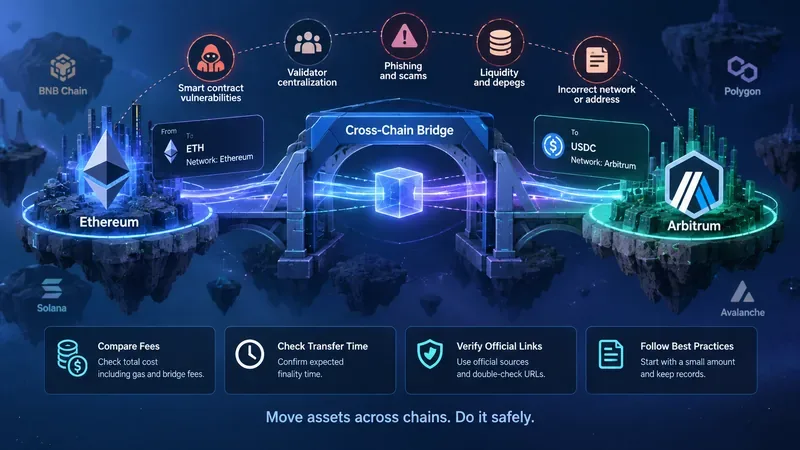
A cross-chain transfer adds a bridge security model between the source and destination networks, so users should evaluate both protocol risk and transaction details before moving funds.
What a bridge really does—and what it does not do
A common misunderstanding is that the same token physically travels between blockchains. Ethereum’s documentation explains that bridges commonly use patterns such as lock and mint, burn and mint, or atomic swaps. In a lock-and-mint design, for example, an asset can remain locked on the source chain while a corresponding representation is created on the destination chain. See Ethereum’s technical overview of blockchain bridges.
This distinction matters because the destination asset can inherit dependencies that the original asset did not have. Its value may depend on a bridge contract, validator network, custodian, liquidity pool, or issuer redemption mechanism. Action: verify the exact token contract on the destination chain through the token issuer or protocol’s official documentation; do not assume identical ticker symbols represent identical assets.
Security risk #1: the bridge can add a new trust layer
Verified principle: a bridge’s security can differ from the security of the two chains it connects. Ethereum distinguishes externally verified or “trusted” designs from designs that minimize additional trust by relying more directly on the connected chains. External validator, federation, multisig, or oracle-based designs add parties whose behavior or keys may become security assumptions.
That does not mean every externally verified bridge is unsafe, nor that every system described as trust-minimized is automatically safe. Implementation quality, upgrade controls, verifier diversity, monitoring, contract correctness, and the security of each connected chain still matter. Action: document who can authorize a cross-chain message and what threshold is required before using the bridge for treasury-sized transfers.
A concrete example: Wormhole Guardians
Wormhole’s current documentation states that its core protocol uses a Guardian network. Signed messages, called VAAs, become valid when the required supermajority signs them; its documentation currently describes a 13-of-19 signature threshold. Wormhole also describes additional protections such as full-node observation on supported configurations and accounting controls for cross-chain assets. These are specific properties of Wormhole, not universal properties of bridges. Review the current Wormhole security model before relying on those assumptions.
Action: when comparing another bridge, look for equally concrete answers: number of verifiers, signing threshold, how verifiers observe chains, upgrade authority, emergency controls, and what happens when a chain reorganizes or halts.
Security risk #2: smart contracts can fail even when the architecture sounds strong
Verified risk: bridge contracts can contain implementation bugs. Ethereum’s bridge documentation explicitly lists smart-contract risk and technology risk among the hazards of bridging. Audits can reduce risk, but an audit is not proof that a contract contains no exploitable flaw.
Cross-chain systems are especially sensitive because they often coordinate contracts and state across multiple environments. A validation error on one side can potentially cause an invalid mint, unlock, or message execution on the other side. Upgradeable contracts add another dimension: the current code may not remain the code governing the system indefinitely.
Action: check the official protocol documentation for contract addresses, audits, bug-bounty information, upgrade mechanisms, pause controls, and recent security notices. For large transfers, check these again immediately before execution rather than relying on research done months earlier.
Security risk #3: the destination chain matters too
Another misconception is that choosing a secure bridge makes the entire cross-chain position as secure as the source chain. That is not necessarily true. If assets are moved from a highly decentralized network to a chain with different consensus, sequencer, validator, or governance assumptions, the resulting position is exposed to those destination-chain risks as well.
Ethereum’s documentation, for example, notes that sidechains use their own consensus and do not automatically inherit Ethereum Mainnet’s security guarantees. Rollups and other scaling systems have their own architectures and withdrawal/finality assumptions. Action: evaluate the destination network separately from the bridge; ask what must remain operational for you to transact and eventually exit.
Security risk #4: wrapped assets and liquidity can become systemic dependencies
Some bridges create or move representations of assets whose backing depends on assets locked elsewhere. If backing becomes compromised, frozen, or incorrectly accounted for, a destination representation can trade below the value users expected. Other bridge designs use destination liquidity supplied by market participants instead of waiting for a canonical cross-chain settlement path.
The exact exposure therefore depends on the route. There is no defensible rule that “liquidity bridges are always safer” or “canonical bridges are always cheaper.” Action: determine whether you receive a canonical asset, a bridge-specific wrapped asset, or liquidity from a relayer, and verify what ultimately settles the transfer.
How cross-chain bridge fees actually work
A displayed “bridge fee” may be only one part of the cost. Depending on the protocol and route, the total economic cost can include source-chain gas, destination execution gas, protocol fees, liquidity-provider fees, relayer fees, message-verification costs, price impact, or an integrator fee. Token conversion during the route can add swap fees and slippage as well.
Cost component
Why it can change
What to check
Source gas
Network congestion and transaction complexity
Wallet’s estimated network fee before signing
Destination gas/execution
Destination chain and bridge design
Whether included in the quote or paid separately
Protocol / message fee
Bridge pricing and route
Official fee documentation and live quote
Liquidity / relayer fee
Capital utilization, gas, settlement delay and route liquidity
Amount sent versus amount received
Swap cost
Pool liquidity, volatility and trade size
Price impact, minimum received and slippage settings
Integrator fee
Interface or application policy
Fee breakdown in the application quote
Across provides a useful documented example of why fees should be evaluated at the route level. Its current documentation says a transfer’s total fee is the difference between input and output amounts and describes LP and relayer components; relayer compensation can reflect destination gas, capital opportunity cost, and capital at risk. It also documents optional integrator fees. See the Across fee documentation. These formulas describe Across, not every bridge.
Action: compare the final amount expected at the destination, not merely a headline percentage. Get fresh quotes for the same asset, amount, source chain, and destination chain because fees can be route- and time-dependent.
Fast does not necessarily mean unsafe—and slow does not prove safety
Transfer time is partly a consequence of architecture. A liquidity network may give a user funds quickly while settlement occurs later. An optimistic system can use a challenge mechanism for settlement. A native bridge can require waiting for finality or a protocol-specific withdrawal period. Therefore, “two seconds” and “seven days” do not, by themselves, tell you which system has the stronger security model.
Across, for example, documents an optimistic verification model for its settlement process, with proposals that can be challenged under protocol rules. Wormhole documents Guardian-signed messages. These designs should be evaluated according to their own failure conditions rather than compared solely by user-facing completion time. See Across’s security-model documentation.
Action: distinguish time until funds appear from time until the underlying cross-chain settlement is final. For high-value transfers, understand both.
Phishing and wrong-route errors are separate from protocol security
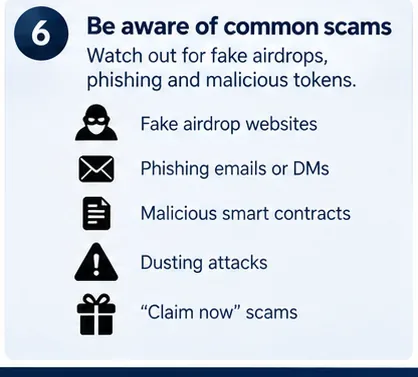
A bridge can operate correctly while a user still loses funds by visiting a cloned website, approving a malicious contract, selecting an unsupported token, or sending to an incompatible address. A protocol audit cannot protect a wallet that signs an unrelated malicious approval.
Unknown factors also matter here. A search-engine result, social-media reply, direct message, or advertisement cannot by itself establish that a bridge interface is official. Domains and front ends can change over time. Action: reach the bridge from a verified project documentation page or official application directory, compare the connected wallet’s chain and transaction details, and never enter a seed phrase into a bridge website.
A safer workflow before bridging meaningful value
Confirm the asset and route. Record the source token, source chain, destination chain, and exact asset you expect to receive.
Identify the security model. Determine whether validation depends on native verification, external validators, Guardians, an oracle, optimistic settlement, liquidity providers, or another mechanism.
Verify official contracts and links. Use primary protocol or issuer documentation, not an unsolicited link.
Read the complete quote. Compare input, expected output, gas, bridge/relayer fees, swaps, price impact, and any application fee.
Check destination requirements. Make sure you will have the destination network’s native gas token if it is needed for the next transaction.
Inspect wallet prompts. Confirm chain, token approval, spender, amount, destination address, and transaction type before signing.
Use a small test when the stakes justify it. A successful small transfer can catch an address, network, token, or workflow mistake. It does not prove that the bridge is immune to future exploits.
Verify receipt independently. Check the destination wallet and appropriate block explorer rather than relying solely on a front-end success message.
What remains uncertain even after careful due diligence?
No checklist can establish that a cross-chain bridge will survive every future exploit, governance compromise, chain reorganization, liquidity crisis, or software failure. Ethereum’s official documentation explicitly notes open questions about bridge behavior during congestion and unforeseen network-level events. Security also changes over time as contracts are upgraded, verifier sets change, new chains are added, and liquidity shifts.
Action: treat bridge selection as a current risk decision, not a permanent certification. Recheck documentation and security notices before each unusually large transfer, and avoid leaving capital in a wrapped or bridged form longer than your strategy requires merely for convenience.
Bottom line
The safest way to think about cross-chain DeFi bridges is not “Which bridge is best?” but “What new assumptions does this route add?” A route can expose you to smart-contract code, external verifiers, destination-chain security, wrapped-asset backing, liquidity, relayers, governance, upgrades, and user-interface risks—all before considering ordinary wallet mistakes.
Fees deserve the same route-specific treatment. Compare the amount that actually arrives, understand whether settlement continues after the user-facing fill, and separate protocol charges from gas, liquidity, swaps, and integrator fees. Finally, verify the destination asset and official interface before signing. Those steps cannot remove cross-chain risk, but they make the risk visible enough to make a deliberate decision rather than trusting a bridge simply because it is fast, familiar, or marketed as decentralized.