If you want one simple answer, there is no universal winner among Lido, Rocket Pool, and Jito. Lido and Rocket Pool are Ethereum liquid-staking systems, while JitoSOL is a Solana liquid staking token. That means the first decision is not which logo has the highest displayed yield. It is which base asset and network you actually want exposure to.
For an ETH holder who prioritizes broad stETH integration and a straightforward liquid representation of staked ETH, Lido is the natural benchmark. For an ETH holder who places more weight on Rocket Pool's community-oriented, permissionless staking design, rETH deserves a closer look. For a SOL holder who wants liquid staking with staking rewards plus MEV-related economics, JitoSOL addresses a different ecosystem entirely.
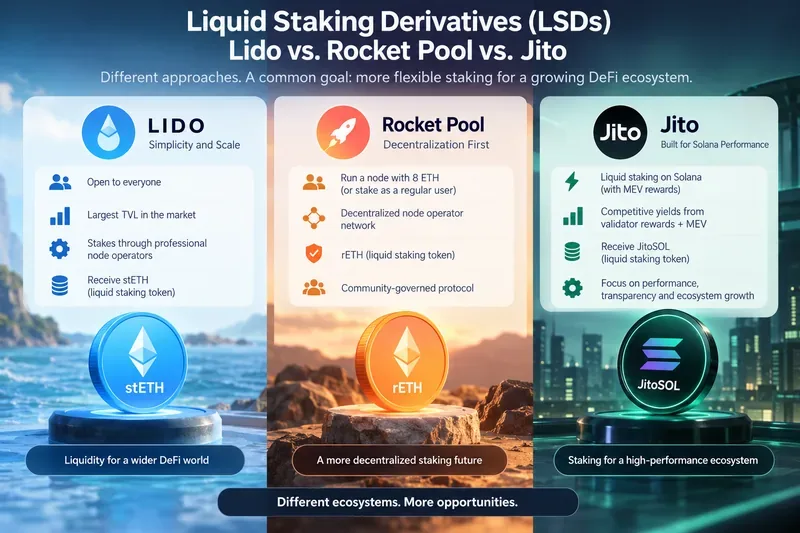
Caption: Lido and Rocket Pool provide liquid staking exposure to Ethereum through stETH and rETH, while Jito provides JitoSOL for Solana; the right comparison starts with the network and token you intend to hold.
What Are Liquid Staking Derivatives?
Liquid staking derivatives, often shortened to LSDs, are tokens representing assets that participate in proof-of-stake validation while remaining transferable and potentially usable elsewhere in DeFi. The more precise industry term today is often liquid staking token, or LST.
The attraction is capital flexibility. Native staking can impose operational requirements or withdrawal timing. An LST lets a holder maintain a tokenized position while the underlying assets participate in staking. That token can potentially be traded, supplied to lending markets, deposited into liquidity pools, or used as collateral where integrations support it.
That flexibility adds risk. You are no longer exposed only to the base network. You also depend on protocol smart contracts, validator operations, governance, the LST's market liquidity, and any DeFi application where you reuse the token.
Lido vs. Rocket Pool vs. Jito: The Short Comparison
| Feature | Lido | Rocket Pool | Jito |
|---|
| Base network in this comparison | Ethereum | Ethereum | Solana |
| Liquid staking token | stETH; wstETH is commonly used for non-rebasing integrations | rETH | JitoSOL |
| How holder rewards appear | stETH normally rebases as protocol accounting updates | rETH value relative to ETH reflects accumulated staking economics | JitoSOL value relative to SOL accrues staking and MEV-related rewards |
| Protocol reward fee | Currently 10% of staking rewards, subject to DAO governance | Economics depend on protocol revenue sharing and node-operator configuration | Jito documentation states a 4% annual management fee on total rewards |
| Direct redemption | Withdrawal queue for ETH | Protocol/market liquidity depends on current Rocket Pool mechanics and liquidity | Delayed direct unstake up to one Solana epoch; documentation states 0.1% direct withdrawal fee |
| Best first fit | ETH users emphasizing stETH ecosystem integration | ETH users emphasizing Rocket Pool's decentralized node model | SOL users seeking liquid staking plus MEV-related rewards |
Terms and fees can change through governance or protocol upgrades. The comparison above reflects official documentation checked in September 2026 and should be reverified before depositing.
When Does Lido Make the Most Sense?
Lido is a strong fit when you already want ETH exposure and want a liquid staking token designed for broad DeFi use. According to the current Lido token integration documentation, stETH represents ETH staked through Lido and is transferable and usable in DeFi applications. It is a rebasing ERC-20: balances normally update when the protocol's oracle reports changes in pooled ETH.
This reward mechanism matters in practice. If you hold stETH directly, your token balance can change through rebases. Some smart-contract integrations prefer wstETH, a wrapped representation whose balance does not rebase in the same way. Before moving stETH into another protocol, confirm which version it supports and how its accounting works.
What does Lido charge?
Lido's official protocol-fee page states that the protocol currently charges 10% of staking rewards. The fee is distributed according to the applicable staking module and can change through Lido DAO governance. This is a fee on rewards, not a 10% deduction from your deposited ETH.
How do you get ETH back?
Direct protocol redemption uses Lido's withdrawal queue. The WithdrawalQueueERC721 documentation describes a FIFO process in which a withdrawal request receives an unstETH NFT representing the right to claim ETH after finalization. Lido also notes that tokens waiting in the withdrawal queue do not earn rewards during that waiting period.
Alternatively, a holder can trade stETH or wstETH in a secondary market if sufficient liquidity exists. That may be faster, but the market price can differ from the underlying redemption value and trading introduces fees and slippage.
When Is Rocket Pool a Better Fit?
Rocket Pool becomes particularly relevant when your Ethereum staking decision includes decentralization and node-operator structure, not merely convenience. Its official protocol introduction describes two primary user paths: tokenized staking through rETH and node operation through the Rocket Pool network.
For a regular staker, the key product is rETH. You do not need to run a node simply to hold rETH. Rocket Pool documentation says tokenized staking can be accessed with small ETH amounts, while node operators provide bonded ETH and operate validators that also use ETH supplied through the protocol.
Why is the node model important?
Rocket Pool's architecture is designed around independent node operators rather than a single staking operator. Current node documentation describes minipools that combine operator-bonded ETH with ETH supplied through the protocol to create Ethereum validators.
Be careful with old articles that quote one permanent bond size or commission rate. Rocket Pool has undergone multiple upgrades, and node economics can change. Current official documentation should be treated as authoritative for anyone considering node operation.
For example, the current validator creation documentation shows 8 ETH bonded minipool examples and describes matching protocol ETH to reach the 32 ETH required for an Ethereum validator. This is operationally much more involved than simply acquiring rETH.
When Is JitoSOL the Better Choice?
Jito is not an alternative way to stake ETH. It is relevant when your base asset is SOL. Jito's official JitoSOL introduction describes JitoSOL as a Solana liquid staking token that combines validator staking rewards with MEV rewards.
Jito defines MEV, or maximal extractable value, as additional value validators can receive through transaction inclusion and ordering activity. Its current documentation says JitoSOL automatically incorporates staking and MEV rewards rather than requiring JitoSOL holders to claim those rewards manually.
How do JitoSOL rewards appear?
JitoSOL does not work like a stETH balance rebase. Jito's current FAQ says rewards accrue in JitoSOL's price relative to SOL. In simplified terms, the amount of JitoSOL in your wallet does not need to increase for the staking value represented by each token to grow.
What fees and exit conditions matter?
The same FAQ currently states that JitoSOL charges an annual management fee equal to 4% of total staking and MEV rewards after validator commissions. It also states that direct unstaking through Jito charges 0.1% of withdrawal value.
For direct delayed unstaking, Jito says users can wait up to one Solana epoch, roughly two days. A holder may instead sell JitoSOL on a secondary market for immediate liquidity, but that replaces the protocol withdrawal process with market-price, liquidity, and slippage risk. Jito specifically advises checking spread and slippage for large secondary-market transactions.
Which Token Has the “Best Yield”?
Do not choose among these protocols from a single APR screenshot. Lido and Rocket Pool produce ETH-denominated staking economics; JitoSOL produces SOL-denominated staking and MEV economics. If SOL falls relative to ETH, a higher SOL staking rate does not necessarily produce a better dollar or ETH-denominated result. The reverse is also true.
Displayed yields can also vary because network staking rates, validator performance, execution rewards, MEV, fees, and protocol conditions change. A fair comparison should measure net return in the base asset over the same period after protocol fees and relevant transaction costs.
For example, imagine $10,000 worth of ETH in an Ethereum LST and $10,000 worth of SOL in JitoSOL. Even if JitoSOL has a higher staking rate during that period, changes in ETH/SOL exchange value can dominate the difference. The decision is therefore primarily an asset-allocation choice, then a staking-product choice.
Which Is Better for DeFi Composability?
Composability is ecosystem-specific. stETH/wstETH and rETH operate within Ethereum and Ethereum-compatible DeFi integrations that choose to support them. JitoSOL operates within Solana's token and DeFi environment.
A token having many integrations is useful only if those are integrations you intend to use. If your plan is simply to stake and hold, deep lending or liquidity-pool support may matter less than protocol risk and exit liquidity. If you plan to borrow against an LST, integration quality becomes critical.
Adding a lending position also changes the risk. Suppose you stake ETH, receive an LST, deposit it as collateral, and borrow a stablecoin. You now have staking-protocol risk plus lending-protocol smart-contract risk, oracle risk, liquidation risk, and stablecoin risk. The fact that the original ETH remains economically staked does not make the combined position low risk.
How Should You Compare Decentralization?
A single “decentralization score” can hide important differences. Examine at least four dimensions: who can operate validators, how stake is allocated among operators, who can change protocol parameters, and whether critical smart-contract controls exist.
Rocket Pool explicitly positions its protocol around a decentralized network of node operators. Lido has multiple staking modules and governance mechanisms for allocating stake and selecting or onboarding operators. Jito uses an automated validator-selection system called StakeNet; its current FAQ says the system selects validators using performance, fees, reliability, Jito software participation, and stake-distribution considerations.
None of those descriptions by itself proves that one protocol is “more decentralized” in every meaningful dimension. A serious comparison should look at current operator concentration, governance powers, upgrade controls, and actual stake distribution rather than marketing language.
What Risks Do All Three Share?
- Smart-contract risk: Bugs or unexpected protocol behavior can affect funds or token accounting.
- Validator risk: Poor validator performance can reduce rewards; Ethereum protocols also account for potential penalties and slashing.
- LST price risk: Secondary-market prices can trade above or below their underlying redemption relationship during stressed liquidity.
- Liquidity risk: A liquid token is only immediately liquid at an acceptable price when sufficient market depth exists.
- Governance risk: Fees, operator policies, and protocol parameters can change.
- DeFi layering risk: Using an LST in lending, leverage, restaking, or liquidity pools adds independent protocol risks.
Jito's official security overview states that JitoSOL uses Solana Labs' stake-pool program and lists completed audits. Lido and Rocket Pool likewise publish protocol code and security material. Audits reduce certain risks but cannot guarantee that a protocol will never experience a bug, governance failure, market dislocation, or operational problem.
Lido, Rocket Pool, or Jito: Which Fits You?
Choose Lido for consideration if...
You want to stake ETH, value stETH/wstETH's role in Ethereum DeFi, understand the rebasing versus wrapped-token distinction, and are comfortable with Lido's governance and operator architecture.
Choose Rocket Pool for consideration if...
You want ETH liquid staking and place particular value on a community-oriented, permissionless node-operator model. It is also the most relevant of these three if your goal includes becoming an Ethereum node operator rather than only holding an LST.
Choose Jito for consideration if...
Your underlying asset is SOL, you want a liquid Solana staking position, and you specifically value JitoSOL's combination of staking and MEV-related rewards. You should also be comfortable evaluating Solana-specific validator, DeFi, and liquidity risks.
Choose none of them if...
You do not need liquidity or DeFi composability and prefer native staking with direct validator choices, or if the added smart-contract and governance layers exceed your risk tolerance. Holding an LST is not mandatory to earn proof-of-stake rewards.
A Practical Pre-Staking Checklist
- Decide whether your desired base exposure is ETH or SOL before comparing yield.
- Verify the current protocol fee from official documentation.
- Understand whether rewards appear through token rebasing or a rising exchange rate.
- Check direct redemption mechanics and expected waiting periods.
- Compare secondary-market liquidity and potential slippage for your position size.
- Review validator architecture, governance controls, audits, and recent protocol upgrades.
- If using the LST in DeFi, evaluate the second protocol separately rather than treating the position as ordinary staking.
- Keep enough native ETH or SOL outside the position to pay network transaction fees.
Bottom Line
Lido versus Rocket Pool is a meaningful direct comparison because both offer liquid staking exposure to Ethereum. Jito belongs in the broader LSD/LST comparison, but it solves the same capital-efficiency problem on Solana rather than Ethereum.
Lido is the straightforward benchmark for users prioritizing stETH/wstETH integration; Rocket Pool stands out for users who care strongly about its distributed node-operator architecture; JitoSOL is the relevant choice among these three for SOL holders who want staking plus MEV-related rewards.
The best result is not the token with the highest APR on the day you look. It is the one whose base asset, reward accounting, protocol architecture, exit path, liquidity, fees, and added DeFi risks match what you actually plan to do with the position.
Risk note: This article is educational and not individualized financial advice. Liquid staking tokens can lose value relative to their underlying assets, smart contracts can fail, protocol rules can change, and DeFi integrations can add liquidation and counterparty-like risks. Verify current terms in official documentation before staking.