Home
» News
»
How to Participate in Crypto Airdrops Safely Without Compromising Your Wallet
How to Participate in Crypto Airdrops Safely Without Compromising Your Wallet
Crypto airdrops can be legitimate distribution programs, but the word “airdrop” is also routinely used as bait for phishing, malicious token approvals, deceptive signatures, and fake support. The safest mindset is not “How do I claim everything?” but “What authority am I giving away for this claim?”
This guide reflects wallet-security documentation checked on September 15, 2026. It focuses on practices that remain useful across projects rather than claiming that any particular airdrop is safe. A project can change its website, contracts, eligibility rules, or claim process after this article is published, so current primary sources always take priority.
1. Research the project before connecting a wallet
Common misconception: if an airdrop appears in a wallet or block explorer, it must be legitimate. That is false. Anyone can send many kinds of tokens to a public address, and unsolicited tokens can be used to lure holders toward malicious sites. Ledger’s security documentation specifically warns that scam airdrop tokens can appear on legitimate explorers and then direct users toward fraudulent claim or trading pages.
What is verified: a token arriving on-chain proves that a token transfer occurred; it does not prove the sender, website, or promised value is trustworthy. What depends on circumstances: some real projects do distribute tokens without requiring a prior claim, while others use official claim contracts. What remains unknown: an unfamiliar token’s legitimacy cannot be determined from its name, logo, or wallet display alone.
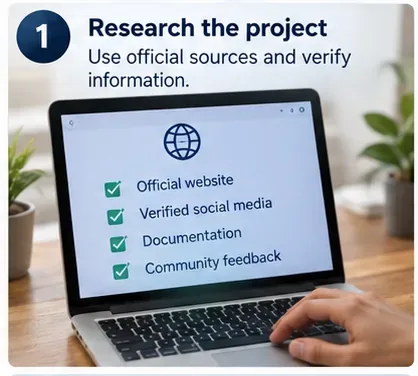
Action: begin from the project’s known official website or documentation and confirm whether an airdrop was actually announced there. Do not use the URL embedded in an unsolicited token, NFT, email, direct message, reply, or search ad as your starting point. Ledger’s airdrop scam guidance provides examples of this attack pattern.
Start with primary project sources and independently confirm that the airdrop exists before connecting a wallet.
2. Separate airdrop activity from your main holdings
Common misconception: a hardware wallet makes every dapp interaction harmless. A hardware signer protects private keys from simply being extracted by a website, but you can still authorize a harmful transaction or token approval yourself. The signer is a security boundary, not permission to stop reading transaction details.
What is verified: MetaMask recommends considering a hardware wallet for high-value holdings, while Ledger emphasizes readable transaction verification rather than blind signing. What depends on circumstances: whether you need a separate wallet depends on your exposure, transaction frequency, operational discipline, and the value at risk.
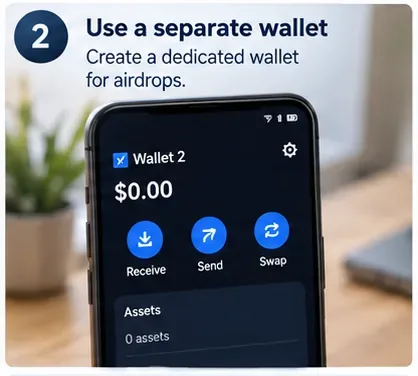
Action: keep long-term or high-value holdings separate from the wallet you use for experimental dapps and airdrop claims. Fund the activity wallet only with the assets and gas you reasonably need. This limits the amount exposed if you make a bad approval or signature, although it does not make the activity wallet itself safe.
Wallet separation reduces the value exposed to an airdrop interaction, but it does not replace transaction verification.
3. Treat links as untrusted until independently verified
Common misconception: a familiar logo, polished interface, HTTPS padlock, or near-identical domain establishes authenticity. None of those signals proves that a page belongs to the intended project. Phishing pages can copy branding and use valid HTTPS certificates.
What is verified: wallet providers repeatedly warn users about phishing and impersonation. MetaMask states that its support will never ask for a Secret Recovery Phrase and advises users to use official support channels. What depends on circumstances: projects may announce a claim through websites, governance forums, social accounts, or documentation, so there is no universal legitimate URL pattern.
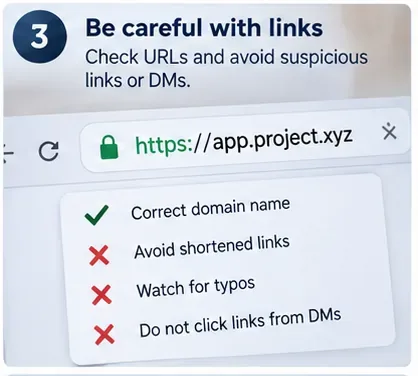
Action: navigate from a source you already trust, compare the full domain carefully, and cross-check the claim announcement in at least one other official project channel. Bookmark verified pages for repeat use rather than relying on search results each time. See MetaMask’s official-support guidance.
Check the full domain and reach claim pages from official project sources instead of unsolicited links.
4. Never provide a seed phrase or private key to claim an airdrop
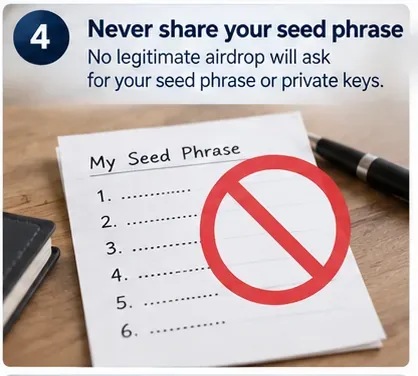
This is one of the clearest rules in self-custody. MetaMask states that anyone with your Secret Recovery Phrase can control accounts derived from it and that the phrase must not be shared. A normal dapp connection or on-chain claim does not require typing your wallet recovery phrase into a website.
Common misconception: a “wallet verification,” “synchronization,” or “activation” form may legitimately need the recovery phrase. For ordinary airdrop participation, it does not. A wallet may ask for a recovery phrase when you intentionally restore the wallet in legitimate wallet software, which is a different operation from claiming a token.
Action: if a claim page, support agent, form, bot, or direct message asks for your seed phrase or private key, stop. Close the page and verify the situation through the wallet or project’s official support route. MetaMask’s recovery-phrase security documentation explicitly warns never to share it.
A legitimate airdrop claim should not require you to disclose your wallet seed phrase or private key.
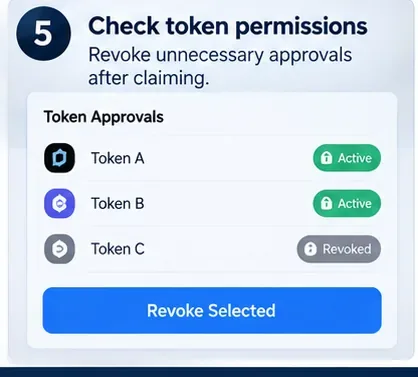
5. Understand approvals: disconnecting is not the same as revoking
Common misconception: disconnecting a wallet from a website cancels every permission previously granted on-chain. It does not necessarily do so. A token allowance is an on-chain authorization that can let a spender contract use tokens up to the approved amount. Coinbase’s wallet documentation distinguishes dapp connections from token approvals and warns that malicious contracts can exploit broad allowances.
What is verified: token approvals can remain until revoked or otherwise changed according to the token and contract behavior. Revoking an approval generally requires an on-chain transaction and network fee. What depends on circumstances: not every airdrop claim requires an ERC-20 approval, and the exact permissions differ by chain, token standard, and claim contract.
Action: before signing, ask why a claim needs spending authority at all. Prefer narrowly scoped permissions when the wallet and protocol support them. After you finish, inspect existing allowances and revoke permissions you no longer need. Coinbase provides current instructions in its dapp permissions and token approvals guide.
Review token allowances after a claim and revoke permissions that are no longer necessary.
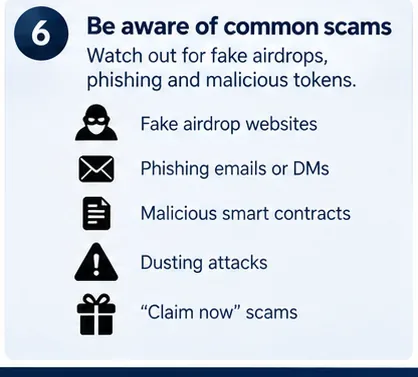
6. Learn the scam patterns without assuming every unusual airdrop is fraudulent
Fake claim sites, impersonated accounts, urgent direct messages, malicious contracts, and unsolicited tokens are established scam patterns. However, one suspicious-looking feature alone does not prove a specific project is fraudulent. Security decisions should rely on verifiable evidence rather than rumors.
Action: treat urgency as a reason to slow down. Independently confirm eligibility, claim deadline, contract address, and official instructions. If a token unexpectedly appears in your wallet, do not follow instructions encoded in its name, metadata, memo, or associated website. Never pay an unexplained “unlock,” “verification,” or “activation” fee merely because an unsolicited message promises a larger reward.
Urgency, unsolicited links, and unexpected tokens should trigger verification rather than immediate interaction.
7. Read what you sign, and avoid blind signing when possible
A wallet connection by itself typically exposes public account information, not your private key. The dangerous step is often what follows: a signature, approval, permit, or contract transaction. This is why “I only connected my wallet” and “I authorized a transaction” should not be treated as equivalent actions.
Ledger defines Clear Signing as presenting transaction intent in human-readable form on a secure display, including relevant action, recipient, and amount. Blind signing means approving data you cannot meaningfully interpret. Clear Signing does not certify that a project is economically sound, but readable intent gives you a better chance to detect an authorization you did not expect. See Ledger’s Clear Signing documentation.
Action: verify the chain, contract, spender, asset, amount, destination, and permission type before approval. If the wallet cannot explain what a signature or transaction does and you cannot independently decode it, do not sign simply because the website says the action is harmless.
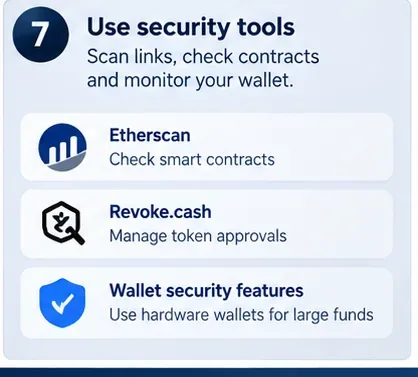
Use security tools as additional checks, but make the final decision from the actual transaction and permission details you are authorizing.
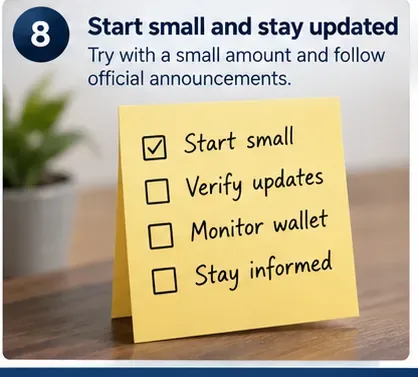
8. Start small, monitor the wallet, and clean up afterward
Common misconception: a successful small transaction proves the contract is safe. It does not. A test can catch wrong-network, wrong-address, gas, or workflow mistakes, but malicious logic may behave differently depending on permissions, assets, timing, or later transactions.
Action: when practical, test with limited value, then verify the resulting transaction on the relevant block explorer. After the claim, review balances and token approvals, disconnect sessions you no longer use, and keep wallet software, browser, operating system, and hardware-wallet firmware current through official distribution channels.
A small test limits operational exposure; continued monitoring and permission cleanup matter after the airdrop claim is complete.
A practical pre-claim checklist
Question
Safer response
Was the airdrop confirmed by the project?
Verify through current official website/documentation and another official channel.
Does the page ask for a seed phrase or private key?
Stop. Do not provide it.
Is your main holdings wallet connected?
Consider an isolated activity wallet with limited funds.
Does the claim request token spending permission?
Understand why, inspect the spender and limit the allowance where possible.
Can you understand the signature or transaction?
Do not blind-sign unexplained data.
Did you finish the claim?
Verify receipt on-chain, review approvals, and revoke permissions no longer needed.
If you already signed something suspicious
Do not assume that merely changing a wallet password cancels blockchain permissions. A local wallet password normally protects access on that device; it does not rewrite on-chain approvals. The correct response depends on what was exposed.
If you disclosed a Secret Recovery Phrase or private key, treat the affected wallet as compromised and move remaining assets to a newly created wallet using a new secret, subject to network conditions and your ability to do so safely. If you granted a suspicious token approval but did not expose the wallet secret, inspect and revoke the relevant approval. If you signed an unclear message, determine what authorization it created before taking further action.
Action: use the wallet provider’s official support and security documentation, not someone who contacts you privately offering “recovery.” MetaMask’s security guidance reinforces that private keys and recovery phrases must never be shared.
Bottom line
Safe airdrop participation is less about predicting which token will be valuable and more about controlling what an unfamiliar website or contract can do with your wallet. Verify the announcement from primary sources, isolate experimental activity from important holdings, never disclose recovery secrets, understand every approval, avoid blind signing, and remove permissions you no longer need.
No checklist can prove that a new smart contract is exploit-free or that a project will remain trustworthy. What these practices can do is reduce avoidable exposure and make each authorization deliberate. If you cannot establish what you are signing or why a claim needs a particular permission, skipping the airdrop is a valid security decision.