Home
» News
»
The Rise of Base Network in 2026: TVL, Meme Coins, and Ecosystem Gems Worth Researching
The Rise of Base Network in 2026: TVL, Meme Coins, and Ecosystem Gems Worth Researching
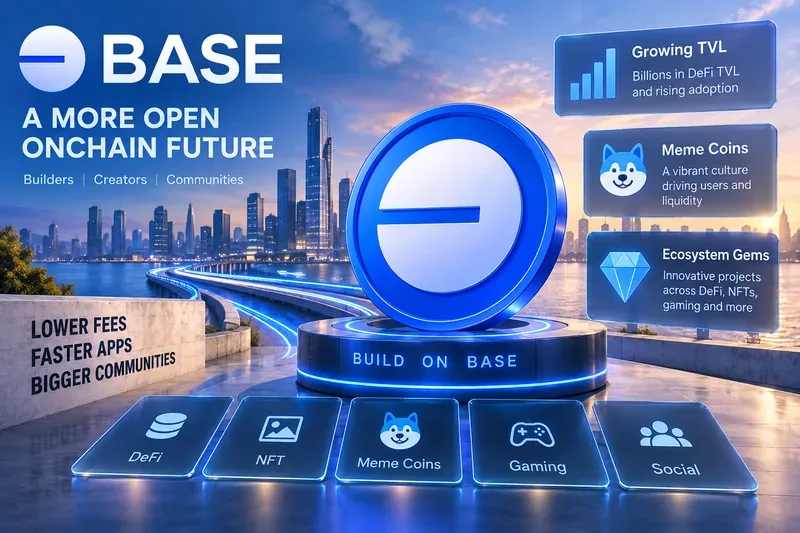
The most important answer is that Base's rise is no longer just a meme-coin story. Meme coins and social tokens helped Base attract attention and trading activity, but the network now has substantial DeFi liquidity, a large stablecoin economy, lending markets, derivatives, AI-agent projects, tokenized assets, and a consumer-facing Base App. For anyone trying to judge whether Base has become a durable ecosystem, the strongest evidence is not the price of any one token; it is the combination of capital, transaction infrastructure, developer activity, and applications that keep users on the network.
As of September 15, 2026, DefiLlama showed roughly $5.56 billion in DeFi TVL on Base, while L2Beat showed about $14.78 billion in total value secured for Base Chain in its September 14 snapshot. Those numbers are not contradictory. They measure different things. DeFi TVL focuses on value deposited in DeFi protocols; L2Beat's total value secured includes assets secured by the L2 more broadly, including canonically bridged, natively minted, and externally bridged assets. When someone says “Base TVL,” the first useful question is therefore: which TVL definition?
Base's 2026 growth story spans several layers at once: DeFi liquidity, stablecoins, social and meme-token activity, trading infrastructure, consumer apps, and newer markets such as AI agents and tokenized assets.
Why has Base grown so quickly?
Base began as an Ethereum Layer 2 incubated by Coinbase and built around the OP Stack. Its original value proposition was straightforward: Ethereum-compatible applications with lower fees and easier distribution. The 2026 version of Base is broader. The official Base strategy page now describes the network around global markets, payments, agents, and builders rather than just L2 scaling.
That shift matters because an L2 becomes more defensible when users have reasons to remain after the initial incentive cycle. Base now has several reinforcing distribution channels: Coinbase connectivity, the Base App, a large stablecoin footprint, onchain trading, lending, social applications, and an ecosystem program that lists more than 700 companies. The official Base ecosystem directory also warns that listings are not endorsements and that yields and rates can change, which is a useful reminder when evaluating projects individually.
Infrastructure has improved as well. Flashblocks, launched on Base mainnet in 2025, provide approximately 200-millisecond pre-confirmations through supported endpoints. Current behavior is documented in the Base Flashblocks documentation. Fast pre-confirmation does not eliminate Ethereum settlement or smart-contract risk, but it improves the user experience for trading and interactive applications where waiting several seconds feels slow.
How much liquidity is actually on Base?
There are two useful lenses.
Metric
Approximate snapshot
What it measures
DeFi TVL
$5.56B on September 15, 2026
Capital locked in DeFi protocols tracked on Base
Total value secured
$14.78B on September 14, 2026
Broader asset value secured by the Base L2, including bridged and natively minted assets
Stablecoin market cap
About $5.0B in the same period
Dollar-linked liquidity circulating on Base
The first two figures come from two different analytics methodologies. The current Base DeFi snapshot can be checked at DefiLlama's Base chain dashboard, while L2 value secured can be checked at L2Beat's total-value-secured dashboard. Because onchain values move continuously, the exact number will change after publication.
The more important conclusion is not whether the right headline is $5.5 billion or $14.8 billion. It is that Base has moved beyond the stage where its economic activity can be explained by a few speculative pools. Lending, stablecoins, spot trading, perpetuals, and other financial applications now hold or route meaningful capital.
Base's own 2026 strategy says the network processed more than $17 trillion in stablecoin volume during 2025 across 26 local currencies and 17 countries. That is a flow metric, not TVL, and it should not be added to TVL. It does, however, show why payments and stablecoins are central to Base's roadmap. The source is Base's 2026 Mission, Vision, and Strategy.
Did meme coins drive the Base ecosystem?
They helped, especially as a discovery and community layer, but saying meme coins “built Base” would overstate their role. Meme assets are unusually good at generating social attention, small-wallet participation, DEX volume, and new-token experimentation. They are much less useful as evidence of durable cash flow or sustainable product demand.
Three examples show how Base meme culture evolved in different directions.
BRETT: the pure culture-and-liquidity case
BRETT's own site describes the token as a fan tribute based on a character from Matt Furie's Boys' Club and explicitly connects its identity with Base culture. That makes it a clean example of a meme asset whose main strength is community and recognizability rather than a claim on Base itself. The official project page is Based Brett.
When it may fit a thesis: if the thesis is specifically that Base retail activity and culture will expand. When it does not fit: if the goal is low-volatility yield, protocol cash-flow exposure, or direct ownership of the Base network.
TOSHI: a meme project that added tooling
TOSHI began squarely in meme-coin territory, but its project documentation now also includes Base-oriented tools such as token launching infrastructure. The Toshi documentation describes both its meme origins and its broader tooling ambitions.
What to check: separate the token's cultural value from adoption of the tools built around it. A functioning product does not automatically make the token fairly valued, and a strong meme community does not guarantee that the tools will win users.
DEGEN: from Farcaster tipping culture to a broader ecosystem
DEGEN began around Farcaster social tipping and developed into a broader community ecosystem, including Degen Chain. Its official site still describes it as the social coin of Base and publishes the canonical Base contract address. See Degen's official site.
What to check: distinguish the ERC-20 token on Base from activity on Degen Chain and from the surrounding app/community. These pieces are related, but they are not the same technical layer or risk exposure.
Where are the more fundamental “ecosystem gems”?
“Gem” is a dangerous word if it is treated as a synonym for “token that will go up.” A more useful definition is a project that reveals where real usage is developing. On that basis, several Base projects deserve research because they represent different parts of the network's economic stack.
Project
Role on Base
Why it is worth researching
Main risk to test
Aerodrome
DEX and liquidity marketplace
Core spot-liquidity and incentive infrastructure
Incentive dependence, LP loss, smart-contract and token risk
Morpho
Open credit and lending markets
Large Base deposits and lending activity
Collateral, curator, oracle and liquidation risk
Moonwell
Lending and borrowing
Accessible money-market model and Base integration
Liquidation and variable-rate risk
Virtuals
AI-agent economy
Connects agent tokens, commerce and onchain coordination
Agent-token speculation versus actual agent revenue
Avantis
Perpetuals and synthetic/RWA trading
Shows Base expanding beyond spot DeFi
Leverage, oracle, liquidity and market-structure risk
Aerodrome: the liquidity layer
Aerodrome Finance describes itself as the essential trading and liquidity marketplace of Base. Its model combines swaps, liquidity-provider emissions, and voter-directed incentives. For Base, the important point is not merely the AERO token. Aerodrome provides liquidity infrastructure that helps new and existing assets trade onchain.
Useful condition: Aerodrome is most relevant if you are evaluating where Base spot liquidity is concentrated. For an LP, however, volume alone is not enough; compare fees and incentives with impermanent loss, token-emission dilution, and pool depth.
Morpho: Base has become a serious credit venue
Morpho's own Base analytics showed about $5.86 billion of total deposits, $1.93 billion of outstanding loans, and $3.93 billion of TVL on September 14, 2026. Those figures are available from the Morpho Base network dashboard.
That is a useful counterweight to the idea that Base is primarily a meme chain. Credit markets of this scale require borrowers, collateral, lenders, vault curators, liquidators, and stablecoin liquidity. They also add a different risk profile: a lending position can look conservative compared with a meme coin but still lose money through bad collateral, oracle failures, liquidation dynamics, or smart-contract problems.
Moonwell: simpler lending exposure
Moonwell offers supply-and-borrow markets and issues mTokens representing supplied positions. Its current official lending FAQ explains that rates vary and that supplied positions accrue interest through mTokens.
Useful condition: Moonwell is more relevant to users looking for straightforward lending and borrowing than to someone looking for high-beta token launches. Borrowers should monitor collateral factors and liquidation thresholds; headline APY is not the same as realized return.
Virtuals: Base as an AI-agent economy
Virtuals is a different kind of Base-native growth story. Its current whitepaper describes a network of tokenized AI agents and an Agent Commerce Protocol in which agents can coordinate and transact. The Virtuals Protocol whitepaper states that VIRTUAL serves as the base liquidity pair and transactional currency across its agent ecosystem.
Useful condition: the thesis is stronger if agent activity generates measurable services, payments, or revenue. If most activity is simply trading newly launched agent tokens, the exposure behaves more like speculative token-launch infrastructure than an AI-services economy.
Avantis: Base's push into leveraged markets
Base itself has highlighted Avantis as an early Base Ecosystem Fund investment and describes it as an oracle-based synthetic derivatives protocol for crypto and real-world assets. Base's 2026 MCP launch also includes Avantis among the protocols accessible through ecosystem skills. The official Base description is available in the Base Ecosystem Fund announcement.
Useful condition: Avantis is relevant if the thesis is that Base is becoming a venue for sophisticated onchain trading. The tradeoff is obvious: leverage and synthetic exposure introduce liquidation, oracle, execution, and market-liquidity risks that are absent from simply holding ETH.
Base is also moving beyond crypto-native assets
One of the strongest 2026 signals is that Base's roadmap now includes assets that are not traditional crypto tokens. On September 1, 2026, Base announced that Coinbase-issued tokenized stocks were live on Base for eligible non-U.S. users. The official Base tokenized-stocks announcement frames these assets as programmable equities that can be integrated into onchain lending, trading, and other financial products.
This matters because the long-term Base thesis is increasingly about becoming a financial execution layer, not just hosting another cycle of ERC-20 speculation. Whether that thesis succeeds depends on actual liquidity, regulation, user demand, and the ability of protocols to handle real-world assets safely.
What about the Base network token?
Do not confuse ecosystem tokens with a Base network token. Base announced at BaseCamp 2025 that it had begun exploring a network token, but the official announcement gave no timing, design, distribution, or governance details. In the official Base materials checked through September 15, 2026, I found no subsequent announcement of a launched Base network token. The latest explicit status located remains exploration. See The State of Base at BaseCamp 2025.
Practical consequence: BRETT, TOSHI, DEGEN, AERO, VIRTUAL, and other Base ecosystem tokens are not automatically “the Base token.” A ticker using BASE or a Base-like logo should not be assumed to represent Coinbase or Base without an official announcement and verified contract address.
How should you decide whether Base fits your thesis?
If you want a high-activity Ethereum L2 with deep DeFi and strong distribution, Base has a credible case. The network has substantial value secured, billions in DeFi deposits, meaningful stablecoin activity, fast transaction infrastructure, and a growing set of financial applications. If you want exposure specifically to meme culture, Base also has mature communities—but that is a much more volatile thesis.
A practical evaluation can be reduced to four questions:
Is liquidity persistent? Watch DeFi TVL, stablecoin supply, DEX volume, and lending utilization over months, not one week.
Are users doing more than trading new tokens? Payments, borrowing, lending, social activity, AI-agent commerce, and tokenized assets provide stronger evidence of diversified demand.
Does a project's token capture the value you care about? A useful protocol can exist without its token being attractively valued.
Can you explain the downside? For a meme coin, that may be liquidity evaporation. For lending, it may be liquidation or bad collateral. For an LP, it may be impermanent loss. For perps, it may be leverage and oracle risk.
Bottom line
Base's rise is real, but the strongest version of the story is broader than “Coinbase plus meme coins.” As of mid-September 2026, Base supports billions of dollars of DeFi liquidity, a roughly $5 billion stablecoin base, a large lending economy, major DEX infrastructure, consumer distribution through Base App, fast Flashblocks pre-confirmations, AI-agent markets, perpetual trading, and newly launched tokenized stocks for eligible users.
Meme coins such as BRETT, TOSHI, and DEGEN helped define Base's culture and can continue to drive attention and liquidity. They should be analyzed as speculative community assets, not as proxies for ownership of the Base network. The more durable “ecosystem gem” research is in projects that reveal where users repeatedly trade, borrow, lend, pay, create, and coordinate.
Network and protocol data in this article were checked on September 15, 2026. TVL, stablecoin supply, protocol deposits, yields, token prices, and trading activity change continuously, so current dashboards should be rechecked before making financial decisions.