Home
» Ecosystem
»
Berachain Ecosystem Preview: How Proof of Liquidity Works and the DApps to Know
Berachain Ecosystem Preview: How Proof of Liquidity Works and the DApps to Know
Berachain is no longer a pre-mainnet experiment: its mainnet launched in February 2025, and by September 2026 the network has a live Proof-of-Liquidity system, native trading and lending infrastructure, and a broader set of third-party DeFi applications. That changes the most useful question from “what might launch?” to “how does the incentive system actually work, and which applications matter if you want to understand the ecosystem?”
This preview focuses on those decision points. It does not rank protocols by token price, TVL, or projected returns. Instead, it explains the roles that major applications play in Berachain’s liquidity and incentive loop, using first-party documentation checked on September 16, 2026.
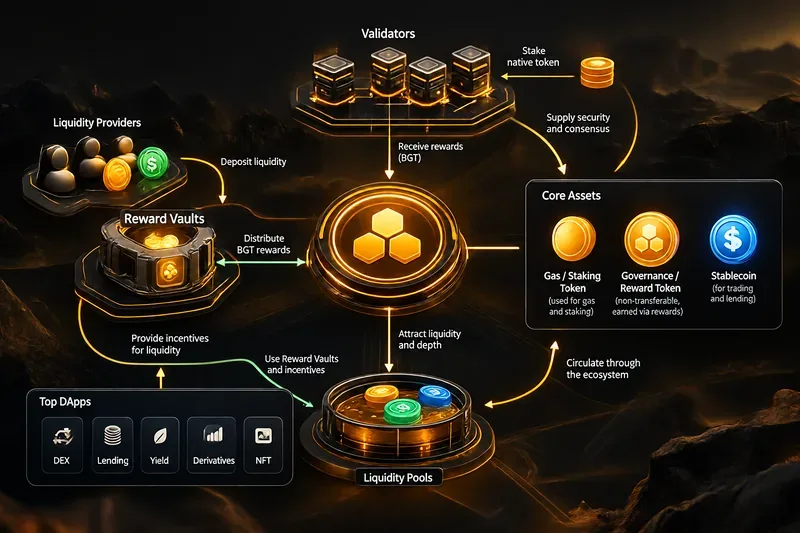
Berachain’s core idea is to connect validator rewards with application-layer liquidity through BGT emissions and Reward Vaults.
What is different about Berachain?
Berachain is an EVM-identical Layer 1 blockchain, so Ethereum tooling and smart-contract patterns are familiar to developers. Its defining feature is Proof of Liquidity (PoL), an economic design that separates the asset used for gas and validator security from the asset used for governance and ecosystem rewards. The current architecture is documented in the official Berachain Proof-of-Liquidity overview.
The three core assets are:
BERA: the native gas token and the token validators stake to secure the network.
BGT: a non-transferable governance and rewards token distributed through PoL. Users generally earn it by staking eligible receipt or LP tokens in Reward Vaults.
HONEY: Berachain’s native multi-collateral-backed stablecoin, used across trading, lending, and other DeFi applications.
This split matters because block incentives can be directed toward useful application activity rather than only toward passive validator staking. The intended feedback loop is that applications attract liquidity, validators route BGT emissions to eligible Reward Vaults, protocols can offer incentives to influence those allocations, and BGT holders can delegate to validators.
How does Proof of Liquidity actually work?
The easiest way to understand PoL is to follow the flow of value rather than treat it as a new label for Proof of Stake.
1. Validators secure the chain with BERA
Validators stake BERA. Within the active validator set, Berachain documentation states that the probability of proposing a block is proportional to the validator’s staked BERA. Validator block production therefore still has a conventional security layer based on economically bonded capital.
2. Validators receive and direct BGT emissions
BGT is the reward-layer asset. The amount of variable BGT associated with a validator is influenced by the BGT delegated, or “boosted,” to that validator. Validators configure allocations that direct their eligible BGT emissions toward whitelisted Reward Vaults. Berachain’s BeraChef contract manages these reward allocations, commissions, and eligible vault configuration. The current mechanics are described in the official PoL lifecycle documentation.
3. Users earn BGT through Reward Vaults
A Reward Vault is the bridge between an application and PoL. A protocol can create an activity that produces an eligible receipt token—for example, an LP token from a liquidity pool. The user stakes that eligible asset in its Reward Vault and receives a share of the BGT emitted to the vault.
Berachain’s current documentation is explicit that Reward Vaults are the path through which users earn BGT rewards. A vault can be created permissionlessly, but it must be whitelisted through governance before validators can direct BGT emissions to it. See the Reward Vault documentation and Reward Vault governance requirements.
4. Protocol incentives compete for emissions
Reward Vaults can also distribute incentive tokens supplied by protocols. This creates the distinctive PoL marketplace: applications have a reason to attract validator allocations, validators have a reason to consider the incentives attached to different vaults, and BGT holders have a reason to delegate to validators that return attractive value after commissions.
That does not mean rewards are fixed. A vault’s BGT rate depends on emissions directed to it, the amount staked in the vault, and changing validator allocations. The official Reward Vault documentation notes that displayed APR can fall to zero when a vault is no longer receiving active emissions. Treat headline yields as variable, not guaranteed.
Which Berachain DApps should you understand first?
The official BeraHub app directory lists a broad mix of DeFi and consumer applications. For an ecosystem-level understanding, the following projects are especially useful because each represents a different part of the liquidity stack. This is a functional shortlist, not a performance ranking.
BEX: the native liquidity and trading layer
BEX is Berachain’s native decentralized exchange. It supports weighted pools for uncorrelated assets and stable pools for assets expected to trade near parity or at predictable exchange rates. Its importance to PoL is direct: eligible BEX pool LP tokens can be staked in Reward Vaults to earn BGT when validators allocate emissions to those vaults.
For someone learning PoL, BEX is the cleanest example of the complete loop: provide liquidity, receive an LP token, stake the eligible token in a Reward Vault, and claim BGT. The official workflow is documented in BEX and Proof of Liquidity.
Bend: native lending tied into PoL
Bend is Berachain’s native lending protocol, built on Morpho V1 architecture. Borrowers can post supported collateral and borrow HONEY, while lenders can supply HONEY through curated vaults. Eligible vault shares can also be staked in PoL Reward Vaults for BGT emissions.
This combination is important because it shows PoL extending beyond exchange liquidity. Lending activity itself can produce an eligible receipt asset and participate in BGT distribution. Anyone considering borrowing should still focus first on liquidation risk: each market has its own collateral, oracle, interest-rate model, and liquidation loan-to-value threshold. See the official Bend overview.
Infrared: liquid wrappers around Berachain staking and rewards
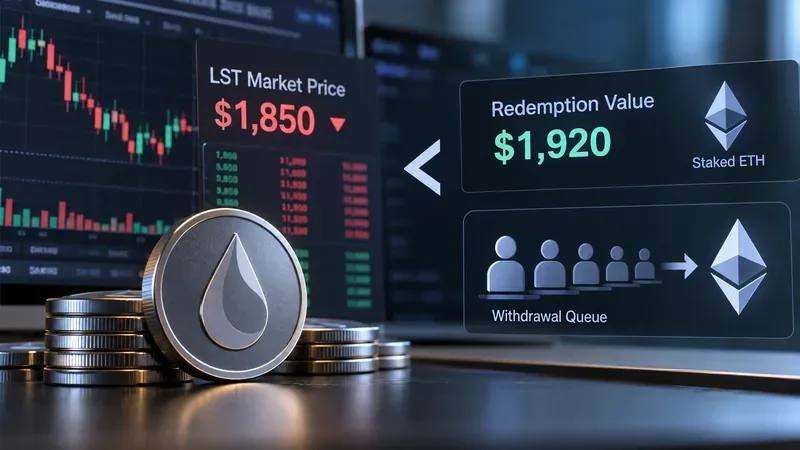
Infrared builds infrastructure around PoL and aims to make BERA staking and BGT-related positions more composable. Its two prominent assets are iBERA, a liquid staking token backed by staked BERA, and iBGT, a liquid wrapper backed by BGT earned through Infrared vaults.
The distinction matters because native BGT is soulbound and cannot simply be transferred like an ordinary ERC-20. Infrared’s design gives DeFi applications a transferable representation that can be used in other protocols, while the underlying system handles the BGT position. Infrared states that iBGT itself does not automatically earn the rewards associated with BGT unless deposited in the relevant vault. Review the current mechanics in Infrared’s official documentation.
Kodiak: concentrated liquidity and managed LP positions
Kodiak is a Berachain-native liquidity platform with full-range and concentrated-liquidity AMMs. Its “Islands” package concentrated-liquidity positions into fungible ERC-20 shares and can rebalance managed positions to keep liquidity in range. Eligible Island shares can be used with PoL Reward Vaults.
This solves a practical composability problem: raw concentrated-liquidity positions are typically NFTs and can be harder to use as standardized reward assets. Kodiak Islands turn managed positions into fungible tokens that can be staked or integrated elsewhere. The trade-off is additional strategy and smart-contract complexity, plus the normal risks of liquidity provision such as impermanent loss. See Kodiak’s official protocol overview.
Dolomite: capital-efficient lending and PoL positions
Dolomite is a modular money market deployed on Berachain. Its PoL integration is designed to let eligible positions retain utility while they are used in lending or borrowing strategies. Dolomite documents support for PoL receipt positions, multiple PoL providers, and dynamic collateral designs that can preserve functions such as staking while assets sit inside a lending account.
That capital efficiency can be useful, but it also makes risk analysis more complicated. Leveraged loops combine lending risk, liquidation risk, smart-contract dependencies, and changing incentive rates. Before using such strategies, inspect each asset, oracle, collateralization requirement, and integration rather than evaluating only the displayed yield. The implementation is described in Dolomite’s Berachain PoL documentation.
BeraBorrow: borrowing against Berachain assets
BeraBorrow is a Berachain-native borrowing protocol centered on NECT, an over-collateralized stablecoin minted against supported collateral. Its protocol site also describes auto-compounding “Dens” and leverage-oriented features. BeraBorrow is useful to watch because it shows how third-party stablecoin and collateral systems can build around Berachain’s liquidity incentives rather than relying only on the native HONEY stack.
As with any collateralized stablecoin system, users should examine collateral types, liquidation mechanics, oracle assumptions, redemption or peg mechanisms, and smart-contract controls before depositing. Current product descriptions are available on BeraBorrow’s official site.
What should you check before providing liquidity?
PoL can make a pool or vault look more attractive because the position may earn trading or lending income plus BGT and protocol incentives. But those reward streams come from different sources and carry different risks. Before entering a position, separate them.
Question
Why it matters
What is the base economic activity?
Trading fees or lending interest may persist even when incentives change; purely incentive-driven yield may not.
Is the Reward Vault currently receiving BGT?
A whitelisted vault can still receive little or no current emission allocation.
What assets are you actually holding?
LPs face price divergence and impermanent loss; borrowers face liquidation; stablecoins carry peg and collateral risk.
Are rewards liquid?
BGT itself is non-transferable, while wrappers such as iBGT introduce an additional protocol layer.
Which smart contracts and protocols are composed together?
Using a vault, wrapper, money market, and LP strategy at once creates dependency on several systems.
Can the displayed APR change quickly?
Yes. Emissions, incentives, pool value, utilization, and the number of stakers can all change.
Does Proof of Liquidity guarantee “better” liquidity?
No. PoL creates a mechanism for directing chain-level incentives toward application activity, but it does not guarantee that every incentivized pool will have durable organic volume, tight spreads, safe collateral, or sustainable returns. The design gives protocols a programmable way to compete for emissions and gives validators and BGT holders economic choices. Market quality still depends on where liquidity goes and whether users continue to value the underlying applications after incentives change.
There is also governance risk. Although Reward Vault creation is permissionless, receiving validator-directed BGT emissions requires whitelisting. Governance decisions, validator allocation choices, protocol incentives, and dedicated emission parameters can therefore alter the opportunity set over time.
What is the best way to evaluate the ecosystem in 2026?
Start with the protocol rather than token prices. Understand the BERA security layer, how BGT delegation affects validator incentives, and how Reward Vaults distribute emissions. Then examine a simple BEX or Bend flow before moving to wrappers, managed liquidity, leveraged lending, or multi-protocol loops.
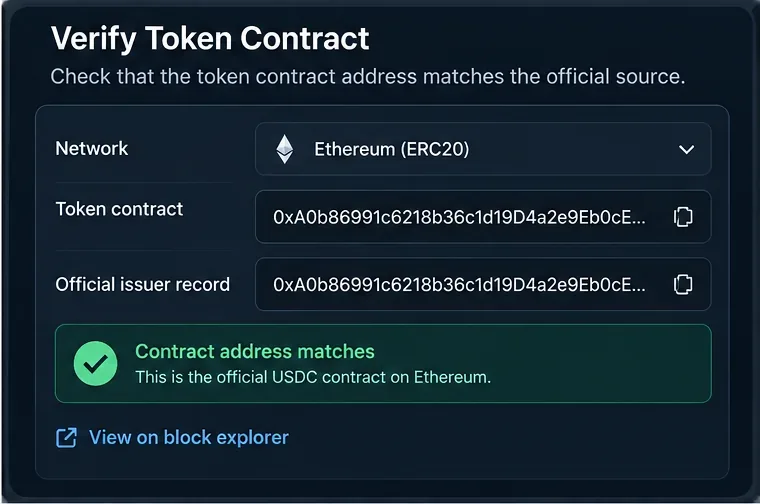
For every DApp, verify three things from first-party sources: the live contract or product you are using, the source of its yield, and the conditions under which capital can be liquidated, locked, depegged, or exposed to another protocol. Berachain’s official deployed-contract directory is a useful starting point for core contracts and tokens.
Bottom line: Berachain’s distinguishing feature is not simply that it has another Layer 1 token or another set of DeFi apps. Proof of Liquidity makes application activity part of the network’s reward-routing system. BEX and Bend demonstrate the native model; Infrared makes BERA and BGT-related positions more composable; Kodiak specializes in liquidity management; Dolomite expands capital-efficient lending strategies; and BeraBorrow adds a third-party collateralized stablecoin layer. The opportunity is a tightly connected DeFi stack. The corresponding risk is that rewards and positions can depend on several moving pieces at once.
Information and protocol status in this article were checked against first-party sources on September 16, 2026. DeFi parameters, vault emissions, supported collateral, incentives, and smart-contract deployments can change; verify the live application and documentation before transacting.