Home
» Ecosystem
»
Cosmos (ATOM) Ecosystem: The Interchain Future and Top Appchains Explained
Cosmos (ATOM) Ecosystem: The Interchain Future and Top Appchains Explained
Cosmos is easiest to misunderstand when it is treated like a single smart-contract network. The more useful mental model is a network of purpose-built blockchains that can communicate without giving up their own execution rules, governance, or economic design. That distinction matters because the quality of the Cosmos ecosystem is not determined by one headline metric. It depends on whether independent chains can deliver better products than they could as applications on a general-purpose chain, while still moving assets and data across the wider interchain.
For a newcomer, the goal is therefore not simply to memorize names such as ATOM, IBC, Osmosis, or Injective. A better outcome is to understand what each layer does, what evidence shows the model is working, and where the appchain approach introduces costs that can outweigh its benefits.
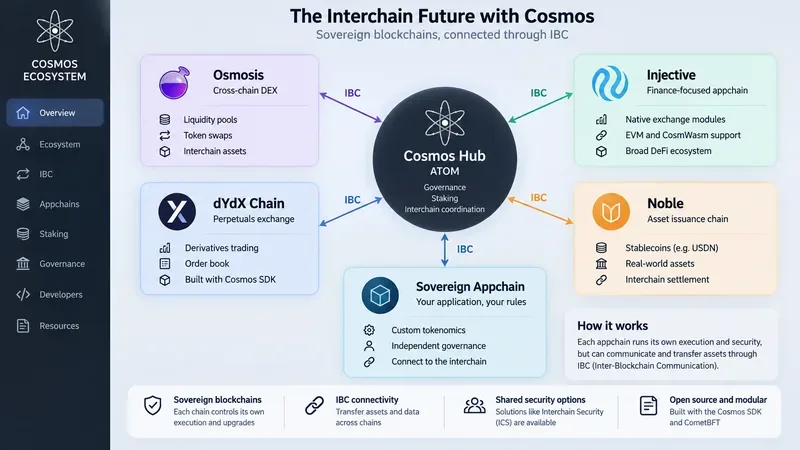
A conceptual map of the Cosmos interchain: independent chains can specialize for different use cases while using IBC for communication. The diagram is illustrative and is not a live network-topology map.
Start with the three concepts that are often mixed together
Cosmos is the technology stack and interchain model
The Cosmos SDK documentation describes the SDK as a framework for building application-specific blockchains. Instead of forcing every application into the same execution environment, developers can customize transaction logic, fee models, governance, tokenization, and other protocol-level behavior. Cosmos SDK chains commonly use CometBFT for consensus and can add virtual-machine layers such as CosmWasm or EVM compatibility when needed.
This is the foundation of the appchain idea. An appchain, or application-specific blockchain, is a chain whose protocol is optimized around a particular product or category rather than serving as a neutral home for every possible application.
IBC is the communication layer
IBC, short for Inter-Blockchain Communication, is the protocol that lets compatible chains exchange authenticated data. Current IBC v2 documentation describes a model in which on-chain light clients verify the state of counterparties, while relayers carry packets between chains. The important result is that interoperability does not require every chain to share one execution environment.
For users, IBC can make separate chains feel more like parts of a larger network. For developers, it creates a way to specialize without becoming completely isolated. The practical test is not whether a chain has “IBC support” on a feature list, but whether transfers are reliable, liquidity is available where users need it, and cross-chain workflows remain understandable when something goes wrong.
ATOM belongs to the Cosmos Hub, not to every Cosmos appchain
The Cosmos Hub documentation identifies ATOM as the Hub’s primary token. ATOM is used for staking and governance on the Cosmos Hub. The Hub is one important chain in the interchain, but Cosmos appchains can have their own tokens, validators, fee models, and governance systems.
This separation is one of the most important limits to understand. Growth in the broader Cosmos technology stack does not automatically translate into identical economic activity or value capture for ATOM. To evaluate ATOM specifically, you need to look at Cosmos Hub usage, staking and governance participation, transaction economics, and services the Hub provides to other chains—not only the number of projects using Cosmos technology.
What should a successful appchain actually achieve?
An appchain adds operational complexity. It needs validators or another security model, node infrastructure, upgrades, governance, RPC services, explorers, relayers, and liquidity connections. That extra work should buy something meaningful. A strong appchain thesis usually has at least one clear reason to exist at the chain level.
Question
Positive signal
Warning sign
Does specialization improve the product?
Protocol-level features materially improve speed, market design, fees, or control.
The chain could offer the same experience as an ordinary smart contract with much less complexity.
Is interoperability useful in practice?
Users can move assets and data through well-maintained IBC routes and supported interfaces.
Assets become fragmented across routes, bridges, or thin liquidity pools.
Is security understandable?
The validator or shared-security model, upgrade process, and failure assumptions are documented.
Users cannot tell what secures the chain or what happens during outages and upgrades.
Does the chain have sustainable demand?
Blockspace is used because the application needs it, not only because incentives subsidize activity.
Activity disappears when rewards or campaigns end.
Can the ecosystem operate reliably?
Relayers, RPCs, indexers, wallets, and exchanges have redundancy.
A small infrastructure failure makes the product unusable.
Four appchain designs that show what Cosmos is trying to achieve
There is no objective “best” Cosmos appchain for every user. The more useful comparison is to examine chains that specialize in clearly different jobs and ask whether chain-level customization improves the result.
Osmosis: a chain designed around exchange and liquidity
Osmosis documentation presents the network as a cross-chain decentralized exchange and liquidity hub. Its role is a good example of why an application might want its own chain: exchange behavior, liquidity mechanisms, fee handling, and asset onboarding can be developed as native parts of the network rather than being constrained by a host chain’s generic rules.
What to evaluate: whether traders can reach deep enough liquidity, whether IBC assets can enter and leave predictably, and whether specialized exchange features create a noticeably better experience. If the chain-level design produces little advantage over a smart-contract DEX elsewhere, the operational burden becomes harder to justify.
dYdX Chain: application-specific infrastructure for perpetuals
The official dYdX Chain documentation describes dYdX Chain as open-source application-specific blockchain software for a decentralized perpetuals exchange, built with the Cosmos SDK and CometBFT. Its design pushes important exchange functions—including the order book and matching architecture—closer to the chain itself.
This is a strong test case for the appchain thesis because derivatives trading has demanding requirements around order handling, liquidations, oracle inputs, and latency. The right evaluation is not “Is it built with Cosmos?” but “Does owning the execution environment let the exchange control market structure and performance in ways that materially improve trading?” If not, a general-purpose execution layer may be simpler.
Injective: native financial primitives plus multiple developer environments
Injective’s developer documentation, updated in 2026, describes a Cosmos SDK architecture with purpose-built finance modules, including an on-chain exchange module, token factory, oracle-related components, and IBC support. Injective also documents both CosmWasm and EVM development paths.
The quality signal here is composability between specialized native modules and application developers. A finance-focused chain is more compelling when developers can reuse robust chain-level primitives instead of rebuilding the same order-book, token, or oracle plumbing inside every application. The trade-off is that custom modules increase chain-specific complexity and can make portability harder than deploying standard contracts to a generic EVM network.
Noble: specialization for asset issuance
Noble documentation defines Noble as an application-specific blockchain built with the Cosmos SDK for asset issuance, with emphasis on stablecoins and real-world assets. It is IBC-enabled and also implements Circle’s Cross-Chain Transfer Protocol for supported assets.
Noble shows a very different form of specialization from a DEX or derivatives chain. The chain’s value proposition is not to host every DeFi application; it is to act as infrastructure for issuing and moving assets. Success should therefore be judged by distribution, integrations, reliability, and the usefulness of the assets issued there—not by how many unrelated dApps it hosts.
Where Cosmos Hub and Interchain Security fit
Sovereign appchains normally need to solve security for themselves, but that is not the only option. The Cosmos Hub documentation explains that Interchain Security can let other chains use some or all of the Cosmos Hub validator set. In the IBC specification, cross-chain validation is the mechanism behind this shared-security model.
This can lower the barrier to launching a chain because a project may not need to bootstrap an entirely separate validator economy on day one. But shared security is not free of trade-offs. Consumer-chain design, validator obligations, governance coordination, economics, and upgrade dependencies all matter. A project should choose shared security because it improves its risk and operational model, not because “Cosmos appchains are supposed to use it.”
How to tell whether the interchain thesis is working
For readers evaluating the ecosystem in 2026, the most useful signals are operational rather than ideological. Look for chains that have a clear reason to own their execution environment; IBC routes that users actually rely on; wallets and interfaces that hide unnecessary cross-chain complexity without hiding risk; reliable relayer and RPC infrastructure; and security models that users can explain in plain language.
Another positive sign is that specialization creates reusable infrastructure. If a chain such as Osmosis becomes a liquidity venue that other chains can access, or Noble becomes an issuance layer that distributes assets throughout the interchain, then the network starts to behave like a set of complementary services rather than isolated mini-blockchains.
When the appchain approach should be reconsidered
Running a blockchain is not automatically better than deploying a contract. Teams should reconsider the appchain path when their application does not need custom execution, when validator economics are weak, when users face excessive bridging and wallet friction, or when cross-chain dependencies create more operational risk than product value.
Fragmentation is the central limit of the model. Every sovereign chain can introduce another token, validator set, governance process, blockspace market, bridge route, and set of infrastructure dependencies. IBC reduces communication barriers, but it does not eliminate economic fragmentation or make all assets equally liquid everywhere. The interchain works best when specialization is strong enough to compensate for that fragmentation.
A practical way to evaluate Cosmos from here
Instead of asking whether “Cosmos will win,” use a narrower checklist. First, identify what a particular chain can do better because it is sovereign. Second, verify how it connects to other chains and which assets or messages actually move across those connections. Third, understand the security model and who bears the cost of keeping it running. Fourth, separate the chain’s token economics from ATOM’s role on the Cosmos Hub. Finally, watch whether users keep returning when incentives are no longer the main reason to participate.
That framework produces a more durable understanding of the Cosmos ecosystem than treating every Cosmos SDK chain as one economic unit. The interchain future is not a promise that all chains become one network in practice. It is an architecture that tries to make specialization and interoperability compatible. Its success depends on whether individual appchains create enough real product advantage to justify sovereignty—and whether IBC and shared infrastructure can make those independent systems feel connected without obscuring their separate risks.