Home
» Knowledge
»
Spot Trading vs. Margin Trading: Key Differences, Risks, and What Beginners Should Know
Spot Trading vs. Margin Trading: Key Differences, Risks, and What Beginners Should Know
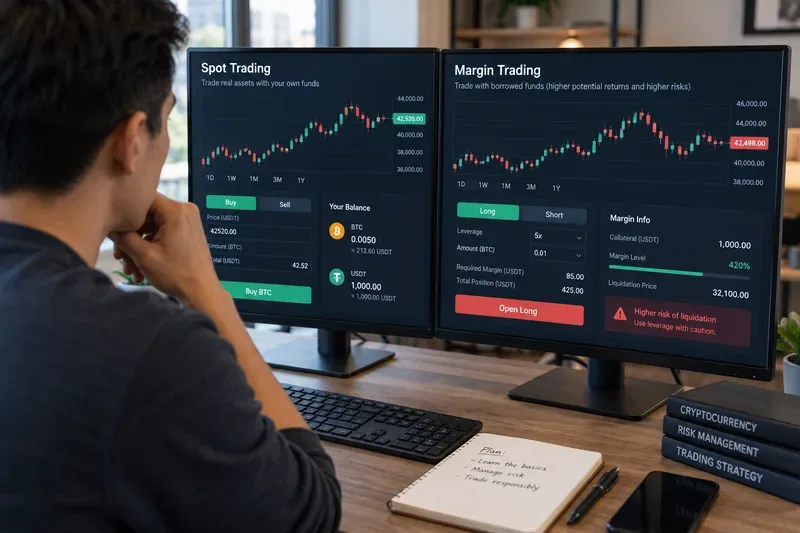
Spot trading and margin trading can look similar on a crypto exchange because both may use the same trading pairs, charts, order books, and buy or sell buttons. The financial mechanics underneath them are very different, though. In spot trading, you generally trade with funds you already have. In margin trading, you use borrowed funds or credit provided against collateral, which creates leverage and adds repayment, interest, maintenance margin, and liquidation risk.
This guide is written for someone who is learning the difference before placing a trade. It explains the core terms when they first appear, shows what to check before using either market, and highlights mistakes that can become expensive quickly. Exchange rules, leverage limits, eligible assets, and regional availability change over time, so product-specific details should always be confirmed on the exchange you actually use.
Information and product references in this article were checked on September 16, 2026.
A spot trade uses the trader's available funds, while a margin trade adds borrowed exposure and extra risk controls such as collateral and liquidation thresholds.
Start with the simplest distinction: whose money is being used?
Spot trading means buying or selling an asset for settlement in the spot market using your available balance. If you buy $500 worth of bitcoin with $500 you already hold on the platform, you are making a spot purchase. You are exposed to the asset's price movement, but there is no margin loan attached to that trade.
Margin trading adds borrowing. You post collateral, which is money or crypto pledged to support the position, and the platform extends additional buying or selling power. That borrowed exposure creates leverage: your market position is larger than the capital you supplied yourself.
Kraken's current explanation of spot transactions on margin states that these trades can use funds exceeding the amount already held in the account and create obligations to maintain collateral, pay applicable fees, and repay the margin extension. See the Kraken explanation of spot transactions on margin.
Spot vs. margin trading at a glance
Feature
Spot trading
Margin trading
Capital used
Your available funds
Your collateral plus borrowed funds or credit
Leverage
Normally none
Yes
Can losses trigger forced liquidation?
Not from leverage on a fully funded spot purchase
Yes, if margin requirements are breached
Borrowing cost
No margin borrowing cost
Interest, rollover, opening, or other margin-related charges may apply
Short selling
Usually not through a simple owned-asset sale
Often possible by borrowing and selling an asset, subject to platform rules
All relevant market risks plus leverage, collateral, borrowing, and liquidation risk
What a beginner should understand before placing a spot trade
1. Learn the trading pair
A trading pair shows what you are buying and what you are paying with. BTC/USD, for example, represents bitcoin priced in U.S. dollars. If you buy BTC in that market, you exchange USD for BTC. If you sell, you exchange BTC for USD.
Before placing any order, confirm that you selected the intended pair. Similar ticker symbols and multiple quote currencies can make a rushed order surprisingly easy to misplace.
2. Know the difference between a market order and a limit order
A market order seeks immediate execution at the best prices currently available. A limit order specifies the worst price you are willing to accept: a maximum price for a buy or a minimum price for a sell.
Coinbase's current order-type documentation notes that market orders can fill across multiple prices and are not guaranteed to execute at the last displayed price. That difference is important because of slippage, which is the gap between the price you expected and the average price at which the order actually fills. See Coinbase's official order type guide.
3. Calculate the amount you can actually lose
If you buy $500 of a crypto asset in a fully funded spot account and that asset later falls sharply, your loss comes from the decline in the asset's value. There is no leverage-based liquidation price attached to that purchase. That does not make spot trading safe: crypto prices can fall dramatically, assets can become illiquid, and platform or custody problems can still occur. It simply means the trade does not contain a margin loan that can force the position closed because of a maintenance requirement.
What changes when you move to margin trading?
Collateral becomes part of the trade
Your deposited funds are no longer just buying power. They also support the loan. The exchange continuously compares the value of your account or position with its required margin levels.
Initial margin is the capital required to open a leveraged position. Maintenance margin is the minimum equity that must remain after the position is open. If your equity falls too far, the platform may reduce or close the position.
Leverage magnifies percentage moves in your own capital
Suppose you contribute $1,000 and obtain enough borrowed funds to control a $5,000 position. That is 5x exposure relative to your contributed capital. A 5% move in the asset changes the position's value by about $250 before fees, interest, and other adjustments. Relative to your $1,000 contribution, that is a much larger effect than the same 5% move on a $1,000 unleveraged spot position.
The same multiplication works against you when the market moves the wrong way. The U.S. Commodity Futures Trading Commission warns that leverage amplifies underlying market risk and can force traders to add funds or close positions when prices move adversely. Although the CFTC advisory discusses leveraged virtual-currency products broadly rather than every exchange's spot-margin implementation, the leverage principle is the same. See the CFTC customer advisory on virtual currency trading risk.
Liquidation can happen before the asset goes to zero
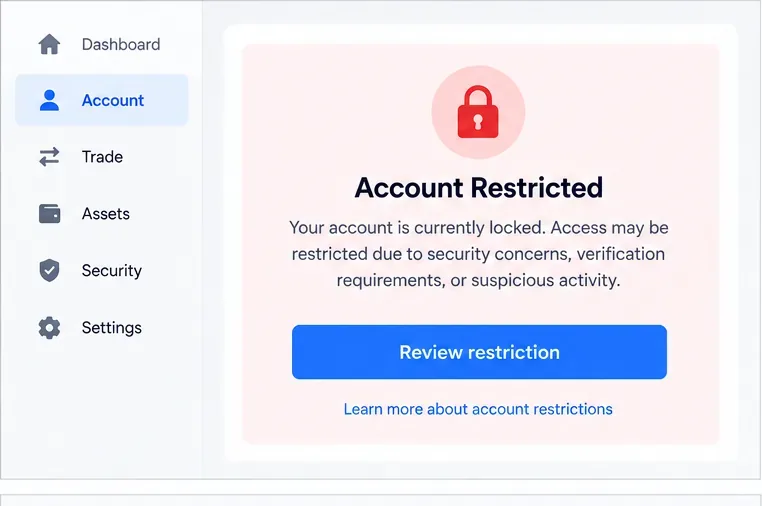
Liquidation is the forced closing of a leveraged position when account equity or margin health falls below the platform's required threshold. This is one of the biggest differences between spot and margin trading.
A fully funded spot holder can decide to keep holding through a large price decline. A margin trader may not have that choice. If losses consume too much collateral, the platform can close the position automatically to protect the borrowed funds.
The SEC's Investor.gov margin bulletin, written for securities margin accounts, makes the broader risk clear: margin users can be required to provide more capital on short notice, and firms may sell positions to cover deficiencies. Crypto platforms use their own rules and legal structures, so do not assume a securities broker's exact procedures apply to a crypto exchange. The risk principle is still useful background. See Investor.gov's bulletin on margin accounts.
How margin longs and shorts work
A long position benefits if the asset rises. In a margin long, borrowed funds are used to increase the amount purchased.
A short position aims to benefit if the asset falls. The trader effectively borrows the asset, sells it, and later needs to buy it back to return what was borrowed. If the price rises instead of falls, repurchasing becomes more expensive and losses grow.
Shorting introduces a risk profile that deserves special attention. A long spot asset can fall only toward zero, but the price of an asset being shorted can theoretically keep rising. In practice, margin systems usually liquidate a losing short well before an unlimited loss develops, but that does not make the trade low risk.
Costs beginners often overlook
Do not compare spot and margin trades using price direction alone. A margin trade may include costs that a standard spot position does not have.
Trading fees: charged when orders execute, depending on the platform and fee tier.
Borrowing or margin fees: charged for the use of borrowed funds or assets.
Spread and slippage: the cost created by the difference between bids and offers or by filling across multiple price levels.
Liquidation-related charges: some platforms may apply specific fees or pricing mechanics when positions are forcibly closed.
Because fee schedules change, check the live fee page and margin terms for the exchange you use rather than relying on an old percentage quoted in an article.
A practical preparation checklist before using margin
Before opening any leveraged crypto position, you should be able to answer all of the following without guessing:
What collateral will support the position?
What leverage will the order create?
What is the position's approximate liquidation level?
What maintenance margin rule applies?
What borrowing fees or time-based charges apply?
Can the platform use other balances in the account to support the position?
Is the margin mode isolated or cross, if the platform offers those choices?
What exact event closes the position automatically?
Is the product available and permitted in your jurisdiction?
If any of those answers are unclear, the trade is not yet fully understood.
Isolated margin and cross margin are not the same
Some exchanges distinguish between isolated margin and cross margin. In isolated margin, risk is generally confined to the collateral allocated to a particular position or isolated margin account. In cross margin, available collateral can be shared across positions, which may delay liquidation for one position but can expose more of the account to losses.
The exact implementation varies by platform. Never assume that the words “isolated” or “cross” have identical liquidation rules everywhere. Read the exchange's own margin documentation before relying on them as a risk control.
Common beginner mistakes to avoid
Using the maximum leverage just because it is available
A platform's maximum leverage is a technical limit, not a recommended position size. Higher leverage generally narrows the room available for adverse price movement before margin requirements become critical.
Ignoring liquidation price until after entering
Liquidation should be understood before the order is placed. In fast markets, waiting until the position is close to liquidation can leave little time to react.
Assuming a stop-loss guarantees the exact exit price
A stop-loss is an order intended to reduce losses once a trigger level is reached. It does not necessarily guarantee execution at that exact price. Coinbase's documentation notes that stop-based downside protection may fail to execute as expected during high volatility, and market orders can experience slippage. Order behavior depends on platform design and liquidity.
Confusing margin trading with futures or perpetuals
Both can use leverage, but they are different products. Spot margin generally adds borrowing to transactions in the spot market. Futures and perpetual contracts are derivatives whose value tracks an underlying asset. They can have different settlement, collateral, funding, and regulatory structures.
Leaving a leveraged position unattended
Crypto markets trade continuously on many venues. A position can move materially while you are away from the screen. Alerts are useful, but they should not be treated as a substitute for understanding automatic liquidation rules.
Which one is simpler for learning market mechanics?
For learning how trading pairs, order books, market orders, limit orders, fees, and slippage work, spot trading contains fewer moving parts because it removes the borrowing layer. Margin trading adds collateral management, leverage, borrowing costs, maintenance requirements, liquidation mechanics, and possibly short-selling obligations.
That is not a prediction about which approach will make or lose money. It is simply a difference in complexity and risk structure. A trader can lose money in spot markets, and a carefully managed margin trade can still be closed profitably. The key is that margin introduces additional ways a position can fail even when the underlying market analysis is otherwise reasonable.
Bottom line
Spot trading is the direct starting point: use funds you own, place an order, and hold or sell the asset. Margin trading builds on that foundation by adding borrowed exposure. In return for controlling a larger position or gaining the ability to short, the trader accepts amplified losses, borrowing costs, collateral requirements, and the possibility of forced liquidation.
Before moving from spot to margin, make sure you understand not only where you expect the price to go, but also how the account behaves if you are wrong. In leveraged trading, position structure can matter just as much as market direction.