Home
» News
»
Bitcoin Lightning Network Adoption in 2026: Faster Payments, Low Fees, and a Broader Ecosystem
Bitcoin Lightning Network Adoption in 2026: Faster Payments, Low Fees, and a Broader Ecosystem
The Bitcoin Lightning Network entered 2026 with a more important adoption story than a simple count of public nodes or channels can tell. One of the clearest recent signals is payment activity: River reported that Lightning monthly volume surpassed $1 billion and grew 300% during 2025, while its estimated average transaction size reached $223. River also reported that network capacity reached a new high in 2025. Those figures are estimates rather than a complete ledger of Lightning activity, because private channels and private payments are not globally observable.
At the protocol and developer layer, 2026 has brought additional changes. Lightning Labs released LND v0.21-beta in June 2026 with production-ready simple Taproot channels, onion messaging support, continued SQL migration work, and faster initial synchronization for Neutrino light clients. Later that month, Taproot Assets v0.8 and its first public SDK expanded the tooling for moving assets such as stablecoins over Lightning. These developments do not prove mass consumer adoption by themselves, but they show that the ecosystem is still widening beyond its original role as a bitcoin-only micropayment network.
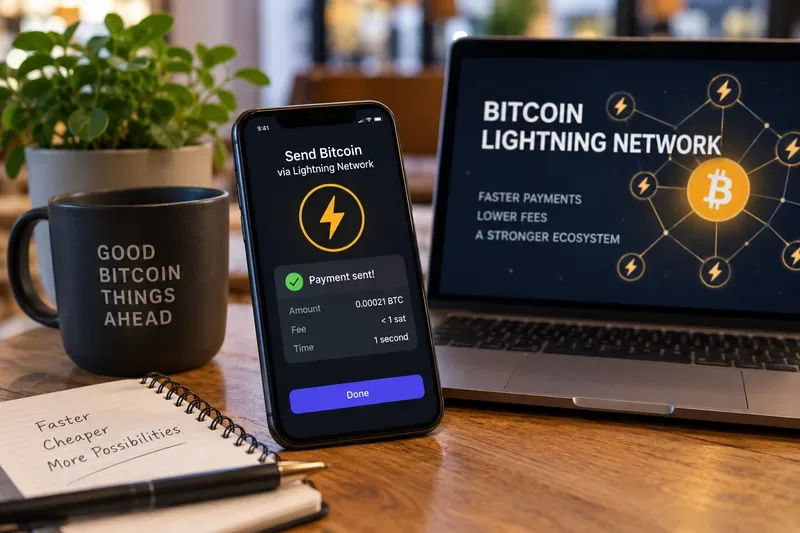
A Lightning payment concept shown on a phone beside a network diagram. Actual payment time and routing fees vary with wallet design, route availability, channel liquidity, and node fee policies.
What the Lightning Network actually changes
Bitcoin's base layer records transactions on a global blockchain. That design prioritizes verifiability and settlement security, but block space is scarce and transactions compete for inclusion. Lightning is a payment-channel network built above Bitcoin. Two parties can lock bitcoin into a channel with an on-chain transaction and then update their balances off-chain many times without placing every payment into a Bitcoin block.
Payments can also travel across multiple connected channels. A sender does not need a direct channel with every merchant or recipient. According to the Lightning Labs documentation on sending payments, a Lightning implementation searches for a route through channels connecting sender and receiver, considering factors such as fees and timelocks. Multi-part payments can divide a larger payment across several routes when one path does not have enough usable liquidity.
This architecture is why Lightning is often described as a Bitcoin scaling network. It reduces the need for each everyday payment to consume fresh block space while keeping channel opening and closing anchored to Bitcoin.
Speed: why Lightning can feel nearly instant
A Lightning payment does not normally wait for a new Bitcoin block. Once a viable route is found, participating nodes update channel states and cryptographically settle the conditional payment. For a user, a successful payment can therefore complete in seconds or less rather than waiting for an on-chain confirmation.
That does not mean every Lightning payment has a guaranteed fixed latency. The sender still needs a workable route. Channel balances are not publicly disclosed, so route finding works with incomplete information about where spendable liquidity actually sits. A payment may need another route, may be split into multiple parts, or may fail if sufficient liquidity cannot be found.
For adoption, this distinction matters. "Fast" is not merely a protocol specification; users care about successful payments on the first attempt. Better liquidity management, pathfinding, wallet infrastructure, and professional routing operations can improve that experience even when public channel counts are flat.
Fees: usually small, but not automatically zero
Lightning fees operate differently from Bitcoin miner fees. A routing node can charge for forwarding a payment. The official LND channel-fee documentation describes two main components: a base fee for a forwarded HTLC and a proportional fee rate, generally expressed in parts per million. Each routing node sets its own policy.
A direct payment through a channel can avoid intermediary routing fees, while a multi-hop payment may pay fees to several forwarding nodes. A payment split over multiple routes can incur additional base-fee components. Wallets and node software can set fee limits and choose routes partly according to cost.
There is another cost that simplistic comparisons often omit: getting liquidity onto or off Lightning can require an on-chain Bitcoin transaction or a liquidity service. Opening and closing conventional channels consumes block space and therefore faces Bitcoin's prevailing miner fees. As a result, Lightning is best understood as amortizing on-chain costs across many off-chain payments, not making the Bitcoin base layer free.
Why public capacity is an imperfect adoption metric
Historically, observers tracked three easy-to-see metrics: public node count, public channel count, and public bitcoin capacity. They remain useful for understanding the visible network, but none is equivalent to "number of Lightning users" or total payment volume.
Private channels are intentionally not announced to the public graph. Custodial platforms can serve many end users behind a smaller number of nodes. Better channel management can push more payments through the same amount of bitcoin. Conversely, a large channel can sit mostly idle. Public capacity therefore measures visible committed capital, not economic throughput.
River's 2025 Bitcoin Adoption Report illustrates the issue. Its analysis noted that Lightning architecture had been consolidating while routing efficiency appeared to improve. The same report warned of concentration: it estimated that the ten largest nodes by capacity controlled 84.6% of visible network capacity in its dataset. That is worth watching because payment infrastructure can grow in usage while simultaneously becoming more concentrated.
In June 2026, Lightning Labs released LND v0.21-beta. Among its notable changes, simple Taproot channels moved from experimental status to production-ready. Taproot key-path spending can make a channel funding output look more like an ordinary Taproot transaction when spent cooperatively, improving privacy and efficiency characteristics.
The release also introduced basic onion messaging support. Onion messages allow nodes to exchange messages through the network without revealing the sender and route to intermediate nodes, laying groundwork for additional protocol capabilities. The same release continued LND's transition toward a native SQL backend and added a faster initial-sync option for Neutrino light clients.
A second important development arrived on June 23, 2026, when Lightning Labs announced Taproot Assets v0.8 and the Taproot Assets SDK. Taproot Assets allows assets to be issued on Bitcoin and routed through Lightning, including stablecoin-style assets.
The v0.8 release added a higher-level SDK, wallet backup and restore options, asset transfer improvements, and additional controls for edge nodes involved in asset routing. This potentially broadens Lightning's addressable payment market: a user could benefit from Lightning's payment rails without necessarily wanting bitcoin price exposure for the transferred unit.
However, "possible on mainnet" should not be confused with broad merchant or consumer usage. Public, independently verifiable data on active Taproot Assets users and real-world payment volume remains limited. Adoption should be evaluated as those measurements become available rather than inferred from software releases alone.
Developer tooling is trying to hide infrastructure complexity
In July 2026, Lightning Labs announced the alpha release of Wavelength, a toolkit intended to make self-custodial bitcoin and stablecoin payment integration easier for applications. At announcement, it was open on signet and testnet, with mainnet access by invitation. That status matters: it is an ecosystem-development signal, not evidence that production adoption has already occurred at scale.
This direction addresses a longstanding adoption barrier. End users generally do not want to think about channels, inbound liquidity, routing peers, backups, or node uptime. Developer infrastructure that abstracts those details can make Lightning easier to embed in consumer applications, while the tradeoff is that users and developers must still understand which components remain self-custodial and which rely on service providers.
Where Lightning has a practical advantage
Lightning is most compelling when payments are frequent, relatively small, time-sensitive, or global. Common target use cases include merchant checkout, person-to-person transfers, remittances, streaming payments, online tipping, gaming, machine-to-machine transactions, and internet-native services where card minimums or conventional cross-border settlement are awkward.
Its advantage is less obvious for users making rare, large Bitcoin transfers where on-chain final settlement is the primary objective. Lightning also introduces operational concepts that ordinary on-chain holders may never encounter, especially channel liquidity and routing.
Characteristic
Bitcoin on-chain
Lightning
Settlement path
Recorded directly on Bitcoin blockchain
Channel updates off-chain, anchored to Bitcoin
Typical user experience
Confirmation depends on block inclusion
Successful routed payments can settle nearly instantly
Fee mechanism
Miner fee for block space
Routing fees; on-chain costs still apply to channel operations
Liquidity requirement
Spendable on-chain bitcoin
Usable channel liquidity in the required direction
Best fit
Base-layer settlement and larger transfers
Frequent, fast payments
What could slow further adoption?
Liquidity remains a real constraint. A channel having 1 million satoshis of nominal capacity does not mean that amount can be sent in either direction. Funds are distributed between the two sides, and payments move those balances. Services and automated management can reduce this burden, but they do not eliminate the underlying constraint.
Network statistics remain incomplete. Lightning is designed with privacy properties that make total transaction counts and volumes difficult to observe. Adoption estimates therefore depend on samples, company data, public network graphs, and modeling. Readers should treat precise global usage figures as estimates unless a methodology explains otherwise.
Ease of use can involve tradeoffs. A custodial Lightning wallet may simplify liquidity and backup management, but the provider controls the funds. Self-custodial designs preserve user control while potentially introducing more technical responsibility or relying on specialized service infrastructure.
Concentration deserves attention. Efficient routing can favor highly connected, well-capitalized nodes. A network can become easier to use while routing activity concentrates around a smaller set of infrastructure providers. Public capacity distribution, route diversity, and implementation diversity are therefore important alongside raw payment growth.
How to judge Lightning adoption from here
No single number captures Lightning's progress. A better assessment combines several signals:
estimated payment count and payment volume, with methodology clearly disclosed;
payment success rates and latency across different payment sizes;
public and estimated private liquidity rather than public BTC capacity alone;
merchant, exchange, wallet, remittance, and application integrations;
the cost and reliability of acquiring inbound and outbound liquidity;
distribution of capacity and routing activity among nodes;
growth of interoperable protocol features and multiple Lightning implementations;
real usage of newer capabilities such as Taproot Assets rather than release announcements alone.
The 2026 takeaway
Lightning's adoption story is increasingly about utilization and infrastructure quality rather than simply adding more public nodes. River's estimates of sharply higher 2025 payment volume provide evidence of increased economic use, while the 2026 releases around Taproot channels, onion messaging, Taproot Assets, and easier developer tooling show continued technical expansion.
The core proposition remains straightforward: Lightning can make Bitcoin payments much faster and often much cheaper for repeated transactions by moving activity into payment channels. But its costs are not always zero, routing is not guaranteed, liquidity has to be managed, and global activity cannot be measured perfectly.
For readers assessing whether Lightning is "winning," the most useful question is therefore not how many nodes exist. Watch whether people can reliably make useful payments, whether merchants and applications keep integrating the network, whether liquidity becomes easier to manage, and whether growth occurs without excessive infrastructure concentration. Those measures reveal far more about a payment network than a single capacity chart.